This is my symphony

What I read & what I lived …

Cider With Rosie
Laurie Lee
Open Road Media

When I opened the email last month, it was clear I’d missed out. According to Amazon’s Daily Deal blurb Laurie Lee’s Cider With Rosie was “an instant classic when it was first published in 1959 [and] one of the most endearing and evocative portraits of youth in all of literature”.  Now because I worked for several years in a book store, I’m at Cider With Rosieleast familiar with many more titles and authors than I’ve read.  So one would think I’d at least heard of this Laurie Lee who “learned to look at life with a painter’s eye and a poet’s heart—qualities of vision that, decades later, would make him one of England’s most cherished authors”.

Of course, I had to remedy this oversight, so one-click order I did and was soon settled into a memoir of one of England’s beloved sons I hadn’t even known existed. But after the first chapter, I admit I didn’t know if it was love or hate.

Three-year-old Laurie sits on the floor of his new home amidst the chaos of moving a family of seven into a new cottage in the village of Slad.  Little Laurie was surrounded by “glass fishes, china dogs, shepherds and shepherdesses, bronze horsemen, stopped clocks, barometers, and photographs of bearded men”. His sisters and mother bustle in and out of the house; his brothers help unload the handcart. Lee’s prose was over-rich, I thought—awash in adjectives and adverbs; drowning in lists. I almost put the memoir aside.

But after another chapter, Lee grew on me. His rich narrative seemed to mirror the lush countryside and the hub-bub that was his home. I settled into those lists and that descriptive prose. Like this: “That kitchen, worn by our boots and lives, was scruffy, warm, and low, whose fuss of furniture seemed never the same but was shuffled each day” and this: “These were the … rocks of our submarine life, each object worn smooth by our constant nuzzling, or encrusted by lively barnacles, relics of birthdays and dead relations, wrecks of furniture long since foundered …” It’s definitely not my style and not what I’d usually choose, but I’m happy I did.

Cider With Rosie let me peek into a world that no longer exists—grannies who lived as neighbors for decades, yet

Rosebank Cottage, Slad

Rosebank Cottage, Slad

never spoke; sisters who decorated their hats with bits and bobs; a picnic caravanned to a just perfect spot in the woods; a school teacher quick to smack boys upside the head; sleeping five to a room in quilt-deep beds; a bottle of shared cider and a stolen kiss under a field wagon.

Lee went on to write two more memoirs of his life and a few books of poetry. I was able to find a wonderful interview with Lee on the BBC—his recollections follow the book closely—which makes a great companion listen.

Cider With Rosie should probably be read when the time is just right, like a hazy summer afternoon or a blustery winter night … or anytime, really, when the edges of the world outside become blurred and you could oh-so-easily fade into the English countryside.

 

A Million Miles In a Thousand Years
Donald Miller
Nelson Publishing

Most people assume that as a teacher, I’m the one who instructs. And it’s kind of implicit in the teacher-student relationship, I agree. But as I move into my twenty-third year of teaching (good heavens!), I find that dynamic is often flipped, and it’s my students who share their wisdom with me.A million miles in a thousand years

During one of my Advanced Placement students’  Socratic Seminars this year, one of the students, Matt, remarked, “Donald Miller once said your life is a story” (this in a discussion of death and dying) and I was intrigued. I’d never heard of this Donald Miller fellow, and who was he that a sixteen-year-old would quote him?–about ‘story’, no less.

After a quick Google search,  A Million Miles In a Thousand Years  popped up and the subtitle “What I learned while editing my life” spoke to my heart. It didn’t take me past reading the author’s introduction to decide I needed the Kindle edition delivered post haste to my reader

The book goes like this.

Miller gained some fame after his first book Blue Like Jazz, and there was interest in a film based on the memoir, even though since writing Blue, he was stuck and had no motivation for much of anything but watching TV.  As Miller and the film makers began writing the screen play, they broke it to him not-so-gently: his life was too boring to be a film. While Miller himself wanted his life to be an “easy story …  [he knew that] nobody really remembers easy stories. Characters have to face their greatest fears with courage. That’s what makes a story good.”  Artistic license was necessary to make the memoir appeal to filmgoers who would want that good story—in the same way, Miller himself begins to re-write his own reality to follow more closely “the essence of a story”. Try putting these on your Life’s “To Do” list: reunite with a long-lost father, ask the girl out, hike to Machu Picchu, cycle across country. Life got interesting real fast.

This is a journey that, at its heart, is spiritual—but with a small “s”. While Miller is a Christian, there’s nothing holier-than-thou here, which is refreshing. But what an incredible vision of God he has here:If I have a hope, it’s that God sat over the dark nothing and wrote you and me, specifically, into the story, and put us in with the sunset and the rainstorm as though to say, Enjoy your place in my story, and you can create within it even as I have created you.

And this:There is a knowing I feel that guides me toward better stories, toward being a better character. I believe there is a writer outside ourselves, plotting a better story for us, interacting with us, even, and whispering a better story into our consciousness.

While much of the book is focused on the author’s own transformation, he also introduces us to other “characters” he has met who epitomize living a good story. Talk about inspiration, dear reader! My only reservation is that I found myself most moved by the first two or three sections of the book– the ones where Miller confronts that his tendency to let life happen to him; as he checks off his “To Do” list, the narrative becomes a bit less compelling. Overall, I think Miller’s story metaphor will especially resonate with readers, but is a great read for anyone who wants to live more deliberately.

You shared some pretty incredible wisdom, Matt. Thank you.

The Truth According To Us (NetGalley)
Annie Barrows
Random House

The charm of writer Annie Barrow’s Guernsey Literary and Potato Peel Pie Society is legendary, especially in the book club world. How many modern “literary societies”, I wonder, have read the novel since its publication in 2008? I know it had everything I love in a good book: quirky characters, strong women, slow-grown love, and a happy ending. Throw in a little-known setting and tell the story in a series of letters … what’s not to like?

I approached Barrows’ new novel, The Truth According to Us, with some trepidation. First of all, Barrows was the The Truth According To Uscoauthor of Guernsey, so my guard was up. But it turns out, she wrote that first novel with her aunt—or, more accurately, revised it extensively before publication, as her aunt was quite ill and could no longer work on the book. Her aunt, sadly, didn’t live to see the novel published. (Barrows’ is also the author of the popular series for middle readers, Ivy and Bean.)

Let’s just say I wasn’t disappointed with Barrow’s first novel for adults authored on her own.

Layla Beck arrives on the doorstep of the Romeyn family as a boarder; she’s  to  write the history of the small West Virginia town of Macedonia working for the WPA’s Federal Writer’s Project. Unbeknownst to the Romeyn’s, Layla is an imposter of sorts. While she is working for the Depression era social works agency, Layla has really been tossed out of her senator father’s D.C. home for living the life of a socialite, but refusing to marry a befitting (read, “wealthy”) suitor. She needs to make her own way in the cold, cruel world.

Macedonia’s sesquicentennial is approaching and a history is just what is needed to memorialize such a grand affair. The town’s elite (I use the word loosely) want their family trees to be reflected on with proper dignity–it might even be acceptable to stretch the truth a bit.

But most Macedonians don’t put up with fools lightly. And in her white suit and silk dresses, Layla looks just that in the oppressive summer heat. Her landlady Jottie Romeyn is closing in on spinsterhood, raising her brother Felix’s two girls, Bird, 9, and Willa, 12. Felix comes and goes on mysterious business trips, and it is pretty clear the Romeyn’s have seen better days.

It isn’t long before the work Layla so resisted begins to give her a purpose—and her research begins to reveal that the history the city fathers have in mind is often far from the truth.

Layla also discovers that she isn’t the only one pretending to be something she’s not; the Romeyns also have secrets. And it’s twelve-year-old Willa who starts to unravel the mystery of the family’s past, first to feel closer to her father and then to “protect” Felix from (as Willa sees it at least) the wily Miss Beck. But like most histories, the Family Romeyn’s has a dark side.

I was put off, at first, with what seemed an awkward narrative style—one chapter would be written in third person narrator, then the next might be a first person account by one of the characters. I’d sometimes forget who the “I” was. (I did, however, finally settle into the style.) And while I loved Willa, I couldn’t help but see her as some sort of hybrid of Scout Finch and Flavia De Luce–and I couldn’t decide whether or not this was a good call on Barrow’s part, or if I felt like she was a bit heavy-handed with her parallels.

It’s true for so many of us that the story we write is often the story we’d like to tell about ourselves, rather than the truth … but in the end, Layla Beck, the Romeyn’s, and Willa work it all out.

The Sound of Glass (NetGalley)
Karen White
New American Library

You’re strong at the broken places.

This novel starts with a bang–literally–on a hot summer night in Beaufort, South Carolina. Edith Heywood senses an eerie change in the night sounds as she works in her attic studio, then sees a flash of fire explode across the sky. A thump hits the roof and something scrapes along the shingles, sliding into the yard with a thud. Grabbing her young son C.J. from his crib, she opens the front door to chaos: neighbors running, sirens blaring, lights flashing. Still not quite sure what has happened, Edith locates the object that landed in her back garden: a suitcase. It’s then Edith realizes she had witnessed a plane crash. Nervously, fearfully awaiting her husband’s late night return, Edith almost seems to expect the knock at the dreaded knock on her door. The police officer. The chaplain.

Fast forward fifty years and we meet another Heyward widow, Merrit, in the office of the lawyer who is in charge of transferring that same house–her late husband’s childhood home– into her care. A Maine native (who is blissfully unaware of her Yankee-ness, at first), she has left everything to take on the job of restoring the three-hundred-year-old home and cataloguing its antiques. She must also take on the job of restoring herself after her brief marriage to a hard and difficult man. Merritt is a woman who doesn’t want to call attention to herself, content to blend into the shadows.

And then another widow enters the scene. Loralee Purvis Conners is packing her ten-year-old son Owen into the car and moving from Georgia to—you guessed it—South Carolina to meet his older sister for the first time. One Merrit sound of glassHeyward.  Loralee is a Southern gal through and through, right down to her high heels, big hair, and flawless makeup. She records bits of wisdom and lessons learned in the Journal of Truths she is writing, everything from “Sometimes it’s necessary to tell a lie when the truth will break a heart” to “Never give a lady a tube of lipstick without a mirror.” Loralee is as vibrant and alive as Merrit is bland.

And so Loralee and Merrit’s lives intersect, but not without some considerable conflict. Both women have secrets. Merrit’s secret has shattered her past and Loralee’s, her future. But like the sea glass wind chimes that hang on the porch of the Heyward estate, they tumble and toss together until they lose the sharp edges and become something beautiful. We learn about the death of Merrit’s mother and her estrangement from her father after his September-May romance with Loralee; we learn about the secrets Edith kept in her attic studio and buried in her garden. Throw in an adorable (and very precocious) little brother and a drop-dead gorgeous brother-in-law, and the novel is perfect summer reading.

This is a story about coming to terms with our past. Loralee and Merrit and Edith don’t suggest that we reinvent ourselves, really, but rather we come to find out the who our past may have obscured.

The Lady in the Van
Alan Bennett

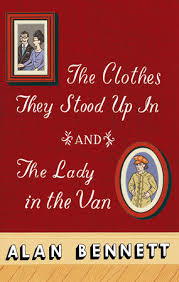
After I read Alan Bennett’s delightful The Uncommon Reader (review link here) I do what all readers do, I assume—I ran to get my hands on another of the author’s works. The library had a copy of a two-fer: The Clothes They Stood Up In (another novella) and The Lady In The Van (a non-fiction narrative); both pieces center around how the stuff in our lives can entrap us. The novella is about a couple who returns from a night out to find their flat bare, stripped of everything right down to the toilet paper and curtain rings. Now the Ransomes are a proper English couple, and LadyVanmuch of their life is spent keeping up appearances—but Mrs. Ransome finds that in shedding her possessions (albeit unwillingly), she gains a new sense of freedom and independence.

The book’s companion piece is the non-fiction The Lady in the Van.  Miss Mary Shepherd is a homeless (sort-of) elderly woman forced to move the van-which-was-her-home from spot-to-spot only to park at last on the writer’s street. Concerned for her safety, Bennett invites her to park in his yard—presumably for a short time. But days became weeks became months and we watch the relationship between the writer and Miss Shepherd develop with a kind of tumultous tenderness that changed them both. This is a story about mental illness and community and one would assume the story’s focus would be the Crazy Lady. And to some extent it is, of course. But it’s also a story (and I would contend it’s the real story here) about how reaching out to others often transforms us more than it does those we “help”.

The Lady in the Van was a 1999 theatrical production in London and is now a film to be released sometime this year  starring the inimitable Maggie Smith, who also starred in the original play. I had no idea this was in the making until my husband shared a film trailer he thought I’d like. “Of course I like it,” I said after watching, “ Considering I read the book several years ago.”

There’s little of Maggie Smith’s work that I haven’t adored and from what I can see in the trailer, she’s made for The Lady in the Van. I think you might agree.

G & T, just like the queMay joy dareen ♥ sweet & tangy ribs ♥ high school musical playbill ♥ sheets on the line ♥ head rubs ♥ rain showers on a tilled garden ♥ “I missed you” ♥ Dreaming Tree ♥ if I had my life to live over again ♥ built on nothing less ♥ black cat “hiding” ♥ lilacs and lilies-of-the-valley ♥ unconditional love ♥ a legacy ♥ pen & paper ♥ Bigby’s, hand-delivered ♥ hands to work; hearts to God ♥ nesting ♥ bare kitchen counters gleaming ♥ never give up ♥ Passion Planner ♥ salsa–hot & spicey ♥ garden reno ♥ the yard, neat & tidy ♥ a tiny rocker ♥ sweet serenity of books ♥ manicotti ♥ last summer’s raspberries ♥ fur babies ♥ tiny dimpled fingers ♥ serving in a sea of red ♥ small food ♥ the courage to change ♥ turn the planner page ♥ sweet sweater ♥ vaulted arches, nighttime sky ♥ orange flash of an oriole ♥ carrot mango ginger juice ♥ afirmations

Where Women Are Kings (NetGalley)
Christy Watson
Other Press

There are three places where women are kings …Nigeria, childbirth, and heaven–these are the places where anything is possible for women.

Elijah is a wizard. Not many little boys have wizards trying to creep out of their skin, and Elijah tries desperately to keep him in. Because the wizard uses its power to hurt the ones Elijah loves.  Mama and his papa moved to England Where Women Are Kingsfrom Nigeria shortly after their marriage. Like so many immigrants before them, they wanted a better life. But life away from Nigeria–“a place like heaven”—is far from idyllic. The flat is small and dirty, papa is gone to work and school for long hours, the neighbors are shifty, and Mama has begun to see the red car following her. And then tragedy strikes. Mama runs to Bishop Fortune at Deliverance Church for help, the wizard grows in Elijah, and Mama becomes very, very sick.

So then there were Gary and Sue and Linda and Pete and Nargis and Darren. The wizard, it seemed, couldn’t stay contained for long. At his last house there was a fire. But then Elijah came to live with Nikki and Obi. He had a Granddad, an Aunty Chanel, and a real cousin, Jasmin. (She was a girl, but still. And even better, “the wizard never woke up when she was near.”)

Nikki and Obi knew little about Elijah’s past, other than his birth mother was in Greenfields Women’s Psychiatric Hospital. That he had “thin scars in lines across his chest and back.” And there was that fire. Their social worker and play therapist navigate them through the adoption process and they grow to love this winsome little Nigerian boy with a terrible secret.

The characters in Christie Watson’s novel are spot on. Nikki and Obi love honestly and imperfectly. They worry. They read books like Parenting a Traumatized Child; Healing With Love;  Resilience and Outcomes. Granddad loves with an open heart and a big booming laugh. Chanel is a breath of fresh air as she tries to be so hip and inclusive it’s comical. There wasn’t a whole lot not to like in the novel.

Writer Christie Watson alternates telling Elijah’s story with Nikki and Obi and letters his Mama writes him from the hospital. Be forewarned: Watson’s story is heart-breaking, and as Elijah’s history unfolded it was difficult to read.

But it’s a story worth telling because sometimes love just isn’t enough.

The One I Was (Abovethetreeline)
Eliza Graham
Lake Union Publishing

Rosamund Hunter has a secret—that much we know. A hospice nurse, she all but freezes as she stands in the vestibule of the imposing manor Fairfleet, home of her next patient, “trying to accustom [herself] to being at Fairfleet again.” And we’re off on a tale that will eventually reveal just why she left … and how her latest employer—the famous journalist Benny Gault– is connected to the home just as closely as she is.

In another life Rosamund was Rose Madison, adored granddaughter of Lady Dorner, owner of the house; daughter of  troubled Clarissa, who tried to out run the mental illness that pursued her … and usually lost. Granny was enough to shield Rose and her brother Andrew from their mother’s erratic behavior, but when she died, the fragile Clarissa is taken in by a cad’s lies and the little family’s hold on life, love, and Fairfleet itself is at risk.

And in still another life, Benny Gault was Benny Goldman, one of the young Jewish boys shipped from pre-war Germany to safety in England. Lord Dorner takes in several boys, providing them with a home at Fairfleet, an One I waseducation, and, perhaps most importantly, safety from the gas chambers. Benny is the boy who rises to the top—he’s curious, eager to learn English, to become English, and throw off his German identity. Benny excels at everything he attempts and returns summer after summer, holiday after holiday, to Fairfleet, the only place he can think of to call home.

But Benny has a secret, too. And in his final days, as he unravels Rosamund’s story (he is after all a journalist) he unburdens his own horrible secret, hoping to find peace at last before he dies.

The One I Was has echoes of Lucinda Riley’s Lavender Garden and Kate Morton’s novels. Like those novels, I was taken up by the hint of mystery and the engaging characters. A fine story, this would make a perfect Mother’s Day gift for Mom or Grandma.

Old English D ♥ loops ♥ tuxedo shirt, crisp and white ♥ home to settle in ♥ a wrinkled $20 ♥ joy dare ♥ two souls, one ♥ family ties ♥ rain puddles ♥ slip sliding tears ♥ hidden heart ♥ rock-a-bye-baby ♥ peepers … finally ♥ purple crocus April gifts and graces♥ bargain spring duds ♥ spring sun and moon ♥ Buddy’s smile ♥ blue sky ♥ How Dante Can Save Your Life ♥ I’m sorry ♥ memories ♥ black and white photos with curled edges ♥ Santa with a glitter hat ♥ vintage Christmas ♥ shelves, neat and tidy ♥ garage swept clean ♥ books to the ceiling ♥ books on the floor ♥ miraculous medal ♥ tender pinks ♥ my reflection ♥ fragile love ♥ Grammy’s baby quilt ♥ grass a growin’ ♥ return of the feathered friends ♥ daffodils ♥ carrot mango ginger juice ♥ paybacks ♥ clean and cozy, hearth and home

April is National Poetry Month, and seeing how we’ve only three days left, posting about poetry is either now or never! Although I was an English major and always bookish, poetry was quite another thing. In short, I just didn’t like it. A fantastic poetry prof in college helped open my mind a bit, but I just couldn’t get excited over the stuff.

I was always intrigued by Emily Dickinson’s poems, but truthfully, I think the bleak romance of her life story is what drew me initially, not her language. But after faithfully reading the three volume Letter s of Emily Dickinson edited by Thomas Johnson (Harvard Press), I bought her complete works and was hooked. Dickinson’s poems are some of the few I’ve memorized and if I was a few years younger, I’d probably get a tattoo based on this (yes, really):

Hope is the thing with feathers –
That perches in the soul –
And sings the tune without the words –
And never stops – at all –

Fast forward to teaching the Odyssey to high school freshmen—I know, to some a fate worse than death—and I found myself (finally, English teacher that I was) truly appreciative of the imagery, the word play, the cadence, probably because I read so much of it aloud to the kids.

And that’s, I think, the hook to falling for poetry. You must listen to it read by expert readers. Like poets …  My husband and I had the serendipitous opportunity to hear poet laureate Billy Collins and poet Naomi Shihab Nye read at a local college nearly. The notice was in the Sunday paper, it was small, but we thought, “Wow! Poet laureate—let’s go” not even knowing Collins’ work at the time.

Oh. My. Goodness. We were smitten. Reading Collins—and especially listening to him—I discovered poetry could be not only insightful and musical, but witty and droll. The poet laureate was down-to-earth, humble, and oh-so-fun.  Here’s the first poem Collins read that evening:

See what I mean?!

You may be one of the lucky ones who has always had a love for poetry, but I came to my appreciation late. If you’re still reluctant, try a little Dickinson or Collins. Go to Youtube and listen to Sara Kay and Taylor Mali’s spoken word.

Don’t worry about being serious; don’t think you’re not sophisticated enough. Just let yourself be delighted.