This is my symphony

What I read & what I lived …

Vinegar Girl (NetGalley)
Anne Tyler
Hogarth/Crown Publishing

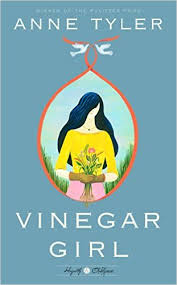
vinegar girl I’m not one for modern novels that piggy back on a great work of literature. Chances are I’ve already read the classic, so the broad strokes of the contemporary retelling seem forced. And I tend to nitpick, as well: “Well, that didn’t happen in The Great Classic” or “Famous Classic Character would never say such a thing!” So the much acclaimed A Thousand Acres (King Lear) by Jane Smiley? I skimmed it. (I know, I know it won the Pulitzer …) I really don’t see Pride and Prejudice in Bridget Jones’s Diary, either. And while I did enjoy The Story of Edgar Sawtelle, once Edgar unravels his uncle Claude (hah!) and runs away, it was so over-the-top Hamlet, that the novel was spoiled for me.

So I wasn’t prepared to like Anne Tyler’s latest novel The Vinegar Girl, which is a retelling of Shakespeare’s The Taming of the Shrew. But here’s the deal. I’ve never read The Taming of the Shrew, so I had nothing to compare it to and Tyler’s story held up well enough on its own.

Kate Batista is stuck in a dead end job and still living at home. She’s 30, works in a preschool, and doesn’t even like kids. Her widowed dad is a stereotypical absent-minded scientist and her sixteen-year-old sister is a stereotypical teenager. Kate keeps house for them both and is either the glue that holds the family together or the door mat. Probably both. Until her dad decides he can kill two birds with one stone: marry off Kate and keep his Russian research assistant in the U.S. 

Kate resists and then she doesn’t. Because this just might be her ticket out of the house. Pyotr Cherbokov is at times charming, but most often rude and ill-mannered, at least by American standards. Will she go through with the marriage or not?

Anne Tyler’s twentieth novel doesn’t have the keen insight or the charming absurdity that her early novels had. Nor did her last, A Spool of Blue Thread which I read last year and liked well enough (link). But it’s a sweet story, well-told–and since it’s based on one of Shakespeare’s comedies, you know it ends well for our heroine.

And what’s not to like about happily ever after?

I wrote about Not the Average Mama last month–Jessica’s blog is a must read, whether you’re a step or not. This week, Not the Average Mama is participating in a book tag via A Kinder Way. and I thought I’d join the fun. Consider yourself tagged and share the love!

What are you reading now?
I’m reading a digital reader’s copy titled A Hundred Thousand Worlds by by Bob Proehl, published just this week. It’s a romp through a Comic Con-like world, and it’s been fun to lose myself in a world that I know nothing about.

What’s the next one on your list?consequence
I’m torn–do I start another DRC for review or catch up on some hard copies I have on my shelf? I’ll probably start Eric Fair’s Consequence. I heard him on NPR this spring and his story is compelling.

Do you prefer a Real Book or a Reader?
It depends. Advanced reader copies are usually digital, so my Kindle has quite a queue. And then, of course, Amazon tempts me with Kindle deals. But a trade paperback book would probably always be my first choice–I’m just running out of places to put them.

Do you stop mid book if you don’t like it?
I used to never quit on a book. Now, I if get through about a quarter of the book and I’m not drawn to continue, I don’t. Ain’t nobody got time for that.

Do you have to finish a chapter before setting the book down?
Nope!

What’s the best series you’ve read?
I’m not really a series reader–though I read the Harry Potter series, of course. Even as a young reader, I didn’t go for the Nancy Drews that all my other friends were hooked on. I must admit, though, that I have a current obsession with Flavia De Luce mysteries.
boxcar
What’s the first book you remember loving?
The Box Car Children–the first one. My second grade teacher Mrs. Zimmerman read it to us one chapter each afterno0n (unless we begged for one more and she gave in) and it was the first “chapter book” I had ever heard read aloud. I read it again myself a couple times as a child, and then to my own children twenty-some years later. I loved the chipped china cups Jessie found, and I can almost taste the potatoes she roasted in the fire. I’m still infatuated.

Ever been in a book club?
A few of my teaching colleagues and I had a book club for a couple years. I loved it because we talked about something other than school, and I got to see a different side of my co-workers. It kind of fizzled out, in part because of our busy lives, but I wonder. I think sometimes people start reading because it’s a good thing to do–kind of like taking vitamins–and that rubs off onto book clubs. I’m more of a I-must-talk-about-books-like-I-must-breathe type of gal.

Favorite book you read in school?
Now that I teach literature, it’s hard for me to remember what I loved as a student and what I love as a teacher! I didn’t like Fahrenheit 451 as a student, but I love teaching it. Same thing with Lord of the Flies. I think my favorite from high school is probably F. Scott Fitzgerald’s Tender is the Night. Or maybe Steinbeck’s East of Eden. Or maybe …

Least favorite book you actually stuck with?

Recently, I’d have to say it was The Goldfinch. That book got so much press and I found nothing really redeeming about the main character. Same thing with Jonathon Franzen’s novels. I want to like them so that I, too, can be an oh-so-cool modern reader, but I find myself becoming frustrated by characters’ lack of moral insight. I’ll read a book with characters who are evil, but they’ve got to have some sort of realization, if not transformation. It’s the human story, after all.

ark
What is the best book gift you’ve received?
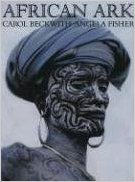
When my husband and I were dating, I coveted a coffee table book about Ethiopia titled African Ark. It was extraordinarily expensive in those 1990 prices: $75. He surprised me with a copy for Christmas (or my birthday?)–I knew it was an over-the-top gift for his bookstore staff/college student budget, but he always spoiled me. 

What author would you like to have a cup of coffee with?
Ray Bradbury was such an incredibly vibrant man, so engaged with life and the creative process. I’d like to start an I’d Like To Be Like Ray campaign; he’s such an example of how aging can be a time a generative period of life. Here’s a video I show my students each flameyear–what’s not to like about a man who wants to get his cat in the shot?!

If you could visit a place in any book, where would it be?
Kenya, for sure. I read Izak Dinesan, Beryl Markham, and Elsbeth Huxley and wanted to live in their world more than any other. Of course I realize that colonial Kenya was an oppressive place for the indigenous peoples and the wildlife. I don’t condone colonialism in any way–but those authors wrote about the land, lifestyle, and people in such a Romantic way, I was hooked. Still am.

What character from a book would you love to meet?
Interestingly, I find myself drawn to characters from the classics more than contemporary titles. (Except, maybe, for that little Flavia I mentioned earlier!) So it would be a toss up between Jane Eyre or Elizabeth Bennett.

What is your favorite children’s book(s)?
I have so many, and most are favorites because I connect them to my own children–and since they now have children of their own, that means some of these titles are a bit dated. I hated the Berenstein Bears series (but my daughter loved them!). The kids also loved the Ruth Stiles Gannet’s Dragon books: My Father’s Dragon and Dragons of Blueland (Me, not so much.)
These are keepers:
Nicholas Bentley Stoningpot III
Wilfred Gordon McDonald Partridge
Blueberries for Sal
(when we go blueberry picking I still say, “Kerplink, kerplank, kerplunk”! and drive people crazy.)
any Tomie dePaola book
any Patricia Polacco book

Lily and the Octopus (NetGalley)
Steven Rowley
Simon & Schuster

I! LOVE! DOGS! I! WANT! TO! READ! I thought when I saw the cover of Lily and the Octopus with its cute little dachshund. The blurb said it was magic, that reading it would be an unforgettable ride, and compared the novel to The Life of Pi,.

Was I in for a surprise.

From the first pages, I knew exactly what this octopus thing was when Lily’s owner Ted said:  “It’s not often you see an octopus up close, let alone in lily and the octopusyour living room, let alone perched on your dog’s head like a birthday party hat … the octopus has a good grip and clings tightly over her eye … it’s harder than I would have imagined … less like a water balloon and more like bone.”  You know, too, right?

So now I had a choice. Do I continue to read a novel that turns around a beloved dog dying from a brain tumor, or not? I mean, it’s only the first few pages, so I do have a choice.  (And with not even a year between me and the death of our beloved Trixie, I think twice, believe me.)

But on I read–because how many novels do you run across with a talking dachshund who loves Chris Pratt and can quote from the movie Elizabeth with Cate Blanchett? A dachshund who is snarky, but whose love for her man is as exuberant as her love for ice cream. Here’s Lily on her first ice cream cone: WHAT! IS! THIS! CLOUD! THAT! YOU’RE! LICKING! I! LOVE! TO! LICK! THINGS! WOULD! I! LIKE! TO! LICK! THAT! And that’s how Lily speaks because to her, life is just that good. Every minute is an adventure.

We come to know (and love) Lily through Ted’s memories of her: their first meeting, her life as a pup, and their life together with his partner Jeffrey. (Make that former partner.) We also learn that Ted’s personal life is in shambles–to lose Lily would mean he had lost his last link, he thinks, to love. We follow Ted and Lily to the vet and hear the prognosis, and we watch as the tumor effects Lily, first by stealth and eventually by storm. So Ted sets out to slay this octopus, to hunt it down and kill it–very much like Captain Ahab–in a fantastical (or is it?) trip on a charter boat. And it’s only after facing his demon–the octopus–on the trip that Ted can let go.

Ted’s goodbyes to Lily are probably all too familiar to those who have lost a beloved pet and his list of nicknames for Lily at the end will take the wind right out of you. Monkey. Bunny. Sweet Pea. Ding bat. Bean. Mush. Slinky.

I’m convinced that our fur friends live simply to give and receive love, and something so pure can only redeem us. Writer Steven Rowley must feel the same because even in his grief, Ted finds Lily has given him the great gift of beginning again.

Lily and the Octopus is not easy to read, but it is a poignant reminder that the lasts in our lives are every bit as precious as our firsts.


* My post title is a reference to that somewhat sentimental poem  our vet sends her patients when we lose a pet. I am convinced, sentimental or not, it tells the Truth with a capital “T”.

bkstore

Eyes Like Stars@Flickr

In some ways, my life–the life I live now as a teacher and writer–began in a bookstore. When I turned thirty and my last babe was potty trained, I started working part time in an independent bookstore. It was the late eighties and I’d been a stay-at-home momma for several years. It was time to inch my way back into the real world. Claim at least a portion of my life again. Call something my own.

And while there were certainly challenges (pay, for one; retail hours for another), the memories I have of that time are bathed in a warm, lamp-lit glow. Here (in no particular order) are some of my favorite take-aways from those bookstore days.

  1. Working on Christmas Eve. I took a kind of sadistic glee in selling husbands (because, yes, the last minute shoppers were men) the heaviest, glossiest–and priciest!–book or tchotcke I could locate for his beloved. Because if she loved the British Isles, she was getting that $75 hardcover photo book of England. And if she loved to cook, the latest Martha Stewart was the thing for her. No paperbacks, no sale books. Nope. Buddy, if you waited until Christmas Eve to get her present, I’ll make sure she gets a good one.
  2. Sidewalk sale. Every summer the owners put on a book sale to end all book sales. Tables upon tables were set up in the mall, and pallets upon pallets of remaindered books were hi-lowed in, then stacked-cookbooks, children’s books, art books, history books, fiction. Set up made for a late night, but opening the cartons of books was like the best kind of Christmas morning.
  3. Shelving. I love physical books–their smell, the covers, blurbs on the back. There was no better way to get to know stock, authors, and titles that wouldn’t be my first pick than to take that cart out and shelve new stock. (Unpacking cartons and organizing the cart was pretty darn fun, too.) Our staff had total freedom to arrange shelves and face-out books we wanted to feature. So those three lonely copies of Barbara Pym’s Jane and Prudence? On my watch, I’d face them out.
  4. Hand selling  books. Our staff was small–eight to ten–and our customers were loyal and depended on our recommendations. One of the perks was being able to read ARCs (Advance Reader’s Copies) that publishing reps left with the managers. The new Clyde Edgerton would get passed from one staffer to the next, and when it was published go straight to the We Recommend shelves. Many were the customers who came in for one book and left with three–all because staff raved about the story or author and the customer couldn’t refuse.
  5. Janie’s coffee and strawberry shortcake cookies. The cookie shop down the mall baked seasonal favorites and their strawberry shortcake cookies couldn’t be duplicated. Think Walkers shortbread with a dollop of ooey gooey strawberry preserves in the middle. And the coffee was robust coffee house coffee before Starbuck’s even moved east of the Mississippi. And, yes, we were allowed to discretely snack during work hours.
  6. Putting together mass market dumps. Those cardboard displays of new paperbacks that are sectioned off in neat little compartments are called dumps. They often have an add-on feature of some sort: a cut-out character or scene or blurb to make the display pop. For some reason the ‘insert slot A into segment C’ was incredibly gratifying. If you put them together correctly, they were sturdy and strong. If not, they swayed on the base or tilted off-kilter like a drunken sailor.
  7. Customers. Book people are, well,  different. And I met a lot of characters. Like the Vietnam vet who was a voracious reader of poetry. Or the older gentleman who was as demanding and grumpy a man as I’ve ever met–who also founded a local accordion ensemble. The wealthy businessman who collected first edition hardcover mysteries. Or the woman who took out a purse flashlight and continued reading after the manager started flipping off banks of lights, our signal that we were closing soon.
  8. Staff. Book sellers are, well, interesting, to say the least. So conversations were satisfying. We talked about religion, relationships, recipes, authors, gardening, and the new Anne Tyler or Ken Follett. Readers and book sellers, I think, are people of infinite curiosity. There’s no better conversation to be had than with another person who is eager to know about something outside of themselves. I’ve run into a few of the staff (long since dispersed when the store closed) over the past twenty years and it’s easy to pick back up where we left off. One of my former co-workers is still my #1 Book Buddy (she’s also a blogger) and she, like the book sellers I’ve known and loved, is an incredibly interesting woman. And friend.
  9. Husband. I met my now-husband at the bookstore. See also #2, 4, 5, and 8.
  10. To Be Purchased Stacks. They were hidden under the counter, behind purses and bags, rubber banded together with our names written on a slip of paper. If our favorite author just published her latest, onto the pile it would go until we had the money. Let’s face it, a reader working in a bookstore is like the proverbial kid in the candy store. We needed to exercise some sort of self discipline or we’d never take home a cent of our paychecks.  We’d add books, compare our stacks with other staff, change our minds, re-shelve them in some crazy book buying ritual we repeated again and again.

I mourn the fact that in my Midwest city of 200,000 there is one independent bookstore. Yep–one. Now granted, we have a couple used bookstores, a New Age bookstore, and (this being the Midwest and all) a few religious bookstores. But if you want to pick up a travel book, a copy of the Box Car Children, an Agatha Christie mystery and the new Rachel Ray cookbook? One. The other choice is what I call a Big Box Bookstore and the character and ambiance is just not the same. And I understand. With the blessing (or curse) that is Amazon, that special order won’t take five days–you’ll get it in two. Bookstore margin is slim (40%) and so is profit.

I eventually left to teach high school; the store closed. Now even I buy books on Amazon and my ARCs come from digial galley services. My bookstore days might be out-of-print–but I still occasionally take a memory out and flip through for old time’s sake.


Thanks for reading! To return to the FICTION WRITERS BLOG HOP on Julie Valerie’s website, click here: http://www.julievalerie.com/fiction-writers-blog-hop-june-2016

So far this summer I’ve read a couple books that are out of my comfort zone–and I’ve not been disappointed. I guess it’s a good lesson in being open to new experiences. Read on and maybe you’ll be tempted to try something completely different yourself (cue the music!)  …

Glass Shatters (NetGalley)
Michelle Meyers
She Writes Press

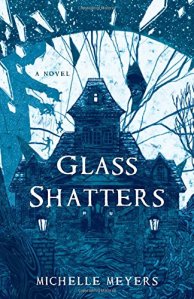
glass shatterShe Writes Press is a kind of incubator publisher dedicated to publishing women based solely on the quality of their writing. I wasn’t disappointed with the first book I read from She Writes Press (you can read my review here) and I wasn’t with another title they’ve published, Glass Shatters. Michelle Meyers’s story is part Frankenstein and part Dr. Jekyl and Mr. Hyde–throw in a little amnesia and you’ll see right away that this is out-of-the-box reading for me.

We meet Charles waking up on the couch, confused. A young neighbor rings the doorbell with an invitation from her mother for dinner that night. Except that Charles doesn’t remember the little girl’s name (Ava), nor does he realize he’s been gone for six months until she tells him so. Then there is the business of his gauze-wrapped head and several obvious incisions. There’s an old man scuffling wordlessly around the house, skulking in the shadows. And the fact that all of the picture frames in his house are empty.

Gradually, Charles pieces together his story. He learns he is a renowned biologist who was on the brink of a possible breakthrough–and might have discovered the secret of immortality. That his wife and daughter had disappeared several months earlier. When the head of the lab where he worked welcomes him back without a single question, Charles returns to his work in cell transdifferentiation. We learn what has happened to Charles right along with him in a series of dreams that slowly unravel his memory.

Glass Shatters is a chilling story asks us to consider whether or not, when it comes to controlling the origins of life, we need to ask how far is too far. This is one you won’t soon forget.


Before the Fall (NetGalley)
Noah Hawley
Grand Central Publishing

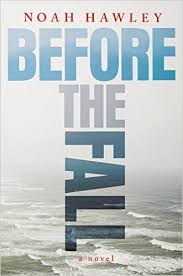
One minute Scott Burroughs is on the tarmac, sitting in a private jet with two very wealthy–and powerful–families and their entourage. The before the fallnext, he’s in the ocean surrounded by the flotsam of a plane wreck. Willing himself to swim to safety, Scott begins heading for what he thinks might be shore. And then he hears a little boy crying.

David Bateman is head of a twenty-four hour news network; his wife Maggie is stay-at-home mom to their two children, Rachel, nine, and JJ, four. Ben and Sarah Kipling move in the same circles–Ben works on Wall Street and word on the street is that he’s about to be indicted for (illegally) investing in North Korea and Iran. And that Scott Burroughs? He just barely made the flight in time for take-off. A struggling artist, Scott is only on board because Maggie, an acquaintance, kindly offered him a seat on the plane.

Through sheer force of will, Scott makes it to shore with the child, four-year-old JJ Bateman. They are driven to the hospital by a surprised fisherman who discovers them on shore, and here’s where the real story begins. David Bateman has enemies: his family has had a security detail since his daughter was kidnapped several years earlier. And Ben Kipling has been trading with the enemy. Literally. Then there’s the possible conflict between crew members. And Scott Burroughs–what is he really doing on board? The press is hot on the trail of each man’s story and Scott tries desperately to stay secluded.

Before the Fall reads a bit like a Grisham novel, but writer Noah Hawley offers his main character, Scott Burroughs, more time to reflect: about his mistakes, his marriage, his art, and, perhaps most importantly, what type of man he wants to be now that he has a second lease on life. The book is a well-written page turner–perfect for vacation reading.

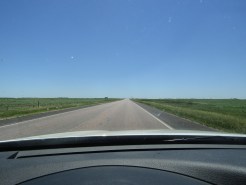
Miles and miles and miles

Miles and miles and miles

After three driving days and 18 hours in the car, I was toast. I haven’t traveled alone in, like, ever. No college road trips because I was married and having babies. No divorcee road trips because I was scraping together a living and raising three kids. So this was a new adventure. But I have to admit–I liked it! Tiring as it was after five hours in the car. Frustrating as it was when I got ‘turned around’. (Notice how I got in touch with my testosterone there and didn’t say I got lost?!) I was large and in charge of when I ate and where I slept. I stopped when I wanted to and began the day at my leisure. No television. I blogged. I read.

I did come pretty close to muscling my way home in one day because I was so over the driving. But I knew I couldn’t do didn’t want to drive 11 straight hours. Over the trip I spent a lot of time talking myself through situations (“Just pull into the lot and look at the map.” “Take the next exit and get off 90–as long as you go west, you’ll get there.” That kind of thing.) So me-myself-and-I talked me down and decided that there was no way I should drive over 1600 miles without taking a couple side trips on the way home.

And so I did.

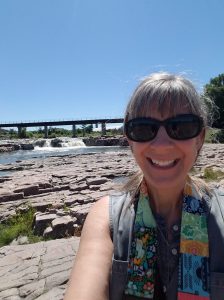
Stop #1 was Sioux Falls, South Dakota where I’d read about a gorgeous park right in the middle of the city. And beautiful it was. Falls Park sits along the Big Sioux river, the banks of which are Sioux quartzite, which, according to a handy green historical

Falls Park Sioux Falls, South Dakota

Falls Park–Sioux Falls, South Dakota

marker, is “silica-cemented quartz sandstone” which was formed by “wave action on the floor of a of an ancient continental sea” a billion years ago. The Big Sioux descends in a series of waterfalls which have in the past been harnessed: the ruins of a 19th century mill still stand, as well as a Sioux Falls Light and Power building that once housed a generator.

parkmeBut most surprising was the fact that visitors walked along the banks and out onto the rocks to the edge of the falls! I was hesitant at first, but when in Rome … The park was a beautiful place to stop and take a short hike to stretch my legs before I was on my way again.

[Funny side story: I’m following Google maps, skirting through a pork (1)slightly industrial area when I caught a distinct whiff of pork. Like smokey, spicy, roasting or grilled meat. I thought maybe I was channeling my husband who is fanatic about any meat product smoked and salted. Me talking again: “You can’t just imagine pork–maybe there’s a BBQ restaurant smoking meat nearby.” And then I saw the parking lot sign: Smithfield. Those workers must be perpetually hungry working in such deliciously hazardous conditions!]

Stop #2 was Austin, Minnesota, where my handy dandy Roadtrippers app told me I could find the new SPAM museum. Now I know foodies turn their nose up at the stuff (heck, nearly everyone I know finds SPAM revolting) but I grew up eating it. Maybe it’s an acquired taste–but I like it. My only reservation was that B (he of the smoked pork cravings) wasn’t with me to share the joy and I felt a little disloyal going without him. But only a little. I knew I’d find some great peace offerings souvenirs to bring him. And I did: a SPAM mug, a SPAM tee-shirt, and a few packaged SPAM samples. It’s difficult to describe a museum dedicated to a canned meat product, but link here to a short video clip I took that will give you a glimpse into this great SPAM emporium. And to top off my meat-o-ganza, I stopped across the street at Piggy Blues BBQ and dined on BBQ pork tacos. 

And then, finally, this little piggy went all the way home … and  I’d do it all over again in a heartbeat. 

Amy Snow
Tracey Rees
Simon & Schuster

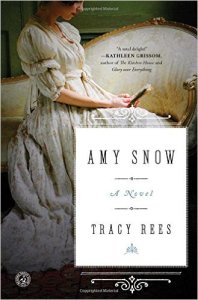
Life just seems to move at a slower pace in the summer. Afternoons are hot and humid, the evenings languid. We spend a lot of time on the deck and not so much time in front of the television. It’s a time when we try to break free from our daily routine.  Amy Snow, a novel published earlier this month, makes for a great escape. One of this novel’s blurbs reads: “An abandoned baby, a treasure hunt, a secret. As Amy sets forth on her quest, readers will be swept away …” Pretty accurate, I’d say.

Wealthy heiress Aurelia Venneway finds a newborn baby naked in the snow. Without a thought to propriety, she bundles the little girl under her cloak and rushes into the parlor.amy snow Lady Venneway is cold and distant; she’s just lost yet another pregnancy and the foundling is like a slap in the face. The orphan (named Amy Snow by Aurelia) is banished to the kitchen while the entire household staff tries to keep her out of Lady Venneway’s sight. For a time, Amy is Aurelia’s play thing–eight years younger, she adores the headstrong lady, and is game to join in any of Aurelia’s escapades. And then the two young women grow to be best friends. It’s harder now to stay invisible to Lady Venneway, but the consequences if Amy doesn’t are humiliating. When Aurelia becomes deathly ill–and the prognosis is dire–she demands that her parents permit Amy Snow to be her companion.

The real story begins after Aurelia’s death. Turned out of the house immediately after the funeral, Amy Snow is on her own. Or is she? A mysterious letter is secreted away in her skirt–and Amy soon begins the work of getting to know the real Aurelia Venneway. Before her death,  Aurelia arranged a scavenger hunt, of sorts, for Amy, each clue giving her specific directions: find Enwhistle’s bookshop; stay in Twickenham for three months; travel to Bath. At the end of her travels, Amy doesn’t simply adore her friend blindly but rather with eyes open to Aurelia’s charms … and her faults.

What adds even more fun to the novel is that it was an unsolicited manuscript, submitted by writer Tracey Rees to the Richard and Judy ‘Search for a Bestseller’ Competition–which makes the author’s story a bit of a fairy tale, just like Amy’s. Amy Snow kept me turning page after page–like the post title says, the novel is lavish. If you want to get lost in a world of nineteenth century manners, velvet dresses, carriages, stately horses, dashing young men, and strong-willed women, Amy Snow is perfect for your blanket or beach chair reading.

The girls were three, six, and nine–all sunburned shoulders and knobby knees, pink barrettes and flipflops. The oldest two, I learned as we stood waiting for the De Smet tour to begin, were home-schooled and they obviously knew Laura’s books. As we moved to the Surveyor’s

Ingalls homestead de smet

Pa’s homestead

house they listened to the docent–and didn’t touch!–trying to stand still and pay attention, which was difficult considering what they probably wanted was to try on the gingham bonnets in the gift store. These were Laura fans–even Dad asked questions about the Ingalls family which was sweet because most of the men I saw over the two Laura days lagged behind their wives and children, suffering silently. The family was chatty and interested in history–enough so we could have side conversations about the Homestead Act and exchange documentary recommendations (Dad’s was The Men Who Built America). The little one’s middle name? Ingalls.

Over brunch before I left, friend Denice and I wondered just how many kids read the Little House books today. She had tried the Little House in the Big Woods with her young library visitors at school just a few years ago–and they were bored. (And this is a children’s book lover who can make any book come alive!) I asked an interpreter on the homestead which visitors knew better: the television series or the books? Her reply–that it seemed nearly everyone had read at least one or two of the books–made me feel better. But still, at one stop on my trip I heard a young girl ask her dad, “How did Mary get her sight back?” Dad’s reply? “I think she was hit by lightening.” Ugh.
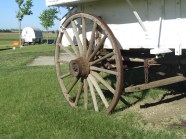
Ingalls homestead

No Jack under this wagon

De Smet is just over the border in the southeast corner of South Dakota. My first stop was easy to find off Route 14, also known as the Laura Ingalls Wilder Highway. The Ingall’s Homestead is a private operation located on a the Ingalls’ original Dakota Territory homestead. My heart sank when I saw the homestead grounds had been mowed low because I had expected the exhibits to be settled in the tall grasses of the prairie. But maybe American tourists would think that wild prairie looked unkempt? Neglected? But nevermind. My disappointment was short lived–I had reservations to spend the night in a covered wagon on the property. Although modeled on a sheepherders wagon, the four little wagons scattered on the hillside made a pretty picture. After the Homestead closed, it was only us campers, the birds, and the ground squirrels. I was content to just sit. The wagon was cozy, my sleeping bag comfy, and I fell asleep to the smell of woodsmoke from other campers’ fires.
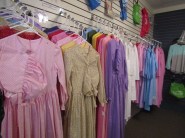
bonnets and prairie dresses

Little girl’s dream come true

While the buildings are not original to the Ingalls, the family who owns and runs the property built Ma’s little house to scale and situated it where Charles Ingalls built it–a few of his original cottonwoods are still standing, and, of course, in the distance is the slough Laura worried about in The Long Winter. (I also learned that the word ‘slough’ is pronounced ‘slew’ to rhyme with ‘blue’–fifty years pronouncing it wrong!) The rest of the buildings on the homestead are meant to give visitors a glimpse of life during the late nineteenth century. There’s a barn with a hay roof like Pa’s, a stable, a schoolhouse, and cash crop fields. This is the first of Laura’s sites I visited that had meaningful hands-on activities for kids: making cob dolls, lassoing a “cow”, driving a pony cart, and riding in a covered wagon. If I was eight I would have been in heaven.

I found the real deal in De Smet on a tour run by the Laura Ingalls Wilder Memorial Society. Finally–the buildings and artifacts had some historical provenance. The docent was knowledgeable–I pegged Randall right away for a high school history teacher– and I was right! He told the Ingalls story, but also put the family’s life in context, making homesteading, the impact of the railroad, and westward expansion easy to understand. The tour included the surveyor’s house, the school house Laura attended, Ma and Pa’s house in town, and the Brewster School where Laura taught for a short time. The gift store also included an exhibit room with some of Mary’s beaded work, one of Carrie’s dresses, a real pig’s bladder “balloon”, and some documents signed by Charles Ingalls when he was justice of the peace. It was the most museum-like experience I’ve had on my Laura adventures so far. 
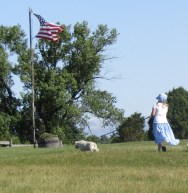
Ingalls Homestead

Bonnet girl

At the end of my time in De Smet, I drove to the cemetery on the edge of town to visit the family plot. Caroline, Mary, Carrie, and baby Charles are buried alongside Pa, whose marker is the only original. I stood in the shade of trees planted a century and a half ago, the sun was bright and warm–and I thought about an ordinary little girl’s story (written for the first time when she was very near my age) that continues to touch hearts and minds so many years later. Her story hasn’t ended.

I think that’s what drives me to visit the Little Houses. I’m once again the eight-year-old who read the Laura books and wished my daddy played the fiddle, I could spend New Years with the Boasts, slide on Silver Lake–and she still lives somewhere deep inside the woman I am today.

sod house

Soddie with sod roof

My goal was De Smet–850 long miles from home–where I’d visit Little Town on the PrairieThe Long Winter, and By the Shores of Silver Lake sites. But I sure couldn’t travel that far without a stop along the way to the banks of Plum Creek. The small town of Walnut Grove, namesake of the TV home of the Ingalls family, is just a few miles from Plum Creek, so I figured a stop at the Laura Ingalls Wilder Museum and Gift Store was in order. Except for the fact that TV actors visit Walnut Grove each year for the Wilder Pageant, Walnut Grove doesn’t offer much to LIW fans. Wilder herself only mentioned the town in passing; the family’s home in the area was at Plum Creek. This little town’s fame is totally reliant on the television show.

soddie with windows

Walls like concrete

The emphasis is on ‘gift store’ at the Laura Ingalls Wilder Museum and Gift Store. This museum was similar to the one on my trip to the Little House in the Big Woods last summer–a lot of books, dolls, and souvenirs for sale, but not much actual Ingalls’ memorabilia. (But of course I did buy two books!) One room housed story boards floor to ceiling, illustrating the family’s journey with photos and explanation of the period, along with excerpts from Wilder’s books. There was a binder of photocopied articles Wilder wrote when she and Almanzo settled in Missouri. A buffalo coat like Pa wore. But other than that? Only a place setting of dishes, a sewing basket, and two balls of crochet thread actually belonged to Wilder. My favorite (and most authentically museum-worthy) display was a few original sketches and paintings by Garth Williams that became the illustrations fans of the books know and love so well.  The originals are surprisingly small–some only 3″ X 3″!

The other room in the museum itself was dedicated to the TV series–magazines, photos, autographs–but that really isn’t my connection with Laura Ingalls Wilder and I admit I barely looked at it. The museum site also has a few other exhibits representing the time period: a chapel, a “Grandma’s House” (which focused on all things housekeeping), and a school room.There was also a sod house on the museum grounds, but it couldn’t compare to the display of sod houses (or soddies as they’re lovingly referred to) on the McCone family prairie grass farm in Sanborn.

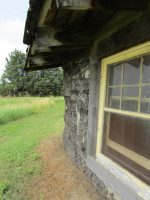
I actually visited the Sod House on the Prairie (which is a private venture) first since it was on the way into town. The family has built replicas of different styles of sod houses–a dug out, a sod house with plastered walls and wood floors, a rough soddie with dirt floors and hay roof–and furnished them accordingly. It is a labor of love–and the re-creations gave me an idea of what life would have been like in prairie homes. One word: dirt. Dirt everywhere. Even the display cards in each soddie were covered with gritty grime … and bird poop. So when you look at Garth Williams’ endearing renderings of Laura frolicking on the banks of Plum Creek with the cozy little sod house tucked into the hill like a Hobbit house, just remember: dirt.

on the banks of plum creek

Plum Creek

Even though Plum Creek is just a creek (!) and the “remains” of the Ingalls’ dugout is only a depression in the bank, the site is surrounded by restored prairie that is home to birds and snakes and foxes (oh, my!) that makes a lovely little hike. (Bring bug spray!) In all honesty, I’d skip Walnut Grove and just drive through Plum Creek for a quick walk to stretch your legs and maybe a wade in the creek.

It was those times when I walked on Ingalls’ land and listened to the tall grass rustle, maybe catching sight of a thrush on the wing, that I felt Laura’s legacy. And that’s what I came for.

Yesterday I tore another June off my desk calendar, ticking off my twenty-third year of teaching. Since I’m that much closer to retirement, I’ve started to  think about about my identity as ‘teacher’–and more importantly, what the loss of that role will mean for me. Before this gig, I was ‘homemaker’, marriage coming in my teens and then baby when I was barely twenty. When the marriage ended and I went back to school, I substituted ‘student’’ for ‘homemaker’ … and soon after added ‘teacher’.

For the next twenty-three years, that was me–the role I’ve played longer than nearly any other. I graded papers over the weekend, worked on lesson plans at night, ran copies before and after school, herded 125 plus sixteen-year-olds through five successive hours each day. It was up at 5 a.m. and to bed at 9. I filed and organized and decorated each August. I drooped and stashed and tore down every June.

So I’m beginning to think about what my good bye will mean for me. I need time to break it to myself gently because that’s how I deal with life. Little-by-little I disentangle myself; bit-by-bit I take another step away. Emotionally, this can’t be a ripping-off-the-band-aid type of departure.

Last week I read a wonderful book about high school in Poland, Korea, and Finland titled The Smartest Kids in the World. (This won’t be a book review, but let me suggest you get the book and start reading now, it’s that good.) Author Amanda Ripley followed three American high schoolers who were dissatisfied with their schooling in the States and became exchange students. Ripley framed her portraits of the teens with statistics and narratives about the success of the education systems in their respective countries. It was clear from the data that other countries have strengths we don’t. The American teens felt their experiences in Polish and Finnish high schools gave them something their home schools never could: higher expectations, greater social freedom, schooling and teachers held in higher esteem. (Korea was a mixed bag because of the hagwon system of after-school tutoring sometimes referred to as cram-school.)

The book reminded me there is plenty I’ve become disenchanted with over the past twenty three years. Teachers now walk in lock step, we’re continually testing and reviewing data, we’ve seen our pay and benefits shrink year after year. When I was a fresh, wide-eyed teacher I couldn’t understand the jaded, worn out senior teachers. Now, sadly, I do. So somehow in the next few years I need to figure out what memories I’ll let define my teaching career. And I’ve started to cherish those times I know are coming to a close like reading long passages of literature aloud, conferencing with students about their rewrites, and connecting teens with a new favorite book.

And this.

A few years ago our then-new principal started the practice of reciting the pledge after morning announcements. Seven hundred voices join together in a poignant tradition, one that brings back my own school days.

From the back of my room, I watch my motley assortment of teenagers–diverse in race, economic status, sexual orientation–pledge their allegiance to our country, the God of their understanding, and each other, and I am moved, at times, to tears.

This, I’ll surely remember.