This is my symphony

What I read & what I lived …

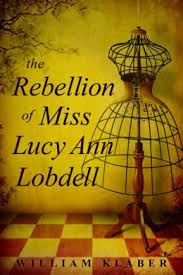
The Rebellion of Miss Lucy Ann Lobdell
William Klaber
release date: June 18, 2013
Lucy Ann was on the run. Her abusive husband had left her, she had no way to support her toddler daughter, and she was living once again with her disapproving family. Her options were few. So Lucy Ann Slater, always more comfortable outside than in, a better shot than a seamstress, became Joseph Lobdell–and wearing short hair and her brother’s clothes, her mannerisms studied, she passed. Initially, I thought Lucy’s story would be closer to Viola’s in Shakespeare’s Twelfth Night. In the end, Lucy’s story as Joe set me thinking about gender and culture, what’s learned and what’s innate.

On his travels, Joe lives in one small town after another. He teaches dance and violin at his first stop; squats in the wilds of Minnesota to hold a landowner’s property through winter; settles to raise horses; works odd jobs on a poor farm; even preaches for a time. At every stop Joe makes friends who know nothing of his secret. He falls in love for the first time. And author William Klaber would have us understand that it was his falling in love with (and engagment to) the wild and passionate Lydia Watson that brought Joe to see himself as more man than woman. Joe’s struggles were real–he had no gauge by which to measure what he felt and my heart ached for him.

But at each of those stops Joe was eventually discovered and threatened with violence, arrested, chased out of town, assaulted. Most of society had only one measure for his cross-dressing: it was an “offense against moral decency … contrary to the laws of God, man and nature.”    And so Joe never knew peace for any length of time.

At times, author William Klaber lost hold of Joe’s narrative, choosing, I think, to cover more territory than was necessary to tell his story. Historically, there are many gaps to Lucy’s story; Klaber attempted to fill them when perhaps he should not have.

I was surprised in reading the author’s acknowledgements, that Lucy Lobdell was real, known as the female hunter of Delaware County. A distant relative of Lucy’s, Dr. Bambi Lobdell, maintains in another book about her life, A Strange Sort of Being, that Lucy was transgender. (It’s now on my wishlist.) But after reading a post on The Advocate.com, it’s clear that despite coming a long way in our thinking about gender identity, we’re still stuck, as this discussion on GenderTrender indicates. I even found myself disappointed that The Rebellion of Miss Lucy Ann Lobdell was written by a man and worried he had co-opted her story to fit his own agenda–why had he mentioned Bambi Lobdell only once in his afterward?

“Oh what a tangled web we weave” for ourselves and others who would simply love.

The Silver Star (NetGalley)
Jeanette Walls
release date: June 2013

Readers of Jeanette Walls’ memoir The Glass Castle will immediately recognize the family dynamics in her new novel The Silver Star. Sisters Liz, a high school freshman, and Bean, age twelve, pretty much raise themselves. Mom, a beautiful singer-songwriter-actress, is sometimes away more than she is home–but the girls are fine, as long as they have chicken pot pies stockpiled. Money is always on their minds because Mom has never actually acted in anything, and singing gigs were few and far between. The little family lives on their grandmother’s inheritance and a few odd jobs. Whenever Mom got bored and decided, “We’ve hit a dead end,” they moved on–to Pasadena, Taos, San Jose, Seattle, Tuscon, Lost Lake.

But when Mom realizes the girls know that her latest long distance boyfriend is fiction, she up and vanishes. After weeks of getting themselves up and out of the house to school, Liz finally decides they should set out for the only relative they know of, Uncle Tinsley in Virginia, lest the authorities find out the girls are on their own. The trip takes several days by Greyhound, but Liz and Bean arrive in Byler, Virgina, a place they hadn’t seen for nearly ten years. Uncle Tinsley, a widower, isn’t too keen on their arrival, sending them first to the barn to sleep; Tinsley is more concerned with “cataloguing” the historical documents and artifacts that cover every inch of flat space in the once-gracious Mayfield. But family is family and Tinsley finds himself warming to his preoocious and spunky nieces.

Soon Bean learns the story of her father’s death and is folded into his family by her Aunt Al. She scavenges fruits and vegetables with her cousin Joe. Aunt Al passes on to Bean the silver star medal that her father was awarded for his service in Korea.They eat venison stew with Uncle Tinsley every night for dinner.  Liz is enchanted by a neighboring farm’s emus and Mayfield’s library and all seems headed for a happily ever after. But as idyllic as life in Byler is, the town also has its resident villain, Jerry Maddox. Foreman at the mill, Maddox hires Liz and Bean when they are looking for odd jobs–he works them hard, he works them long, and he finally abuses his power in an unthinkable way.

Liz crumbles in on herself, and the girls are now outcasts in Byler because of Maddox’s pull. And then Mom arrives, only to make matters worse when she announces they’re moving again–to New York City. There’s no spoiler alert here, because the ending was a delicious one and justice was served. Walls’ novel is compelling, touching, triumphant–and not to be missed. But who knew the power of emus to save the human soul?

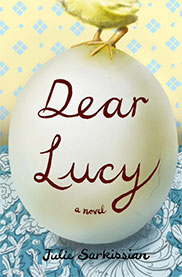
Dear Lucy (NetGalley)
by Julie Sarkissian

And you are there from the beginning of the baby and that is why you are its family. 

Samantha and Lucy spend their days and nights on the farm of Mister and Missus, little more than hired hands, but without the pay. They weed, stitch, gather eggs, feed the pigs. Both are sad souls, left on the farm’s doorstep when no one else would have them. Samantha is sixteen and pregnant, waiting for the birth of a baby that won’t be hers for long. Lucy is a child in a woman’s body with a simple mind and sometimes violent temper. Even though mum mum locks her in the bedroom when she goes out, even though mum mum doesn’t send Lucy to school with the other children, even though mum mum screams at Lucy for what she cannot do, Lucy waits devotedly for her

return. So for Lucy, the most important thing, is to put together Samantha and her baby and the father so they can live in a “special place … so when the baby opens its eyes on its very first day it sees its family.”

While the farm may seem idyllic, Mister and Missus share a dark past. And when Samantha discovers the truth of their secret in the attic, she begins to plan her escape. When Mister and Missus prevent her from following through, Samantha makes Lucy promise to find her baby. Lucy’s quest to find baby’s father leads her off the farm and into trouble–but lands her back with mum mum. This time, mum mum hopes Lucy will become the “house girl” and enlists the help of a cleaning woman to train Lucy. Although delighted for a time to be with mum mum, Lucy’s heart calls her back to the farm and the baby. A newly hatched chick named Jennifer, nestled in her dress pocket, serves as Lucy’s power inner voice which pulls her on towards the loving family she never had.

A little bit Of Mice and Men and a little bit Curious Incident of the Dog in the Nighttime, Dear Lucy is haunting and poetic. A plot that might otherwise seem outlandish is entirely believable, in part because of the fresh voice of Lucy’s inner world. The simple young woman who could do no right returns to the farm, to Samantha’s rescue, led on by the power of “promises, which are the truth.”

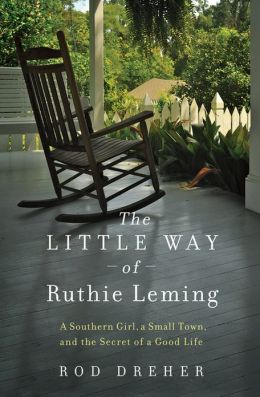
The Little Way of Ruthie Leming (NetGalley)
Rob Dreher
release date: April 9, 2013

“When a community loses its memory, its members no longer know one another,” writes the agrarian essayist Wendell Berry. “How can they know one another if they have forgotten or have never learned one another’s stories? If they do not know one another’s stories, how can they know whether or not to trust one another? People who do not trust one another do not help one another, a moreover they fear one another. And this is our predicament now.”

Writer Rod Dreher has turned my head a couple of times: once when commentator David Brooks called him “one of the country’s most interesting bloggers” (link) and again with what I think is his allusion to St. Therese, the little flower, in the memoir’s title. Because I’ve had a sort of a crush on David Brooks for years (my husband knows that Friday’s Newshour when Brooks shares a spot with Mark Shields is a sacred time). And as an adult convert to Catholicism, I seriously considered Therese as my confirmation name because of her devotion to doing ordinary things with extraordinary love.

Dreher recounts his life growing up in St. Francisville Louisiana and the restlessness and discontent that small town life brought him. As many young people do, he rather clumsily made his way out into the wider world, shaking the dust from his feet and  hurting (although never intentionally) the ones who loved him most. As a successful journalist, Dreher came to write for The National Review, The Wall Street Journal, and The New York Post, among others; he lived the life he loved in New York, Washington D.C., Dallas. Or so he thought.

It was the illness of his younger sister, Ruthie Lemming that brought him back to St. Francisville. Ruthie adored Rod as little sisters typically do, despite that fact that for all of Dreher’s turning inward, she was bent on reaching outward and touching lives, and just as he spurned small town life, Ruthie embraced it. And embrace it she did–because whether she was baking, fishing, star-gazing, or dancing, Ruthie lived life as few people do. She was head over heels for her high school sweetheart, her children were the apple of her eye, and friends were for life. Co-workers adored her and her church family was just that: family. Ruthie gave her heart to the children she taught with passion and there was no problem that couldn’t be fixed with love.

All this made reading of her illness (a particularly virulent lung cancer) even more devastating. For this Little Flower suffered much–physically, of course, but even more in the knowledge that her illness and death caused those she loved so much pain. Typical Ruthie, Dreher would say. But Dreher is wise enough to know that no saint, even Ruthie, is without those frailties that worry us all. There was friction with her teenaged daughter Hannah and an unspoken rift between Ruthie and Dreher for years. It’s that honesty that made Ruthie’s story so compelling.

The story of Ruthie’s life and death is especially powerful in the way it gives the reader (this one anyway) pause to examine his or her own life. That was certainly true for her brother, who mindfully returned with his family to the home town he once left. The question I kept coming back to was whether or not my life impacts others as Ruthie’s did. Sadly, many of us might not want to know the answer. I also became drawn to Dreher’s idea of community, something so lacking in contemporary American culture today. My hope for other readers is that Ruthie’s life, and Dreher’s, can serve as a road map of sorts, leading us to find that “place where you know, and are known … [where] we’re leaning on each other.”

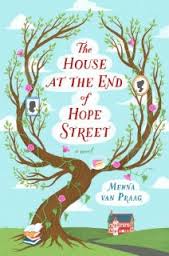
The House at the End of Hope Street (NetGalley)
Menna van Praag
release date: April 4, 2013

This house may not give you what you want, but it will give you what you need. And the event that brought you here, the thing you think is the worst thing that’s ever happened? when you leave, you’ll realize it was the very best thing of all. 

At fifteen, precocious Alba began study at King’s College, the youngest ever admitted. And while her

intelligence was remarkable, so was her other gift– for Alba saw her grandmother’s ghost, her mother’s aura moments before she entered the room, and the color and shape of people’s words spilling into the air. But her incredible gifts didn’t shield Alba from pain: her mother was in and out of mental hospitals, her father had disappeared, and her older siblings turned her a cold shoulder. Add to that the worst event of her life (which also resulted in her withdrawal from university), and Alba finds herself homeless and running away.

Until, that is, she finds herself on the doorstep of the house at the end of Hope Street, ringing the bell. And when Alba enters the house, she finds it speaks her language: the floors soften to meet her feet, the walls breathe, and hundreds (thousands?) of women look out at her from their framed photographs which fill every inch of wall space. Peggy, beautiful at eighty-something, is the current house mother. The house’s mission? To give women ninety days to right their topsy turvy lives. So Alba joins Carmen, a singer with a dark secret, and Greer, an actor whose roles leave her feeling empty, on a sweet journey of self-discovery.

When Alba loses her mother, she discovers the family she thought she knew was a sham. For a time, her preoccupation with the worst event of her life takes a back seat while she sets out to find her father and unravel family secrets, pulled forward by the ghost of Stella, a former resident of Hope Street. And then, spurred on by Carmen to write her lyrics for a love song, Alba allows herself to (finally) experience love.

Part of Alba’s charm for me was her voracious appetite for books, which very much mirrors my own and many other book lovers, I’m sure: “Alba stopped trying to make friends and instead sought refuge in the library. It was there she discovered worlds far more wonderful than hers, populated by character so captivating and lives so sensational that it was quite easy, after a few pages, to forget about her own life.” Writer Menna van Praag never lets her characters or the plot slip into cliche, although I expected it at every page turn. The novel is a bit like Harry Potter for grown-ups. Alba’s special gifts remain believable and her life unfolds more satisfying–and perhaps more simply–than she ever dreamed.  And true to some of Peggy’s first words to Alba, the worst thing that ever happened becomes the best thing of all.

On a side note, I somehow missed my 100th post–that seems, somehow, like a milestone! This post makes 1-0-2–celebrate! [Image courtesy of cyberscooty]

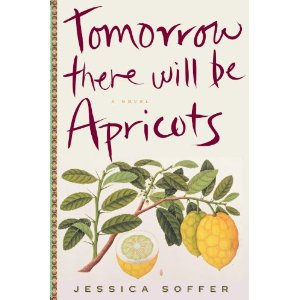
Tomorrow There Will Be Apricots (NetGalley)
Jessica Sofer
release date: April 26, 2013

Leaving is the easy part, I wanted to tell her. It’s moving on that one gets mired in. It takes year. Decades, actually. It takes tragedy and drama and the most painful part: the haunting feeling of what’s lost when it finally starts hurting less. 

The publisher’s blurb for this soon-to-be-released novel by Jessica Sofer states, Two women adrift in New York—an Iraqi Jewish widow and the latchkey daughter of a chef—find each other, solace, and a new kind of family through their shared love of cooking.” Oh my goodness–everything I love in a story: a spunky granny, a winsome teen, a faraway place, and food. But what I got was so much more than a feel good read. 

Lorca’s life is anything but perfect. Her mother, preoccupied with her high-pressure life as a chef, is as distant and warm as the polar ice cap. Lorca’s father, probably an alcoholic, is absent. And right before winter break, Lorca’s school counselor suggests a boarding school. Because Lorca is a cutter. With that plot twist, I almost turned the novel aside. As a high school teacher for many years, I’ve had more than a few girls who have self-injured. I’ve spoken to their counselors, I’ve even spoken to the girls in a few instances. And I don’t understand it. At all. But I saw Lorca’s imperfect life mirrored in her cuts, bruises, and scars in an almost eloquent (albeit painful) way. Like many children dying for a parent’s recognition (if not love), Lorca never stops trying to win her mother over. And that’s how Victoria comes into the story. 

Victoria and her husband Joseph once ran a successful Iraqi restaurant. Just days after Joseph’s death she agrees to teach a small cooking class in her apartment–and up turns Lorca, searching for the recipe for a dish that she’d overheard her mother praising: masgouf, the national dish of Iraq. Victoria has her own bruises and scars. She left war-torn Iraq during a revolution; she witnessed the public hanging of her uncle, and most likely other atrocities. Her adjustment to immigrant life in New York was less than smooth, made even more difficult by an unexpected pregnancy. VIctoria’s life with Joseph was never the same after the birth of the daughter she could not keep. 

In only a couple cooking classes, Victoria and Lorca think they’ve found  in the other the answers to all their painful questions. And I worried Sofer would take the easy way out of her plot tangles. It will be for you to see if she did or not. But in the end, I saw both women–young and old–still painfully making their way through life–a little bit more tender perhaps, a little stronger, but moving on. 

The Aviator’s Wife (NetGalley)
Melanie Benjamin

I was Mom. I was Wife. I was Tragedy. I was Pilot. They all were me, and I, them. That was a fate we could not escape, we women; we would always be called upon by other in a way men simply never were. But weren’t we always, first and foremost–woman? Wasn’t there strength in that, victory, clarity … 

I’ve read my tattered copy of Gift from the Sea too many times to count and have given the book as a gift just as often to friends who were navigating life’s rough seas. Anne Morrow Lindbergh’s book of short essays attempts to unlock the puzzle that it is to be an independent woman, yet still wife and mother. And when I worked at the bookstore, I read War Without & Within and Locked Rooms Open Doors–eager, as is the rest of the world, to find out more about the famous kidnapping. Lindbergh’s writing is sometimes raw, sometimes tender, always insightful.

So when I began Melanie Benjamin’s recently published novel about Anne Morrow Lindbergh, I was guardedly optimistic that Lindbergh’s fictionalized voice would ring true. And while I have plenty of questions about the veracity of some of the scenes and events, the novel was compelling enough for me. Benjamin begins with Anne Morrow’s college years–the years she met and fell in love with Charles–then alternates chapters of the Lindbergh’s life together with the last days of his life. Anne Morrow is accurately presented as sensitive, shy and full of self-doubt, and Charles, her alter ego–brash, confident, and definitely not given to introspection. They are America’s darlings of the air during the pioneering days of early long-distance flight, yet the public’s invasion of their privacy was horrific: photographers hounding them on their honeymoon, odd admirers showing up at their door at all hours– some even, after the kidnapping, offering the couple their own children. The couple felt so threatened that Charles took to wearing a sidearm when he answered the door.

Benjamin’s Anne begins to question Lindbergh’s control early in her marriage, and the kidnapping gives her more insight into his emotional life–or lack of it. Yet she, like so many women then and now, feels powerless to resist him. It was only when she reached middle age and they began to drift apart that Anne Morrow Lindbergh felt she had the distance and freedom (and perhaps wisdom) to examine her life. And so The Gift from the Sea was born. The Lindbergh’s later years were spent pretty much apart and both took lovers. Charles Lindbergh (how I missed this gossip, I’ll never know) fathered several children with two or three other women. Their life together, once so public, was shrouded in secrets.

I have no idea whether or not some of Benjamin’s conjectures are true or not–that Anne Morrow’s sister was gay or that Anne Morrow Lindbergh danced the night away at the White House, doing the Monkey with Buzz Aldrin. But she rekindled my interest and I’m eagerly looking forward to reading Susan Hertog’s biography and following the Lindberghs a little bit longer.

Speaking From Among the Bones (NetGalley)
Alan Bradley
release date: February 2013

Was sorrow, in the end, a private thing? A closed container? Something that, like a bucket of water, could be borne only on a single pair of shoulders? 

The story begins in true Flavia fashion with a twelve-year-old girl who can’t keep her eyes off  a severed head dripping blood–described, of course, in all its gruesome glory. And with that, author Alan Bradley has me hooked, ready for another romp with the sweetheart of Bishop’s Lacey. Except in a typical Bradley “gotcha!”  it’s just a stained glass window in St. Tancred and Flavia is remembering the Second Reading from a month ago. But in just a few turns of the page, there’s a bat, a dead man in the organ loft, blood dripping through the church ceiling, an exhumed saint, poisoning–now that’s more like it.

The bishop has decided to disinter the body of St. Tancred on the occasion of the quincentennial of his death. The digging stops at the discovery of yet another body and rumors that the saint’s crozier was inlaid with diamonds–then it’s a race against time, Flavia, and the evil magistrate Mr. Ridley-Smith. Flavia finds yet another  connection to her mother Harriet when she discovers lonely, simple Jocelyn Ridley-Smith locked in and hidden away on his father’s nearly empty estate. To make matters even worse, Buckshaw is for sale.

I am still sometimes  put off by the arcane references to chemistry. But while Flavia can still wax eloquent about arsenic, for example (“In its arsenious oxide form, the arsenic was soluble in water, but not in alcohol or ether. The cyanide was soluble in alkaline water and dilute hydrochloric acid, but not in alcohol …”), we also get a glimpse of a new Flavia’s world where “everything was topsy-turvey.”. Where laughing with sister Daffy was preferable to kicking her, where she blurts out endearments to Dogger, and is troubled by a lump in her throat and brimming eyes on more than one occasion.

And perhaps most exciting for this reader is that there is sweetness in the bottom of this pie for anyone who loves Flavia and the DeLuce family.

Next up: I am almost done Melanie Benjamin’s historical novel about Anne Morrow Lindbergh, The Aviator’s Wife. It’s been a good read overall, so look for my post soon.

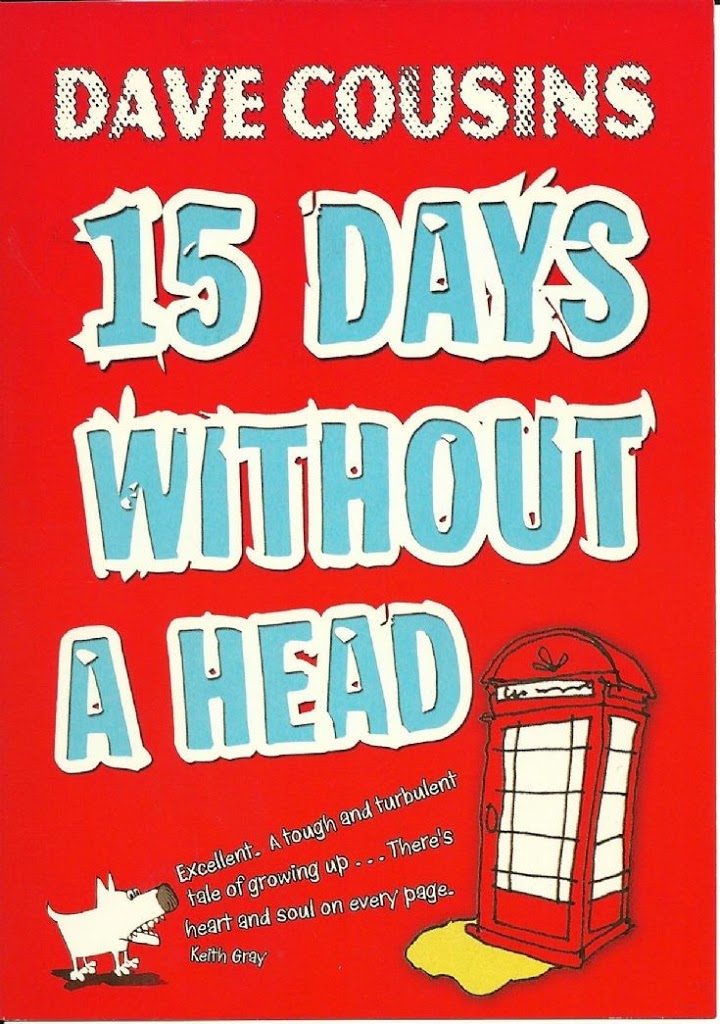
15 Days Without a Head (NetGalley)
Dave Cousins
Release date: May 2013

Laurence Roach’s mom is single, depressed, alcoholic … and disappears one day without a trace. His six-year-old brother Jay can be hard to manage and sometimes acts like a dog, especially when he doesn’t want to mind. And so it falls to Laurence to hold it all together–but that’s a lot to ask of a fifteen-year-old. Still, he tries, terrified that social services would pry the family apart.

The laundry piles up; what little food left in the flat is soon gone; Laurence, late for school one too many times, risks a daily report. Then Jay’s babysitter and a nosy neighbor lady start to snoop. Laurence keeps up the ruse for a long fifteen days, with the excuse that Mum was working long hours. The boys come down with fever. They’re hungry–Monster Munch and lemonade for breakfast  no longer holds any appeal. Desperate, Laurence even dresses in Mum’s clothes, hoping to fool the bank into letting him withdraw money from a long-forgotten savings account opened by his nanna.

All the while, Laurence still believes that he can make it all better–Mum would return, stop drinking, get a new job–by winning a family holiday on the radio show Baz’s Bedtime Bonanza. Pretending to be his (dead) dad, Laurence answers trivia questions night after night, advancing in the game and fighting off challengers. And finally, a chance sighting and some lucky sleuthing leads him to the truth behind his mother’s absence … but no spoiler alert here.

Author Dave Cousins has great insight into the mind of a teen–those years of sometimes child, sometimes adult. His word play is a clever, yet poignant, with chapters titled Whensday, Blursday, Lieday, Thataway, and on to Doomsday and Madnessday, ending with Today. As in the novel’s title, the Roach boys are fifteen days without their mother. And Laurence chases the roaches that skitter across the kitchen, Jay telling him all the while, “A cockroach doesn’t die even if you chop its head off.” The question Laurence answers to win that all-expenses paid family holiday? “Which of the following UNFORTUNATE creatures will not die–EVEN if you remove its head?”

The Roaches don’t die either, surviving the almost-destruction of their nuclear family, perhaps even stronger than before. 15 Days is an insightful Young Adult novel about family struggles for teen readers.

Next up: It’s a snow day! It’s my birthday! And little Flavia DeLuce is calling me, calling me …

All the Light There Was (NetGalley)

Nancy Kricorian
Release date: March 2013

Both heaven and hell are here in this world.

Maral is fifteen, Armenian, and living in Paris at the time of the German occupation. Life is not easy in the cramped apartment she shares with her mother, father, aging aunt, and brother. Food is scarce and rationed, most meals consisting of bulgar and turnips. But her father, a cobbler, maintains a steady flow of customers, her mother is a seamstress and her aunt knits on commission, so at least at the beginning of the war, their lives maintain a semblance of normalcy.

Maral and her brother Missak have a sometimes contentious relationship, especially as she struggles to understand his participation in the Resistance: printing inflammatory pamphlets against the Nazis and chalking graffiti all over Paris. And Marel turns the head of Missak’s best friend Zaven who becomes Marel’s first love. Zavel and brother Barkev are also resisters and after an arrest are imprisoned in Paris–and then transported to Buchenwald.  Marel continues her studies at the French lycee and university, waiting, waiting, waiting for her Zavig’s return. But after months and months, Marel begins walking about (in secret) with Andon, an Armenian POW forced into conscription for the Nazis–a relationship frought with uncertainty and guilt.

The Pergorian family has survived and is still haunted by the atrocities of World War I. They know that community and faith can soften the depravity of war. And so it is without a second thought that Marel’s mother offers to harbor the five-year-old neighbor of a Jewish family who has been deported to a work camp. They hide Claire for several weeks before arranging for her to be smuggled to unoccupied Nice to live with her aunt. Missak supplements his opposition work by printing counterfeit ration coupons. It might very well be the small instances of resistance that preserves our sanity in the face of such misery.

I had hoped to learn more about the Armenians, a people who, I know, have a storied past. Nestled between the Middle East, Russia, and Europe, Armenians have fought fiercely to maintain their identity. Unfortunately, author Nancy Kricorian provided little of the nuanced history I was hoping to read. Ethnic foods and names and a few guarded references to the genocide during World War I were, sadly, as far as Kricorian went.

Marel’s story ends happily enough and All the Light is in the same vein as Sarah’s Key. Readers who enjoy similar books will find the story satisfying.