This is my symphony

What I read & what I lived …

Lemoncholy Life of Annie Aster (Edelweiss; NetGalley)
Scott Wilbanks
Sourcebooks Landmark
paperback release: August 4, 2015

lemoncholy: (noun) 1. The habitual state in which one makes the best of a bad situation. (adjective) 2. Afflicted with, characterized by, or showing lemoncholy.

I’ll just lay it right out there and tell you I loved this novel from the very start. Imagine a bit of Miss Peregrine’s, House at the End of Hope Street, Time and Again, and Time Traveler’s Wife all stirred up in a pot and Scott Wilbank‘s first novel is just that tasty. Lemoncholy Life begins in the middle, but I’m guessing with time travel that’s just a formality. A letter. A murder. Enough said.

Lemoncholy Life of Annie AsterThings really get rolling when one fine day in 1895 Elsbeth Grundy looks out her door to see a huge (and rather elegant) house sitting in the wheat fields of her back forty. Indignant at the gall of anyone who would build a house on her property without permission (and, seemingly, overnight, mind you!) Elsbeth writes her “neighbor” a letter and pops it in the brass mailbox by the picket fence.

Annie Aster steps through her back door (one she had recently purchased at an antique store and just had installed, by the way) and straight onto a path she’d never seen before. Following it through a garden exploding with roses of every kind, she came to a picket fence—and saw fields of wheat beyond, and in the distance, a small gray cabin. Curious, Annie opens the mailbox to find Elsbeth’s letter. The year is 1995.

And of course the two women begin corresponding across those 100 years. And of course Annie’s new red door is a time conduit. And of course their lives become entwined in ways they didn’t think possible when Annie reads an old newspaper account of a murder—and decides she and Elsbeth just might be able to prevent it.

But in many ways this isn’t a story about Annie and Elsbeth and their time traveling capers. This is a novel rich with complex characters who are trying to find a place in this often cold and heartless world. Like Christian, Annie’s best friend. A car accident left him with a brain injury. He stutters; he’s sometimes lonely. And Edmond. Another loner, who would like to get to know Christian better … but he’s haunted by a secret. And finally, Cap’n—a street urchin who leads a gang of pickpockets and shills in Elsbeth’s world but risks almost everything to help one of the few people who have ever treated her with kindness.

The Lemoncholy Life of Annie Aster had more plot twists and turns than I could keep track of, at times. If I have any criticism it would be that Wilbanks has enough material here for two books, easily—and instead of the rapid fire connections across time that came at the end of the novel, I’d have loved a sequel with a little more exposition of those back stories.

But no matter. For all you time-traveling, sleuth-loving readers, Lemoncholy Life is not to be missed. And as a special treat, dear reader, author Scott Wilbanks will guest post right here on August 24thThis Is My Symphony’s first time ever participating in a blog tour—and I couldn’t be more excited it’s for this novel!

ADoseofShipBoy@Flickr.com

ADoseofShipBoy@Flickr.com

It’s hard to believe that in July 2010 I started writing about books on some new (to me!) thing called a blog. I hit my 100th post hardly even thinking about it, so when I saw the post numbers creeping up this month excitement started to get the best of me. Two hundred is a lot of life, books, and all things bookish! I’ve grown as a writer, I’ve grown as a person, and I’m continuing to grow this not-so-much-a-hobby-as-a-passion of mine. (It is, indeed, my personal symphony.) So here’s to two hundred more posts … and beyond.

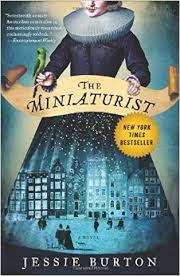
The Miniaturist (review)
Jessie Burton
Ecco

When I was growing up I had a cardboard doll house that was over four feet tall—it was identical to this one.

You’d think, cardboard—ugh. But it was incredibly sturdy and I treated it like the prized possession it was. The original house came with some cardboard furnishings, but I didn’t use those for long because my nana gifted me Petite Princess dollhouse furniture that was incredible. The sofa had real satin cushions, the fireplace came with teeny logs and brass andirons, the antique-style phone had a little thread cord, the brocade chair had a winged back. Gorgeous.Rummer

I moved nearly every year as a child and each move brought a new house, new school, new friends—but that doll house was a constant. I sat for hours and hours in front of it creating a world within my world—as any good reader would do. (And any book that involved dollhouses was also a sure hit; I especially like stories by Rummer Godden like Little Plum, The Doll’s House, Holly and Ivy–now all included in a more recent paperback titled The Fairy Doll.)

So the hook for me to read Jessie Burton’s novel The Miniaturist was the miniatures. But the fascinating story about sixteenth century Amsterdam kept me reading long into the night. Nella Oortman arrives in the city after a rather hasty marriage to a wealthy merchant in the Dutch East India Company. Johannes Brandt was older and kept a surprising distance from his beautiful young wife. Nella is confused—her mother had prepared her for her wedding night, she dreamed of the babies to come … but Johannes takes no interest in Nella as a wife. Instead, she is left alone to navigate her relationship with her controlling sister-in-law Marin while Johannes spends long hours working and traveling.

MiniAs something of a consolation prize, he has an incredible wedding present made to keep Nella occupied: a tall cabinet re-made into a replica of their home. Along with what is essentially a doll’s house, Johannes provides Nella with a line of credit so she can furnish it. Nella hires a miniaturist and commissions a few pieces–a betrothal cup, lute, and marzipan, but is chilled when the unknown craftsman includes extra items that are miniature duplicates of objects in their home.

Nella becomes even more frightened when the miniaturist continues to send items that seem to indicate he (or she) knows more about the Brandt household than is prudent; Nella gradually learns that certain secrets might best remain hidden. And as Nella begins to discover more about the Brandt family and their magnificent house, she begins to understand her own strength and purpose, as well.

The Miniaturist is a peek inside a time and place I knew little about and a cautionary—yet hopeful—tale about a young woman coming into her own.

We are getting ready to say gTrixieoodbye to this girl. She has been with us for 14 wonderful years, but her body and mind are rapidly failing and we’d like to say goodbye while she can still recognize our touch and our voices as we love her into the next world.
Motoring down a country road on that sunny June Sunday so many years ago—greenhouses and hobby farms on either side of the road–we saw a hand-painted plywood sign by a mailbox: Lab Puppies. Hubby just wanted to “look”, but it was love at first sight and there was no turning back. She chose him, he said. And who was I to argue? The puppies’ momma was young, sociable, and begged to play chase—a great example for her babes of what a dog should be.

There is nothing in the world like the smell of a puppy. (Someone should bottle it, am I right?) And that fat little puppy tummy breathing in out in out. We toyed with the name Penny because this yellow lab had a darker coat that shimmered like a new penny, but settled on Trixie, a name that was spritely and feminine–just like her.  Easy to train and easy to love, she was eager to please. Trix cried every night we crated her for the first month until we thought to tether her to our bed post where she slept like the baby she was.

Of course she could get into mischief. She has probably eaten over 250 dollars cash in her lifetime—both “snacks” snatched from my purse when we had to run out in the evening to some activity or other. After a long day at home, you see, Trixie felt (apparently) we really shouldn’t be leaving again. So once she munched my grocery money and then again money I had collected for a baby shower at work. Both times a dose of hydrogen peroxide brought up most of the money, some of it shredded, of course—but I became quite the expert at slopping off the bills, rinsing them, laying them out on paper towel, and painstakingly matching serial numbers so the bank would cash in at least some of them.

Trixie was born to be a camper. She loved the woods. She loved hiking—the longer the better. She loved the Lake and swimming with her dad. She loved the attention she got whenever one of us waited with her outside of the shower house or camp store. She loved marshmallows–raw, not toasted. Nothing could dampen her enthusiasm for the woods, and, in fact, she was the reason we moved from a tent to a camper—a week of rain, a week of sleeping with a wet dog between our sleeping bags, a week of muddy paws everywhere and hubby relented, agreeing to a pop-up. (Thank you, girl!) Now we had the pull-out and she had the floor. Sadly, she hasn’t gone up north for a few summers. The heat, the confusion (she lost her hearing), the lack of her routine just didn’t sit well.

Trixie

Trixie at 4 years

We’ll never see the likes of her again and it seems impossible we’ll soon say good-bye. Our vet has agreed to come to the house when it’s time. I’d like Trix to lie by the lilies that border our garage (the same lilies behind her in this picture) and drift off to sleep peacefully. She loved that flower bed, running headlong through it nearly every time she played catch or chase—leaves shredding, flower stalks bending, clods of dirt flying. I’m pretty convinced she did it just so she could get a rise out of me; what fun it must have been to look over her shoulder and see me running after her (time after time after time) yelling, “Get out of my flowers!”

I’m convinced that if there’s a world after this one, our fur friends will join us. In one of my dreams of heaven,  I come to a grassy hill (the very best kind of hill there is) and start to climb, when over the crest bounds a lab as bright and shiny as a penny. I’d know that crazy lope and those flapping ears anywhere! “Where’ve you been?” she’ll  seem to say, cocking her head to one side. Then we’ll go find some trails to hike or flowers to run through.

And we’ll both be happy again.

Categories: Life

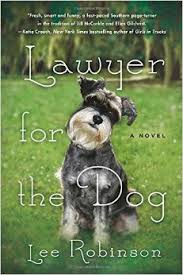
Lawyer For the Dog
Lee Robinson
Thomas Dunne Books

DogThis was probably one of those times when I did choose a book by its cover. Take a look—how can you resist that little guy’s face?! (My first dog was a schnauzer, so that didn’t hurt either!)

Lee Robinson’s Lawyer For the Dog is pretty simple to summarize. It goes like this:

Main character is a woman of a certain age–finally a love interest who’s not a millennial! (check)
Said character is single and ready for love  (check)
Add a tangle of past love, regret and self-doubt  (check)
Enter a winsome schnauzer who is the center of a custody battle  (check)
Bonus: the knight in shining armor has grey hair! (check)

Sally Baynard is a family lawyer in Charleston, South Carolina. She’s been divorced and single for almost two decades, but her ex-husband has decided he’s still in love with her. So Judge Joe Baynard decides to insinuate himself into her life again by assigning Sally as lawyer—and ultimately guardian— for a dog in the center of a nasty divorce case where both parties demand that Sherman the pup live with them. Sally is not too sure about Joe’s unexpected declaration of love, but she is attracted to the dog’s vet, Dr. Tony Borden. Complicating matters is the fact that Sally’s ailing mother (she has Alzheimer’s) lives with her, so a love interest seems like just one more hurdle.

Shall I mention again that it was incredibly refreshing to read some chick lit where nearly all the characters all had grey hair and experienced the pangs of middle age?!

This quick and easy summer read would please any hopeless romantic or dog lover—especially those over forty. The story might not be complicated, but it is delightful.

I’m almost finished with my summer digital reader’s copies and when I am, man-oh-man, I am diving into this shelf of real, honest-to-goodness print books as soon as I can. I’ll breathe that thick paper and glue smell deeply and bookmark my pages with an honest-to-goodness dog-ear, not a wimpy little icon inserted at the top of a digital page. (I freely admit to being a corner-folder and spine-breaker who manages to ravish her books in those—and many other—ways!)  While I do love me my Kindle, there is nothing that compares to the satisfaction of a book in hand.

Here’s what I have to look forward to:

Pioneer Girl: The Annotated Autobiography—It’s my goal in the next few year to visit as many of the Laura Ingalls Wilder landmarks as I can and there are more books than one would think to guide readers in their all-things-Laura travels. This book is by far the most comprehensive of the bunch and I’m just starting the section on Little House In the Big Woods since I’m checking Pepin, Wisconsin off my list this summer. If you’re a LIW fan, this should be your definitive guide.

TBRA Week in Winter—This book by Maeve Binchy showed up unexpectedly when my mom returned some books I’d lent her … and included A Week In Winter which I’d gifted her for a trip! But no matter. What’s to protest about a sweet Binchy in which the protagonist, “decides to take an old, decaying mansion set high on the cliffs overlooking the windswept Atlantic Ocean and turn it into a restful place for a holiday by the sea …” Any book whose blurbs use the words “delightful” and “heart-warming” can’t be all bad.

Eleanor & Park—I should probably read more YA fiction. Every summer I try to read a title I can share the next year in my classroom, and I’ve had this one on my radar for a while. Eleanor, Park, star-crossed, high school—and John Greene loved it, so that will sell the book to my kids right there. (And an author whose name is Rainbow can’t hurt, either.)

The Woman Upstairs—This came out in 2013 and has been on my wish list for just about that long. I heard Maureen Corrigan review it on NPR’s best books for the year segment and it sounded intriguing. Probably a little dark, but that’s okay—it will counter-balance Maeve Binchy.

The Road to Character—I’ve been in love a fan of the pundit David Brooks for years. He is honest, fair, and balanced in his political critique (but not in the Fox News way). In the past few years he has branched out, writing more about character in our culture. My hunch is he finds us lacking. Go figure.

The Miniaturist—I loved the cover, plain and simple. And I’m pretty sure friend Denice liked it.

Sycamore Row—This one was in the re-sale bin in our local independent bookstore and for three bucks and 637 pages (!) it was the bargain of the century. It’s got all the good John Grisham stuff: a rich guy who’s dying, a revised will, bratty adult children, and a black maid. I should also say here that everything I know about the law I’ve learned in John Grisham. Like never, ever join those large settlements you see on late night TV because even though the lawsuit is for a bazillion dollars, you’ll only get ten thousand. If you’re lucky.

It’s an odd assortment, I admit. Suggestions I got from a review here and there, a little bit of serendipity, nothing too cutting edge. And that’s just fine with me.

Happy summer reading!

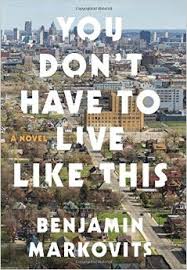
You don’t have to live like this (Edelweiss)
Benjamin Markovits
Harper

As a lifetime resident of the Midwest, I’m a sucker for novels about the region (especially those written by Midwesterners like this). I think the good-people-salt-of-the-earth values take on life is refreshing. So I’ve been anxiously waiting to read Benjamin Markovits’ novel about Detroit for a few months. For many Michiganders, Detroit is ever in our peripheral vision and there might be a little “as Detroit goes, so goes the state” bit of worry associated with our preoccupation of Detroit’s woes.

Here’s the author’s take on Detroit.

Thirty-something Greg Marnier is at loose ends. After his doing his undergrad at Yale, he’s just spent ten years Detroitstudying and teaching abroad in what turned out to be a dead-end career path. He moves home to Louisiana and is back sleeping in his childhood bedroom. His high school and college friends are on the adult track: good jobs, apartments in Manhattan, babies on the way. Marny (as his friends call him) is stuck.

Then a Yale buddy who’s made more money than he knows what to do with crosses Marny’s path while he’s killing time working for the Obama campaign and presents him with an intriguing idea—Robert James has bought up hundreds of derelict properties in Detroit with the intention of creating a new settlement. Fix up the houses, bring in new residents to live rent free while the neighborhood takes root, and rebuild Detroit settlement by settlement. With nothing to lose and everything to gain, Marny jumps at the chance and within a few month he’s patching plaster, clearing out trash, and otherwise trying to make an abandoned 1930s duplex livable.

As might be expected, long-time residents in the neighborhood (holdouts who refused to sell to Robert James) are resentful. New Jamestown (as the neighborhood is dubbed) settlers are seen as interlopers—overwhelmingly white (despite an attempt to choose applicants who would provide the neighborhood with racial balance), mostly middle to upper middle class, and college educated do-gooders—and from the start there are hints at a culture clash to come: Marny buys a gun, settlers patrol the neighborhood at night, and some long-time residents’ are openly hostile.

No conversation about Detroit is complete without a discussion of race and there is plenty of that in You Don’t to go around the block two or three times. I was hoping Markovits would offer some sort of new perspective or insight into racial tensions in the Rust Belt, but there were none—which is, sad to say, probably pretty much the reality of race relations in Detroit. I was a bit surprised that Markovits isn’t a Detroit native, nor does he even live in the state. And I thought it off-putting that the writer is, in fact, a native Texan who has lived most of his adult life as an expat in Europe. Ummm … talk about interloper! Where’s Markovits’ street cred?

There are more Michigan and Detroit references in You Don’t Have To Live Like This than I could count—General Motors and Ford (of course!), Lake St. Clair, WDIV, the Tigers, Belle Isle, Grand Rapids (a shout out to my hometown), Woodward Avenue, Slows Bar BQ, Detroit Free Press, Ferris State, Kendall College of Art and Design, I-94, Grosse Point, Ann Arbor, Zingerman’s Deli, Bell’s Oberon. And that list is hardly definitive. At first the references were fun, but halfway through the novel it felt forced, as if Markovits wrote with a Detroit travel guide at hand. Enough already!

You Don’t Have To Live Like This is not a short read at 400 pages and it is a ramble through any number of cultural issues. There are hedge funds and black on white crime and a skewed justice system and vigilantes and bad press and price fixing–and, of course, race relations. Even Obama makes an appearance at a Christmas party where he suggests a 3-on-3 basketball game, and elbows Marny, leaving him with a bloody nose.  My feelings on the novel are mixed because like so many contemporary novels I felt it lacked focus.

But simply for a romp in my backyard, it was definitely worth the time.

I’m new to this grandma gig—only seven months into it, to be exact. And while I was once a stay-at-home-mom who raised three kids (pretty successfully, most people would say), the new littles in my life (J, seven months, and L, 5 months) made me wonder whether or not I still had my mojo. I’m watching my grandson J a day each week this summer while his momma (who works nights) sleeps. But my worry was a waste of time because it’s like riding a bike, I’ve discovered. And because these baby days will pass by in a blink, I’ve started a Things I’ve Learned list. Here’s round one:

EAT BREAKFAST* before baby arrives. The first couple times I didn’t, thinking, “Oh, I’ll eat something during his nap.” Yeah, right. Those were the days J napped for 30 minutes. And then there was play time. Then puffs and a bottle. A walk around the block. More playtime.  By the end of the day I hadn’t eaten—unless you count sharing his puffs. I. Was. Famished. Babysitting just might be a new weight loss breakthrough.
*And the closely related: do my MAKE UP before baby arrives—for all the reasons above. Except instead of dying of hunger, I looked washed out, wrinkled, and old. Kinda like a grandma.

Battling DOG HAIR AND Grammy and JGERMS is a losing battle I stopped trying to fight. I didn’t have any pets until my youngest was 2 (when I simultaneously potty-trained and housebroke both critters, I might add), so I didn’t really have to deal with this when I had crawling littles. Now we share our home with four hairy beasties. I vacuum before J comes, I wash the floors. And then I put him on a quilt to play, where he does not stay for long. By the end of playtime, he has fur and fuzz (and since it’s summer and humid) stuck to every little crease and roll, in places I’d never expect it. Ugh. I briefly did battle with a wash cloth and finally surrendered and just gave his little mitts a rinse-off under the faucet.

SIMPLE IS BEST when it comes to toys. When “watching” an oversized box—“Fisher Price Lil’ Zoomers Safari Sounds Jungle”—is as fascinating as a big screen TV and playing smack-the-toy-off-Grammy’s-hand can go on and on (and on!) and measuring spoons are every bit as entertaining that expensive Brio rattle.

You need a Masters in engineering to use this NEW-FANGLED BABY STUFF, or, that time when Grammy couldn’t use the stroller because I couldn’t figure out how to unfold it. Or, when terror struck my heart as I watched my son-in-law snap the car seat out of the car!!! instead of just unhooking Baby and carrying him in. I could hardly manage buckling him into the five point harness, let alone worry about latching the seat into its base. (Cut to a slow-mo of me running down the driveway, waving my arms, and yelling, “Noooo …”)

GRANDPAS ARE MORE FUN—it’s true. In he pops in for a few minutes, sits across the room, working at the computer, and what does J do? Everything in his little arsenal of cuteness to get Grandpa’s attention, despite the fact that Grammy has spooned yummy carrots into his little mouth, and watched the birdies outside at the feeder, and listened to Toddler Radio on Pandora, and changed the mother of all diaper blowouts … nope, it’s still Grandpa and his cell phone and computer and flying around the living room business that wins the prize. *Sigh*

I need a BABY MONITOR. The pack ‘n play is upstairs in our spare bedroom. I put J down and let him talk a while. (Momma says let him go for ten minutes, even if he ”complains” a bit.) I listen in the hall for a feIMG_1700w, but “This is ridiculous—go downstairs!” So I sit at the bottom of the stairs. “Don’t be silly—go do something!” But while I’m wiping down the high chair tray or picking up toys, I realize I don’t really know if he’s sleeping yet, do I? I creep upstairs and peek through the crack in the door. He’s quiet, but his legs are still pedaling. Back down I go, repeat the above—and you get the picture.  Grandma was tired enough without having to deal with that nonsense! Time to check Craig’s List again …

Everything runs on BABY TIME when littles are involved. I learned pretty quickly to adjust my plans for a walk, for carrots instead of applesauce, for reading instead of rolling cars … and just go with the baby flow. When J or L come play at my house, everything else comes to a halt—my full attention for playtime or cuddles is theirs. Because that’s really what grandmas do best. Mommas and daddies juggle Baby, work, house, and still have places to go and people to see. Me? Not so much. Grammy’s time is only Baby’s.

What reader doesn’t like reading about books … or bookstores or libraries or authors, for that matter? I’m surprised, really, at how many I’ve read over the past year or two: A.J. Fikry, Small Blessings, Mill River Redemption, The Bookman’s Tale. Here are two recent releases, one about a powerful book and the other about a bookseller with remarkable gift.

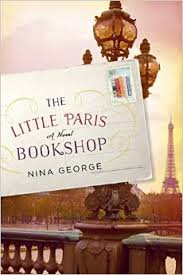
The Little Paris Bookshop (NetGalley)
Nina George
Crown

Monsieur Perdu’s bookshop Literary Apothecary was a re-purposed barge (replete with two bookstore cats), moored along the Seine. For a bookseller, Perdu was unusual—while a customer might come in looking for the latest best seller, they’d leave with a book that he chose for them, one that they needed. Perdu had a rare gift and could read his customers (I guess one could say) like a book; “transperception” his father called it. Armed with this sense, Perdu Little Paris Bookshopseeks to treat “feelings that are not recognized as afflictions … [like] the feeling that washes over you when another summer nears its end … or the slight sense of grief when a friendship doesn’t develop as you thought … or those birthday morning blues …” And for each of the ailments, Perdu “prescribes” a book.

But as we read about Perdu’s gift of perception and learn a bit about his own inner life, we realize that Perdu himself is in need of some healing. A lost love haunts him, a new love beckons, and in a burst of resolve, he casts off the Literary Apothecary’s ropes, starts up her engine, and begins to motor into the harbor—with first one, then two, unexpected passengers.

The heart of Little Paris Bookshop pulls in the right direction. There are lyrical passages about reading and books (“Whenever Monsieur Perdu looked at a book, he did not see them purely in terms of stories … he saw freedom on wings of paper”) and toss-away mentions of contemporary novels (“The customer teetered on her smart high heels, but instead of offering her his hand, Perdu handed her The Elegance of the Hedgehog.”). But once Perdu’s bookshop becomes unmoored, the novel also begins to drift. Perdu motors down the Seine past Marseille (and also towards some healing and resolution) but it’s a winding affair that is sometimes failed to satisfy this reader. (I even wondered if something had been lost in translation.) But if you’re a bibliophile, by all means give Monsieur Perdu a chance.


The Book of Speculation (NetGalley)
Erika Swyler
St. Martin’s Press

In dilapidated house high on a bluff above Long Island Sound lives a lonely librarian, Simon Watson. His mother was a mermaid–a sideshow act who held her breath underwater for ten minutes–who drowned; his sister Enola is a tarot card reader in a carnival. One day a book arrives that changes his life, sent to him by an antiquarian bookseller by the name of Martin Churchwarry. The book is older than old–sixteenth century. Its pages are water damaged, filled with notes and sketches and a ledger. Churchwarry sent it on to Simon after finding his grandmother’s name inscribed in speculationthe cover.

As any good librarian would do, Simon begins to research the book’s original owner, a Mr. Hermelius Peabody, and connect the book to his own family. About the same time the book arrives, Enola and her sideshow boyfriend Doyle (The Electric Boy) show up—and maybe it’s not a coincidence that both occur around the anniversary of their mother’s drowning. Like most antique books that show up unbidden, this book has some powerful magic between its covers. As Simon connects the dots between his grandmother and mother and Enola and Peabody, he thinks maybe he can break the curse he’s sure has plagued his family.

In between connecting the dots on the family hex, Simon manages to lose his job, fall in love, and discover a terrible family secret—all this as his family home begins its descent over the bluff.

I had a fun time working my way through The Book of Speculation even though I know nothing about tarot cards (which feature largely in the story) or circus and carnival life. I think, again, it was the fact it was book about the power of a book that kept me reading.

A rainy day ♥ summer stretching for months ♥ a scruffy black cat ♥ live a good story ♥ “You’re strong at the broken places”* ♥ “If wJune joy daree own the story we can write the ending”** ♥ lazy summer reading ♥ closets, rearranged ♥ diving ducks ♥ just me & my house ♥ kibbeh & hummus ♥ farm road pastel ♥ a full heart ♥  BBQ smokin’ on the grill ♥ Tory Burch ♥ precious baby girl ♥ addiction ♥ lazy river water ♥ a hard head, stubborn ♥ dog-tired ♥ out of my comfort zone ♥ fireflies ♥ summer candle light ♥ hard memories ♥ wine & good conversation ♥ ducks in a pond ♥ soft & silky baby blanket ♥ my nest is best ♥ Denice’s Day ♥ line-dried sheets ♥ gauzy curtains, billowing ♥ field of hay ♥ two-year-old Dad ♥ stair-stepped Scheffts ♥ little Buddy dog ♥ peanut butter & jelly ♥ strawberry shortcake ♥ baby’s finger dimples ♥ sounds of summer

* Karen White
** Brene Brown