This is my symphony

What I read & what I lived …

It was the first week of January, that time of new beginnings and fresh starts, when each year I look at the blank pages of a crisp new planner and think of all that I could fill it with: travels to far away places, appointments to beautify the winter-drab, trips to the gym to sculpt and tone. Except that I knew none of that would really fill my days.

Laura Ritchie@Flickr.com

Laura Ritchie@Flickr.com

So instead, I decided to slough off a few habits that no longer served me. Get out of the same-old same-old rut. Stretch myself a bit. An online class by Brene Brown. More time in meditation. Line dancing (I know, right?!) And sign up for a writing workshop. Mind you, it sounded great on the website. Sit around the table. Listen to others’ writing. Practice the craft. Share what I’ve written. (Actually, the first three sound just dandy, but the last, not so much.)

It would be intimidating, I knew, for the me who would rather snuggle on the sofa with a book, browse this week’s New Yorker, watch some YouTube videos, nest at home on these cold February evenings. But I felt the fear and did it anyway. (Thanks, Susan Jeffers!)

Now I’d done this once before, and thought I knew the drill: write a new piece each week or so, bring enough copies for the entire workshop, listen to the critique–it’s excruciating, intimidating, sometimes beneficial, but definitely not for the faint of heart.

This workshop follows the Amherst Writers and Artists Method, which was a different approach altogether. The AWA is an affirming and non-threatening practice in which anyone who writes is a writer and where it’s a given that everyone is born to create. All writing is treated as fiction, even though we’re invited to write “from memory or imagination.” Workshop writers offer only positive comments: what resonates with you? what will you remember? We write in 10, 15, 20 minutes chunks, always after given some prompt: “it was the first time; blue; what matters … ”

It helps, too, that the studio space and the workshop facilitator are a delight. Stuffed easy chairs, ottomans, sofas. Lamplight and bookshelves. Not a conference table or florescent light bulb in sight. And our workshop leader, Emily? She is a sweet young woman, willow-like and graceful, with what I suspect is a wise, old soul. She is gentle and encouraging. But above all, she’s a confident and skillful writer who knows her stuff.

If you want to grow as a writer, or even if you’ve only ever considered writing, this workshop just might bring you the same satisfaction it has brought me.

(Psssst … I’ve already signed up for April.)


The Canterbury Sisters
Kim Wright
Simon & Schuster

canterbury sistersChick lit for women of a certain age–it’s difficult to come by. Most of the chick lit I’ve read falls into the twenty-something-my-boyfriend-left-me or the twenty-something-I’ll-never-find-Mr.-Right category. And if you’ve read my last post (link) you understand that I’ve been there and done that.
But every once in a while I need that light and breezy read, something to make me smile and believe in falling in love again.

Kim Wright’s Canterbury Sisters was it. Che Milan’s mother passed away after fighting a horrendous battle with cancer. When her ashes are delivered, Che finds this note: “…per our agreement, you must now take me to Canterbury. Do it, Che. Take me there. Even if you’re busy. Especially if you’re busy. It’s never too late for healing.”  Now Che had agreed, in the early stages of her mother’s illness, to make the Canterbury pilgrimage with her. But the end had come too quickly for the two to set out on the trail and receive a blessing for healing in the cathedral.

Spurred by a loss of her own (which is quintessentially chick-lit-ish!) Che throws caution to the wind and almost immediately hops on a plane to England to join a group of women who are just about to embark on the pilgrimage.

Now Che doesn’t particularly relish the intimacy that such a trip implies. She’s a no-nonsense professional, a wine critic whose reviews are both sought after and feared. Heart-to-hearts with a BFF and touchy-feely girl talk just isn’t her thing. But her mom requested it from the grave, and who is she to deny such a demand?

At their initial meeting, the tour leader Tess suggests that maybe the group wants to travel like Chaucer’s pilgrim’s did–each telling their tales “to see who could best articulate the nature of true love”. The women draw cards to determine the order of the stories and as quick as you can say “Once upon a time” they are off and running walking the sixty miles to Canterbury.

So we hear each of their stories, from Becca’s adolescent love song to seventy-three-year-old Silvia’s  tale of love (and memory) lost and found. Some of the women have deceived themselves in matters of the heart and others followed their hearts. Some have had to come to terms with their own shortcomings, others the betrayal of their lovers. But the tales, and more importantly the women, are far from what Che expected.

Che also, we suspect, begins to discover that true love is also far from what she expected. And that the healing she was seeking just might have been her own.

It finally happened. I am almost old. Almost …

Melissa Doroquez@Flickr

Melissa Doroquez@Flickr

My mom, who just celebrated the big Eight-O this fall, tells me, “You’re finally catching up to me!”
And I say (patiently, mind you), “No, Mom–I’ll never catch up to you. You will always be twenty-two years older than me …”
“Well,” she says, “It just makes me feel good to think you’re almost sixty–that’s pretty close to 80!”

Whatever.
I’ve still got a couple years ’til I get there–and I’m not afraid to use them. Who knows what will actually happen (I am learning to live and love One Day At A Time), but here’s how I see those two years unfolding:

1. I’m getting ready to retire after 24 years of teaching. It’s hard to believe that at the end of my career I’ll have had about 3,000 teenagers sit in the seats of my classroom. Un-frickin’-believable. It will be difficult to say goodbye, but I think I’m ready. In that time “my” kids have watched me remarry, lose a parent, and become a grandma. Together we watched 9-11 unfold. I’ve had a blind student and students with hearing loss in my classroom. A student who was battling brain cancer, and a student who had cystic fibrosis. Students with Asperger’s. I’ve watched teens lose a parent to cancer, a brother to suicide. More than a few have run away or found themselves homeless. I’ve helped build homecoming floats, hosted Swirl and Prom and piled 50 fifteen-year-olds onto a Greyhound to travel to Mackinaw Island. I’ll never be the same because those 3000 sixteen-year-olds touched my life. And changed me profoundly.

2. I’ll welcome at least one new grand into the family–right now the total is at 2 1/2. Never in my life did I think I would turn into “one of those” grandmas. But it happened. This week while babysitting, Jonas took a kiwi and spinach food pouch out of his diaper bag and tried to twist the top. What did Grammy do? Why she uncapped it for him, of course, and let him have a snack! He wanted to carry around my bracelet. Why not, little fella? Oh, you want to take off your shoe? Go for it! I had no idea that on this end of the parenting spectrum I’d throw discipline to the wind and give my little babes whatever their hearts desire. It’s a heady thing, this grandma love, and I’m looking forward to whatever new additions come my way–and much more babysitting.

3. Hubby and I have weathered our share of life’s storms and I am oh-so-ready to head towards calmer waters. I’ve learned I’m learning my way is not the only way and he’s learning … well, that’s his story, not mine. Between us we’ve lost a parent, a step-parent, and three grandparents. We’ve sat watch in the hospital room of a critically ill parent more times than we’d like to admit. We’ve said goodbye to our beloved lab, Trixie, who was the same age as our marriage. We’ve lost a lot. We’ve gained … maybe more? Time will surely tell. I hope in the next few years we can tick off a few items on my bucket list. Like Italy. The Canterbury Trail. Lewis and Clark’s route. But even if none of that pans out, I can still say my life has been sweet, in part because of a man who is bold and courageous and darn good lookin’. So, if nothing else, we’ll pack up that camper and head to the Lake. The U.P. Out west. Because there is nothing so sweet in life as sitting beside the campfire, saying nothing at all. And maybe that’s enough.

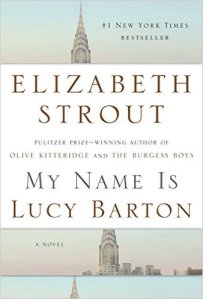
My Name is Lucy Barton (NetGalley)
Elizabeth Strout
Random House

This thing we call ‘family’–those little rag tag bands of humans who make their way through life bumping into each other and bouncing off again, sometimes laughing, but often in tears–becomes more mysterious to me the older I get. Whenever I think I have family and my place in it figured out, Life tosses in a storm, and I’m trying to stay moored against its relentless push and pull.my name is lucy barton

Lucy Barton had a hell of a childhood. Poverty, mental illness, abuse–yet she’s managed (she thinks) to put it behind her and recreate a family in her own image. One with a stable husband, a house in a respectable neighborhood, and two delightful little girls. She’s even a budding writer. But when she spends several months in the hospital with a life-threatening infection, it’s just Lucy, the hospital bed, and the four walls of her room. It’s then that the memories, uninvited, try to wedge their way in. And when her mother comes to visit (for the first time in a dozen years, mind you), Lucy realizes that in order to heal, she must somehow reconcile her past with the present.

One of my favorite writers Ann Tyler, writes about the chaos of family life with honesty and open-hearted acceptance of its flaws. Elizabeth Strout looks at family with the same honesty, but also with painful tenderness. When I read Olive Kitteridge, I wasn’t exactly a fan–not because of the writing, which is lovely and evocative–but because Olive was just so … unlikable, I thought. I gave Strout another go with The Burgess Boys and wasn’t disappointed.

But My Name is Lucy Barton left me wanting  much more from this writer whose understanding of family is a heartbeat away from my own.

Readers of the Broken Wheel (NetGalley)
Katarina Bivald
Sourcebooks Landmark

Katarina Bivald’s Readers of the Broken Wheel is a love letter to books I could have written myself. The reviews of this wonderful little nuggetreaders of the broken wheel are plentiful, so I thought another wasn’t really necessary. There’s Sara, let go from her job in a book shop, who comes from Sweden to visit pen pal Amy in Broken Wheel, Iowa, only to find on her arrival that Amy has died just one week before. The cast of characters in this sad little excuse of a town bring out the heroine in Sara. And there’s also a book shop involved, so what’s not to like? Instead, here are a few of the highlights I marked on my Kindle, and my guess at why I was moved to do so:

Sara had never believed that you had to meet someone in person to be friends–many of her most rewarding relationships had been with people who didn’t even exist.
My own love affair with Book Friends started young. With Rummer Godden’s Little Plum, Miss Happiness, and Miss Flower to be exact. At age eight I was obsessed with the doll characters in her books–in part because, like one of the human characters, Gem, I moved often. Like every year often. So when the threat of a new school, new friends, and new neighborhood loomed over my rather timid little self, the friends I found in books were always a sure thing. I was never the new girl with Book Friends–and even better, I never needed to pack up and leave them behind … because they lived forever between those two hard covers.

All stories started with someone coming or someone going.
Oh-so-true, Sara. Children have come into my life. Friends. Lovers. Neighbors. Employers. Mentors. And, in my own experience anyway, they tend to leave just as readily as they arrive. Estrangement. Divorce. A new job. A disconnect. With stories there’s always another page to turn, another chapter to dog ear, at least for a time … until someone comes. Or someone goes.

Books had been a defensive wall, yes, though that wasn’t all. They had protected Sara from the world around her, but they had also turned it into a fuzzy backdrop for the real adventures in her life.
It’s true that books are often a happy place when there simply is no happy to be found. But on the flip side, oh the places I’ve been. I’ve lived in post-war England with Barbara Pym and Helene Hanff. I’ve raced across the savanna with Isak Dinesen and Elspeth Huxley. I’ve solved mysteries with Flavia De Luce. Run away with T. S. Spivet. Learned the ways of Southern gals from Fannie Flagg and the Ya Yas. Laughed, loved, and cried with Father Tim. Every page and chapter a new and glorious adventure that is often more real than my everyday.

There was something almost insulting about a woman who so clearly preferred books to people.
Loved ones don’t always deal with those real adventures so well. I even had one partner tell me I read too much–that books were the source of my discontent. Well then. You can probably figure out how that one ended, no?

You needed a heroine with a voice of her own–a funny voice, self-mocking, but with a whole load of inner ballsiness. And a proper ending.
The heroine, of course–but doesn’t Every Woman need that ballsiness to face life’s hard knocks head on? A good Book Friend allows us to try on a different size of Self when the present one no longer fits or even just pinches a little around the waist. She can put words in our (sometimes too silent) mouths and help us find our voice.

Life was full of happy endings. 
My own, yours, or just someone, somewhere on the page of a book read long ago. Sometimes we just can’t carry on unless we know The End can be happy.

In high school’s everywhere (but especially in mine right now) the last week or two of the semester vibrates with a kind of frenetic energy.papers to grade

It’s almost like the beginning of the school year when everything was new and fresh and possible. Kids–especially those with their eye on the scholarship prize or a dream school–hustle to make up, rewrite, turn in, retake, and otherwise pull out all stops to nudge their class grade up a few points. The semester grade counts. For credit. For GPA. For class standing. And so we teachers keep long lists on our desks of who’s coming when to make up what. When Academic Advising period starts, we shuffle papers like the best of any Blackjack dealer.

OR

We wheedle and cajole and exhort a kid who is close (so close!) to turn in even one missed assignment–or two or three. These are the kids who have thrown their hands up. (Or put their heads down on their desks.) Not necessarily because of the school or the work or the teacher. But her mom had a heart attack. The booze or pills or whatever are back in Dad’s closet. Big brother went to jail. They lost the house. He sleeps in a garage. The baby was up all night. *Shoulder shrug* Why bother? Please–get that credit, graduate. It’s possible, I swear. One. more. assignment.

And then the Scantron machine works overtime zap, zap, zapping those  bubble sheets. The last Powerpoint slide on the last presentation transitions into the grade book. My own head aches, eyes blur from scoring over two hundred essays in the past week and a half.

And it is what it is for all of us … before it starts all over again on Monday.

Categories: Life

The Bishop’s Wife
Mette Ivie Harrison
SOHO Crime

I listened to this story a year ago and immediately added The Bishop’s Wife to my TBR list. This is writer Mette Ivie Harrison first mystery in the bishop's wifea series featuring Linda Wallheim, Mormon wife and mother-turned-detective. Many of us know little about the Mormon faith because so many of their practices are shrouded in mystery. We only hear snippets about baptism after death and holy undergarments and Golden Plates. So I wouldn’t be honest if I didn’t admit to reading The Bishop’s Wife out of simple curiosity.

Let me say first off that I loved Linda, a fifty-something, devout homemaker questioning the worth of the roles that had defined her for so many years. And probably making matters worse is the fact that Linda is the bishop’s wife–her husband’s position in the church puts their private life on hold and puts her in the public church’s eye.

When a member of the Wallheim’s church disappears, the police get involved and the Wallheims (or Linda at least) become suspicious that the young mother may have left because of  her husband’s right-wing religious beliefs. Or worse–did she leave or was she harmed in some way?

The Bishop’s Wife has a huge cast of characters and a subplot involving another suspicious death, but this one fifty years before. I think the novel was at its best when Linda’s life is at its center. While it might be difficult for some readers to connect with her Mormon beliefs, it is easy to connect with Linda’s struggle to define herself now that her children were grown. She questioned whether or not it was enough to be a homemaker in an empty nest.

And just as gripping as Linda’s struggles and the mystery she was trying to solve was the peek we get into the everyday life of a Mormon family. It’s a world few of us know outside of outrageous reality TV, and the glimpse Harrison (a practicing Mormon herself) provides is fascinating. In fact, she did so much explaining of Mormon customs and church life that it distracted at times from the story.

So will I read Linda Wallheim Mystery #2 His Right Hand just published (link) this December in hardcover?

Yup.

Beerhorst

Rick&BrendaBeerhorst@Flickr.com

1.One of my earliest memories is walking with my mom down the hill from our third story apartment in an old turn-of-the-century clapboard house to the public library on the edge of downtown Kent, Ohio. I must have been only three–but I still remember (hazily, mind you!) participating in the circus themed summer reading program where I made some sort of lumpy play-doh circus animal (I think it was an elephant!) that was added to a diorama in the children’s room.

2. I read Tom Sawyer in second grade. The real deal. Now mind you, I didn’t know what the heck I was reading, but I knew, somehow, the book was important. It was the first book I chose after I was allowed to check out a book from any shelf of the school library (not just the early readers section) and I was so proud. But to get there I had to prove my mettle and read through an entire series of books with my teacher. I was quite insulted. I still remember one page to this day: “Up. Up. How far is up?” Are ya kidding me?!

3. My aunt gave me Sendak’s Nutshell Library a couple years after it was published, even though I was (technically) too old at age 10. Still, I knew the stories frontwards and backwards, so when we did poetry writing in fifth grade, I was indignant when another girl submitted Pierre as her own poem. (And now that I think of it, I’m rather flummoxed the teacher didn’t recognize Sendak!) Sure, I ratted out the other kid, but in my mind I was defending my real friend, the book.

4. I have hundreds upon hundreds of books. My biggest furniture purchases have all been bookshelves–I buy a new one and think, “Oh my gosh–I’ll never fill all these shelves” and start stacking books on the floor all over again a few months later.

5. My best job ever was working part time in an independent bookstore for several years. A reader’s dream come true: publisher reps with Advance Reader’s Copies and all the latest news on who was publishing what and when (this was before the internet, mind you, and the fastest way to get information was USPS mailed catalogues); aisle after aisle of books to browse (and shelve, I might add–a pox on the travel and antique sections); coworkers who R.E.A.D. as much as I did and actually talked about books; customers who did the same (and also a few who asked for “some book with a red cover that was on Regis and Kathy Lee …”); borrowing books minus the dust jacket to read very, very carefully at home.

6. Probably because of #4, I love, love love the movie You’ve Got Mail.

7. By the time I was about twelve, my parents didn’t know what the heck I was reading. Because of that I often read some books I probably shouldn’t have–like the provocative Daddy Was a Number Runner in seventh grade. (Which, I found out a few years ago, is something of a classic but definitely not reading material for a naive junior high student.) But I learned to be discerning. I learned to sniff out quality. And I did it on my own–talk about empowering.

8. I was worried my kids would grow up to hate reading because I usually had a book in my hand, and I thought they might be jealous of my attention. Granted, sometimes the book was a children’s  book, but still. I cooked dinner with a book on the counter, I sat on the porch and read while I “watched” them play, I nursed them and read. But they turned out okay. Better than okay, actually–all three are readers.

9. I had a phenomenal English program in high school. We took 9 week courses (I think I remember there were thirty-some choices) whose topics ran deep and wide: Modern Novel, Creative Writing, American Lit 20s-40s, Shakespeare. How fun for the teachers to have the incredible freedom to design a class around something they loved. (That American Lit course was taught by a teacher writing his Masters thesis on … F. Scott Fitzgerald.) But I was assigned Catcher in the Rye twice, so there’s that! Not quite curriculum-y enough by today’s standards. Students could also elect a humanities track, too, but those kids read Greek and Roman classics and took Latin–for this reading addict, that was just too limiting. Yikes, I now think–what an opportunity I missed.

10. Following in the steps of friend Denice (she of the bookstore staff in #5) I now leave an Easter Egg in many of my books–a photo, a ticket stub, a receipt, a postcard, but rarely something as pedestrian as a bookmark. So when I’m dead and gone and my kids are divvying up my books, they’ll find a bit of this ‘n that–maybe an inside joke, maybe a secret message, maybe a clue to the me they didn’t know–hidden in the pages of the books that I could never put down.


Dear Committee Members
Julie Schumacher
Anchor Books

Jason Fitger has been an English professor for twenty-something years at a small university in the Midwest. He’s under pressure, overworked, and hardly appreciated. Writer Julie Schumacher tells the prof’s story through the letters he writes: a department head and dean here, fellowship and job recommendations there.

The tone of each letter varies according to Fitger’s feelings about the situation and the recipient. He might dear committee membermock a student’s request for a job recommendation to Avengers Paintball, for instance (“Mr. Trent received a C- in my expository writing class [which] is quite an accomplishment”); implore his editor to take a second look at a promising student’s work (“Accountant in a Bordello is a shattering reinterpretation of “Bartleby”); or rail against university bureaucrats for threatening to defund the creative writing program.

It’s the reader, really, who must unravel the plot (if there even is one in Dear) because our only perspective is Fitger’s–and truth be told, he’s not a very likable guy most of the time. “Irascible” and “curmudgeon” are two adjectives that come to mind.

I liked Dear Committee Members for it’s inventiveness–even the salutations and signatures mirrored the letters’ content–and I begrudgingly came to like  tolerate Jason Fitger. But the story sometimes seemed too much like an inside joke. It came highly recommended by NPR’s Maureen Corrigan (you can see her review here), although this is one (very rare!) time her plug failed me. However, nerdy high school English teacher that I am, I will be using a few of Fitger’s letters next year to teach my AP kids about tone.

So a mixed review from me*, but if you know someone enmeshed in the politics of university life, this might be a winner.


*and in reading the reviews on Goodreads and Amazon, it’s clear my reservations are just me–although more than a few of those reviewers admitted to being college instructors.

blogging ❤ Dr. Who ❤ pedi ❤ scholarship fund ❤ Jonas ❤ saints & sinners ❤ early mornings January joy dareat work ❤ sanctuary ❤ black jelly bellies ❤ perfect pork loin ❤ burritos bowl ❤ 12 steps ❤ frosty mornings ❤ my resolve ❤ paint chips ❤ meadow garden dreams ❤ teacher teacher ❤ snow dust ❤ candle light & twinkles ❤ mischievous blue eyes ❤ brown Buddy eyes ❤ dentist courage ❤ red bows ❤ puffy down coat ❤ socks in bed ❤ my nest ❤ over & done with ❤ I couldn’t be happier ❤ stickers ❤ pearl ring ❤ miraculous medal ❤ hope chest ❤ steadfast & firm ❤ a place to belong ❤ angel ornament ❤ Christmas mass ❤ pastel farm❤ wooden star ❤ root beer ❤ fizzy Coke ❤ favorite lippy ❤ twinkle toes ❤ pine boughs ❤ balsam candle ❤ line dancing toe tapping ❤ Real Food cinnamon rolls ❤ night light burning bright ❤ outdoor Christmas lights ❤ around the tables ❤ cathedral crèche ❤ Ethelynne ❤ ice pellets ❤ courage to change ❤ one day at a time ❤ Jean❤ first blush of love ❤ tender nights around the fire ❤ workshop ❤ retirement ❤ #3