This is my symphony

What I read & what I lived …

my word of the yearMy word of the year for 2017 is unfold. And I’m pretty sure I’m in love with it. The idea of choosing a word to focus on is gaining popularity, but my prompt came from writer and photographer Susannah Conway whose website is a treasure trove of gentle nudges to think. Reflect. Transform. And dare I say … unfold! (Subscribe to her email and you’ll get access to all sorts of goodies: e-books, online courses, and her blog. I’ve also started her e-book journal Unravel Your Year which has provided me with a beautiful framework to think about the year ahead.)  I like the fact that unfold can be both receptive and generative–I can unfold and receive what life has to offer; I can unfold myself and offer back to the world what I discover.  Such a gentle word with a touch of mystery–the perfect focus for this new year. Many thanks to friend Denice for steering me towards this idea …

Categories: Life

I stepped over the warped floorboard on the porch, thinking its crack might wake him. The baby was bundled into her blanket– a yellow one Nana knit after Poppa died. This October night was cold and brittle, but the grass hadn’t yet frosted. It was so quiet I could just make out the horses shuffling and stamping in the barn. The ground around the house was uneven, so I stepped my way carefully until I reached the road.

sears catalog house

Steve Baker@Flickr.com

I should be able to make it to Tammy’s easily, if not quickly. Two miles straight down 14th, a left, then three blocks into town. She wasn’t expecting me, but she’d never turn me away.

“Next time he does it, you just up and leave,” she’d made me promise. But I didn’t the next time or the next.

Tonight I’d flinched before he even straightened up out of his chair and that’s when I knew it was time.

Ceci stirred in her blanket, one little fist popping through, so I folded her in more closely. I couldn’t carry Ceci and a bag, so I’d need to come back for some things. But not tonight. Tonight it was just me and Ceci on our way. Ahead, the asphalt of the road met the dark autumn night–I fixed my eyes to where they met and walked.

[The flash fiction “Leaving”, 2016 draft, appeared first on This Is My Symphony.]

Girl Waits With Gun
Amy Stewart
Houghton Mifflin Harcourt

girl waits with gunConstance Kopp and her sisters Norma and Fleurette manage the farm just fine, thank you very much. They garden, raise chickens (and pigeons!), and, since their mother died, have successfully rebuffed brother Francis’s pleas to come live with him and his family in town: “You can’t stay on the farm by yourselves. Three girls, all alone out there?” But Francis is no match for their determined independence. Norma tends her flock of carrier pigeons, Fleurette (the youngest by seventeen years) sews with dramatic flair, and Constance holds everything together. To be sure, life is sometimes lonely, and money short, but they’re managing.

And then on an outing into town, one Henry Kaufman crashes into their buggy with his automobile, destroying it–but not the Kopp girls.

Constance naturally sends Mr. Kaufman an invoice for the damages. But Mr. Kaufman, he of Kaufman Silk Dyeing Company, is much too important and much too self-centered to care a fig about a farm buggy. To be honest, Henry Kaufman is nothing if not a bully. Even worse, he might be connected to the Black Hand, an extortion racket that operated at the turn of the century.

But he’s met his match in Constance Kopp.

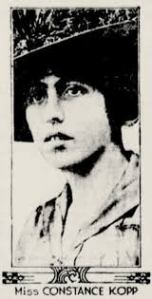
The real Constance Kopp

Despite the fact that she’s a woman and the year is 1914, Constance sets out to right the wrong that was done to her family. And that’s where the fun begins. With the help of the local sheriff, Constance pursues justice relentlessly–despite bricks through her window, a break in, and threatening letters. And as she works with Sheriff Heath, she comes to realize what so many of us do–she wants more. She needs something to fulfill her beyond the garden and taking care of the house. The sheriff respects what Constance cannot acknowledge: her sharp mind and quick wit.

If this was just a sweet novel about old-time justice and independent women at the turn of the century, the story would be satisfying enough.

But writer Amy Stewart based her book on a true story. Yes, Miss Constance Kopp did indeed exist–and became one of the first female sheriffs in the U.S. You can read more about her and see archival documents on the author’s website.

And you know what’s even better than this fun novel? There’s a second in the Kopps Sisters Series, Lady Cop Makes Trouble. You can be sure it’s on my TBR pile.

The Winter in Anna (NetGalley)
Reed Karaim
W.W.Norton & Company
release date: Jan. 17, 2017

… she carried her damage like a faint shadow across even the brightest day … This beautiful woman. This friend.

We all of us have a secret, I’m sure. That one secret that hovers like a dark shadow, dimming ever-so-slightly even our brightest moments. the winter in annaDay after day it trails in our wake, sometimes even touching our dreams as we sleep. Even in those moments when we are most fully alive, most deeply in love, most wildly creative … there it is, seeping in at the edges of our happiness.

I have one. And so did Anna.

Eric leaves college one semester short of graduation, taking a job as sports editor for the The Shannon Sentinel, a small town weekly in North Dakota. “Editor” is probably a stretch–his job is to cover high school sports, which he does with aplomb. And “taking a job” is really just another way to say that Eric was on the run. From a girl. From a life of tedium. From boredom. The staff is small: the publishers Art and Louise Shoemaker (who have a secret of their own, by the way), the front-desk clerk Edith, Eric, and the copywriter, Anna. Eric isn’t on the job more that a few weeks when he’s promoted to editor. It’s then he and Anna begin working together more closely–and it’s then he becomes friends with the beautiful single mother who changed him profoundly.

Eric comes to love the wide Dakota country and the open-hearted people who live there and he tells their story well. Anna and Eric are a team. They cover stories together, put the paper to bed each week. He teaches her to develop photographs.  And there’s pool at the bar on occasion, a carnival in town, the rare party with friends. Drives in to work together when her unreliable car is broken down. Their lives are worlds apart–in age, education, family–yet they become good friends who depend on each other. This is no love story. Or is it?

Eric notices her wrists first. Usually covered by long sleeves, no matter the weather, he sees she’s hiding two white scars encircling her wrists. As their friendship deepens, he learns bits of her story. The unplanned pregnancy. The teenage marriage. The drinking. Abuse. Those are the easy parts of the story to tell. The harder part to tell is her secret, and she saves that when she knows Eric is leaving.

The story opens with news of Anna’s death years later, so there’s no spoiler here. That she kills herself is also no surprise, once we know the pain with which she lived. Indeed, even Eric doesn’t know what to believe about her death. “No one had held the bright possibility of existing fully in each day more than she had. No one had seemed to defy the idea that our future is written in our past more than Anna … so I’ve decided to write this … and you tell me if I have written a tragedy.”

Writer Reed Karaim’s novel–of what holds us captive, of those secrets that bind our past and our present, of reinventing ourselves–is both a mournful and beautiful elegy Anna and the life she lived as best she could.

Girl From Venice
Martin Cruz Smith
Simon & Schuster

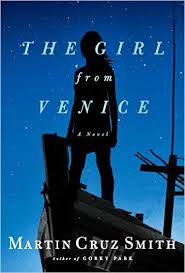
I’ve said it before–I’m a reading snob. No chick lit. No crime. No mysteries. Except when I read Lawyer For the Dog, Girl on the Train, or a girl from veniceFlavia De Luce mystery. And it goes without saying I’m not enticed by bestsellers–but then a title will make me so darn curious I must read it, like Sycamore Row did. So of course I’d never read “the master of the international thriller” Martin Cruz Smith, he of Gorky Park fame. Right?

Wrong. I guess I’m nothing if not inconsistent!

The time: World War II; the place: Venice. A humble fisherman, Cenzo, drags in the dead body of a young woman, the same night his boat is intercepted by a German gunboat. Except the mysterious girl Guilia is not so dead after all–turns out she’s a Jew running from the Nazis. Her life has been far-removed from Innocenzo Vianell0’s. While he’s been casting nets from his boat Fatima, she’s been lounging in a cabana on the Lido. Cenzo spends his evenings drinking grappa and playing cards with friends, while she’s dined at the Excelsior Hotel and played the casinos. Their lives were worlds apart.

And yet, Cenzo, who up until this point has been adamant about steering clear of all things political–a hard thing to do in the middle of a world war–is drawn to help the beautiful young woman he rescues. For a time he hides her in plain sight, teaching her to fish, and eventually finds a way to smuggle her to safety. When he doesn’t get word from her, Cenzo begins to wonder if she is in danger.

Complicating matters is the arrival of his brother Giorgio Vianello, a famous Italian movie star who makes propaganda films for Mussolini. Giorgio might very well be working with the Germans … or could he be working for the partisans? There’s bad blood between the brothers and Giorgio starts sniffing into Cenzo’s business, sensing there’s something not right with his story about the “young boy” he took on as crew.

The story has more than a few chase scenes, a stolen airplane, gold ingots, and movie stars. Throw in a love story and a family secret, and you’ve got a fast-paced story that has made-for-movie written all over it. The Girl From Venice is a war-novel-love-story-family-drama type of read that will appeal to many. It did me.

To Capture What We Cannot Keep
Beatrice Colin
Macmillan

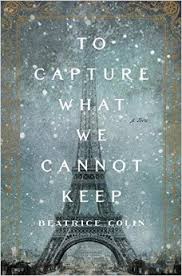
to capture what we cannot keepBeatrice Colin’s new title To Capture What We Cannot Keep tells the story of the building of the Eiffel Tower and a love that almost wasn’t. Caitriona Wallace, a young widow, is forced to find employment after her husband’s estate dwindles, and it’s either work or the poor house. It’s Edinburgh, Scotland, 1895, and her choices for employment are slim. So like many gentlewomen, she becomes a chaperone for brother and sister Jamie and Alice Arrol, who are about to embark on their Grand Tour of the continent. The young people are social climbers, but naive–and, to Cait’s sensibilities, a little gauche in their overreaching. Jamie and Alice have any number of mishaps, spending more money than they should, eluding their chaperone when they shouldn’t, and sometimes falling in with the wrong company.

But the real story is Cait’s–and how she came to love one of the engineers working on the tower, Emile Nouguier. Although immediately attracted to him, Cait resists his attention even as she looks forward to their time together. Young Jamie sets his sights on Emile for his sister’s suitor (Alice is in France to find a husband, after all) and Cait serves as chaperone, all the while fighting her affection for Emile. You won’t need a spoiler alert, but this is fiction geared towards women readers–and most won’t be disappointed in the ending.

For this reader (who took German in high school, much to her grandmother’s consternation: “French is the language of literature, Laurie!”) I found the place names a bit overwhelming. And there were a lot considering the story was set around the building of the spectacular monument. I also realized I knew very little about the Eiffel Tower. But learn, I did. I had no idea the Tower had levels with restaurants and shops–I thought it was like a giant erector set project. I didn’t know that Eiffel’s company also had a hand in building the Panama Canal, until the French effort went bankrupt. Like I say, it’s a good book that will push a reader into a little research to find out more about the characters and events. And that’s just what I did.

To Capture What We Cannot Keep is written in the tradition of other historical novels which fictionalize the lives of famous people, so readers of The Aviator’s Wife and Circling the Sun will not be disappointed.

Where’d you go, Bernadette
Maria Semple
Little Brown

Chick lit plots and characters are like so many cut-out cookies, after a while. You’ve got the caterpillar career girl, the stuck-up (but oh-so-handsome) object of her affections. The mishaps. Enter heart-of-gold True Love to sweep her off her feet. The same can be said of YA fiction, except you substitute “misfit” for “career” and throw in some parent angst and maybe a little bullying. Maria Semple’s Where’d You Go, Bernadette defies both categories. It could be chick lit, could be YA–but what I’m certain of is that the story is inventive and fun. The New York Times called it “divinely funny”, John Green, “A moving, smart page-turner,” and both were spot-on. where'd you go Bernadette

Bernadette, an LA transplant living in Seattle, was once America’s girl-architect phenom. Now she’s all but agoraphobic, living in an historic home for wayward girls she’s tried to thought about making into a home for her family. Bernadette has been hiding from the world for twenty years and thinks she likes it that way. (Her feuds with the stay-at-home moms at her daughter’s exclusive school and her rage at all things Seattle might lead the reader to come to another conclusion about her happiness, however.) Daughter Bee was dearly conceived and barely survived a life-threatening heart defect at birth; her first few years were touch and go. Bee is a gifted young woman with a heart of gold and a wit that’s sharp; she has soared through her first eight years of school and is on her way to Choate. Dad and husband Elgin Fox is a whiz at Microsoft and rarely at home. (If Semple is to be believed, I did learn that the Microsoft culture is creepy.)

There is conflict aplenty in Where’d you go. A battle royale with a neighbor–actually make that two neighbors; Bernadette has issues with people. An admin (that’s an administrative assistant in Microsoft speak) who’s also a home-wrecker. A house that has boarded off rooms and blackberry vines growing up through the floorboards. Top it all off with a trip to Antarctica that no one in the family really wants to take except Bee. Oh, and did I mention Bernadette that does her shopping and appointment making via a virtual assistant from Delhi, India named Manjula?

Now these unconventional characters also deal with some pretty serious matters and when Bernadette disappears (that’s the “where’d you go” part) I was a bit worried that the novel would take a U-turn and end up in A Lesson For Modern Times territory.

But no worries. It’s madcap. It’s zany. And you’ll smile the whole way through this read, I guarantee.

sycamore rowFor at least November, I ordered up a few things I everyone else had read, but me–I’d been too busy reading advanced copies. It was time for a little vacation from those DRCs and how I’ve loved having books in my hand again–ones with real pages I can fold down to mark my spot (yes, I’m that person!) or lie face down opened to the page I left off (I can hear the groans now…). The sight of a TBR stack that’s paper, not digital sets my heart a pitter-patting. I loved cover art right in front of me. Or maybe it’s just all that color–my Kindle is a basic e-reader, black and white, with no frills.
So what have I read on this little reading vacay? I did proper reviews of My Grandmother Asked Me to Tell You She’s Sorry and News of the World. Keepers both. I read Girl Waits With Gun which was a hoot–and deserves its own proper review sometime soon.

For fun I’m reading John Grisham’s Sycamore Row. I do like a good John Grisham once in a while (and I’ve learned it doesn’t pay to file a class action suit, so there’s that)  and this one’s got it all. Race, class, good cops lawyers, bad cops lawyers, a hand-written will, and $23 million on the table. Predictable, but very readable.rosie

I am either proud–or ashamed–to say I’m probably the last person in the U.S. to read The Girl on the Train. And it was just what I needed it to be: a compelling, yet undemanding story I could let unravel. It lived up to its Gone Girl comparison, but with characters I didn’t find repulsive.

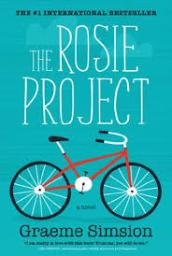
And oh my goodness! The Rosie Project was the dearest thing I’ve read in quite some time. A sweet little nugget of a book, like finding that chocolate caramel when you were expecting a raspberry creme. Once Thanksgiving break begins, I’ll bring out Where’d You Go, Bernadette. The New York Times called it “comedy heaven” and I’m holding them to it.

It’s been a fairly relaxing reading vacation so far–but time again to return to the work-a-day world of new releases.

My Grandmother Asked Me To Tell You She’s Sorry
Fredrik Backman
Simon & Schuster

my grandmother asked me to tell you she's sorryI was enchanted by Fredrik Backman’s A Man Called Ove and Brit Marie Was Here. But with features in the New York Times and thousands of reviews on Amazon and Goodreads, there’s probably not much left to say about My Grandmother Asked Me To Tell You She’s Sorry that hasn’t already been said. (And, yes, I did read them out of order!) So, instead, I’ll tell you why I’ll remember Elsa and Granny and the wurse and the Monster and Halfsie for as long as I have memory.

I’ll remember that there is something elemental (dare I say spiritual?) about the longing of our hearts for story. That we often make sense of the world around us through story, and sometimes the most important Truths we learn are fiction. I’ll remember that some of us understand ourselves more deeply by meeting people who don’t exist and live in places that can’t be found.

I’ll remember that sometimes a Love just doesn’t fit any longer. When worn every day for however many years, its elbows thin, the collar frays. We grow and stretch and one morning we try to slip Love on for yet another day and the buttons don’t close over our belly. The sleeves hitch up above our wrists. And the Love that was once such a delight to wear and fit so very well … just doesn’t.

I’ll remember that grandmothers have been given the precious gift of the Do Over. We can adore our littles unabashedly, but still push them (sometimes hard, even) and not suffer the estrangement that so often divides parent and child. Sometimes grandmas regret choices they made or words they couldn’t take back with their own children. “Mistakes were made!” they cry out. And grannies hope that the hearts of those grownup children start to soften (just a little even) in the presence of the love between grands and little

So there you have it. A grandmother who made amends as only age could allow and a little girl who learned love never really leaves us in a story that was more real than not.

I’ve amused myself with this little blog for eight years now. For most of that time, blogging was a delightful diversion, a pastime for those long summer days.

And then suddenly, it wasn’t.

Thinking I’d been bitten by the blogging bug, I saw blogging conferences in my future and read everything I could about the business of blogging. I poked around the sidebars of blogs I read for book bloggers who were of my own heart. (Networking, I learned, was key.) I hemmed and hawed about participating in blog hops and challenges. Then I bought a StudioPress template and my domain name and migrated from Blogger  to a self-hosted site. I even hired a web designer to help with the back-end technicalities about which I knew nothing.

writer

@Petr Kratochvil

And then I realized that what I really wanted to do was simply write. Now if I’m a picky reader (which I am), you had better believe I’m an even pickier writer. Writers are Anne Tyler and Paulette Jiles. Fredrik Backman and Alan Bradley. Barbara Kingsolver, for goodness sake! But word by word, paragraph by paragraph my thinking shifted. I found I wasn’t as interested in developing my brand as I was in playing with words. I didn’t want to market myself as much as I wanted to get the characters who have played in my head for so many years on the page. I took one Writing Workshop, then another. I attended Sunday morning Writing Circles. And every now and again I’d think oh-so-tentatively, “I’m a writer.”

Because a writer, after all, is someone who writes.

So write I will. No more and no less. There will be no e-books or POD books in my future any time soon. I won’t be distracted with my Klout score or scramble to get my post on Medium. For now I won’t worry about missing out on yet another NaNoWriMo–I’ve got bills to pay, papers to grade, lessons to plan. Because does the world really need another novel, or do I just need to write?

Those characters who’ve lived in my head? They’re making their way onto the page, peeking out every now and then from a workshop piece. It’s slow going, but there’s no rush. I only need to write.

With special thanks and gratitude to Emily and Pat and Brenda who helped me draft my way.


Thanks for reading! To return to the FICTION WRITERS BLOG HOP on Julie Valerie’s website, click here: http://www.julievalerie.com/fiction-writers-blog-hop-oct-2016