This is my symphony

What I read & what I lived …

If you grow up in West Michigan, summer evenings are a time to pile into the car and head to The Lake with Mom and Dad to watch the sunset or walk the pier or maybe visit the Musical Fountain. The trip might involve a picnic–or you might leave right after dinner–and there was usually ice cream promised at the end. These aren’t those beach days spent chasing waves and building sand castles and Mom trying to keep the beach blanket sand-free. No, these trips are short and oh-so-sweet and just right for strolling.
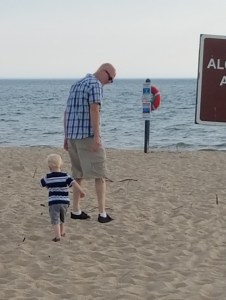
This week we spent an evening in Grand Haven walking the boardwalk along the channel with my two-and-a-half-year-old grandson Jonas and his sister, ten-month-old Alexis. Oh, my. To see the ordinary through the eyes of a toddler! What is so familiar to us adults is a wonderland to a child–especially on that first visit when memories become tucked away for a lifetime.

Turns out that when we talked about all the big boats he’d see, Jonas assumed that he could hop on the boats that lined the channel, a bit of a disappointment–but there were Pronto Pups on a stick (he ate the breading and left the hot dog) and his own bag of chips (a treat!) and kids to chase rolling down the grassy hill, so it was all good. We stopped to watch a fisherman wrestle an enormous catfish onto the bank. Jonas tried to clamber over the breakwall boulders any time he heard “mokorcycles” roar by, and he ran off excitedly to see the “tiny barn”, actually an ice cream snack shack along the way. He rang the giant Coast Guard bell–does it get any better than that? And little sister? She watched, ate cheerios, had a bottle–just took it all in, waiting for the day when she, too, is mobile and can join him in the fun.
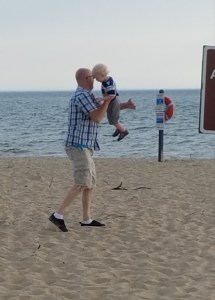
The two photos on the right are my favorites–a boy and his Boop.
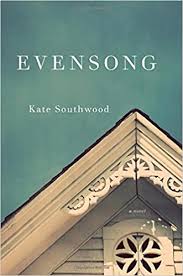


Evensong (NetGalley)
Kate Southwood
G.W. Norton

evensong by Kate SouthwoodLast December my money market company sent me a cheery email reminding me to file for a required distribution–they also told me my estimated life expectancy was 27.5 years. Merry Christmas to you, too, Fidelity!

Still, as I approach the end of another decade, I find myself looking back on the years and wondering. And I’ve got a lot to wonder about. My children, for instance. Miscarriage. Divorce. My difficult father. His death. Addiction. Estrangement. Don’t get me wrong–there have been more moments of joy than not. Days on the front steps watching the kids play in the sprinkler. Meeting the love of my life. Sitting in a candlelit cathedral every Sunday. Camp fires and beach days.

It’s those difficult times, however, that have pushed and prodded me to snap out of any Pollyanna daydreams and get on to the business of reorganizing and rearranging my life. The process is painful … and bittersweet.

The main character in Kate Southwood’s new novel, Maggie Doud, is right there with me. She’s in the hospital after a heart attack and must come to terms with her frailty, the approaching end of her life, and the relationship she has with her daughters Joanne and Lee. Adults now, their relationship is fraught with the resentment and rejection. The girls compete fiercely for their mother’s love–Joanne by being the best and brightest, Lee by being conciliatory. Maggie sees her daughters “circling each other to work out everything they need to know before I die … because they still haven’t realized that I’ve been circling myself all these years, trying and failing to be brave, trying to riddle out the truth of it and portion out the blame in all the places it should be.”

As so often is the case in women’s lives, they can trace the source of their brokenness to a cruel and calculating husband and father. Maggie’s husband Garfield was handsome and successful, but also bellicose and controlling. Maggie forever wondered why he had chosen her–a quiet, even timid, girl who had always lived in the shadow of her more beautiful and outgoing sister Estelle. (But of course any woman who has experienced a controlling husband knows they often target those of us who are young and shy because we’re that much easier to manipulate.) Garfield left Maggie a widow when the girls were teenagers. And although his death freed them from his demands, his presence shadowed them for the rest of their lives.

As she recovers at home cared for by her granddaughter Melissa, Maggie comes to terms with her relationship to her daughters and tries to make sense of her life with Garfield. As Melissa adjusts Maggie’s pillows, tempts her with food, and massages her feet with Jergens, Maggie thinks, “I want to tell her not to be afraid. That her life will change, that everything will change and change again and it will seem sometimes that she is adrift, but she won’t be.”

Her days finally moored in the home she loves, Maggie Doud reconciles her past–and that blame she’s been riddling out is finally put to rest.

I only hope I’m as lucky.

The Last Days of Cafe Leila (NetGalley)
Donia Bijan
Algonquin Books

When I was in high school, I read Thomas Wolfe’s You Can’t Go Home Again in junior English. I don’t remember much about the novel except for its melancholy. And I’m guessing I’d appreciate the novel much more now that I’ve lived a few lives myself. But the title has always stayed with me, and I thought of it immediately after turning the last page of Donia Bijan’s beautiful novel The Last Days of Cafe Leila.

Set in Tehran, Iran the novel follows the Yadegar family from the 1930s through the revolution and on to present day. Zod inherits Cafe Leila from his parents and it is the social center for his Tehran neighborhood and beyond. (Zod also inherits a wife from his brother, but that is another story.) The food is exquisite, the staff warm, and all are welcome. The revolution in 1979 changed life in Tehran. Sensing impending danger, Zod sent his two children Noor and Mehrdad to the United States to attend university. Thirty years pass before Noor returns home, impelled by a crisis–her husband’s infidelity–and dragging along her teenage daughter Lily.

Noor wraps herself in the comfort of her childhood memories as she helps run the cafe and tends to Zod whose health is failing.  The food, her childhood bedroom, her beloved nanny all ground her again–and eventually transform her relationship with Lily. And perhaps because of the solace Noor finds in the Cafe Leila, she decides to stay.

Except you can’t go home again.

Too much has changed, and try as she might, Noor can’t deny her American sensibilities. How else to explain her outrage at the acid attack on a young girl Lily befriends? Or the assertiveness that turns dangerous when she is stopped by the police? Noor might very well love her childhood home, but she surely can’t live there any more. The country has changed; she has changed.

And of course there is the food. The novel is, after all, set in a cafe, so there is no shortage of exotic smells and spices and Persian dishes. We have this: Zod “filled the pockets [of featherlight brioche] not just with beef and onions, but peach jam, saffron rice pudding …” And this: “He soaked prunes and took out meaty shanks to roast with onion for plum soup. he shaped chickpea patties, strained yogurt, and stirred quince custard.” Amber Darjeeling tea stirred with honey. Pomegranate juice.

The Last Days of Cafe Leila is a beautifully written love letter, evocative and moving–a story that transports the reader to a time and place that won’t soon be forgotten.

Hope is the thing with feathers

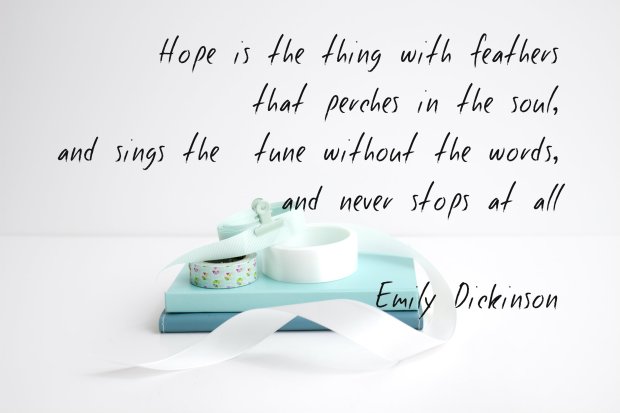
For the past few years, I’ve posted a shout out to National Poetry Month, but April almost got away from me. I’ve written about my love for Spoken Word here and a serendipitous poetry reading here. This year, I’m offering up a few lines from my favorite poem by Emily Dickinson, 314. (In fact, it’s such a favorite I’ve been planning a tattoo of the first line for several months now.)

If you’re not a reader of poetry, these suggestions published for National Poetry Month by the Academy of American Poets will help you dip your toe into a few poems. If you’re a little put off by poetry, don’t be–there are few, if any, rights or wrongs. Forget what your freshman English teacher told.

Just read!

Diet Land
Sarai Walker
Mariner

There may not be a woman in the Western world who hasn’t, at one time or another, had an issue with her weight. I know I have. For years I was too skinny. Then just right. Finally got a little-meat-on-my-bones okay. Putting-on-some pounds-better-watch-it. Downright overweight. Plenty has been written about The Struggle.

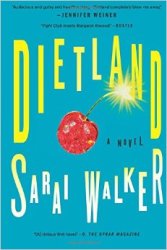
In her first novel, Dietland, writer Sarai Walker dives head first into empowerment and body image. (For women, that is. Do men even think twice this stuff?) Before I get too far into writing about Dietland, let me say it’s not for everyone. Walker’s characters curse plenty and slang is used instead of proper anatomical terms. There are descriptions of porn and a little self-pleasuring goes on. There’s also some pretty graphic descriptions of men who have been kidnapped and murdered. So this is where you decide whether or not to bail or read on. But unfiltered though it may be, Dietland covers some important territory.

Plum Kettle has tried it all since she was sixteen. Waist Watchers.  A famous diet of frozen meals and pills supplemented with meetings of evangelical proportion, called the Baptist Plan after founder Euylayla Baptist. Nothing has worked. Now pushing thirty, Plum is awaiting bariatric surgery. She’s apprehensive, but after a life of dieting, willing to take the risk. Plum works from home answering emails for a ‘tween beauty magazine Daisy Chain, spending hours a day responding to girls’ questions about cutting, small breasts, creepy stepbrothers, and more. When editor Kitty Montgomery calls her into the office one morning, Plum falls into a rabbit hole of revolutionary feminists whose goal is to bring the system down. Some of the revolutionaries are social justice workers with a positive, albeit radical, outlook–and others, not so much. (Which is where the kidnapping, murder, and dismembering–usually with the emphasis on “member”–of those men comes into play.)

Plum’s first awakening is to let go of her obsession with food–instigated by an offer of $20,000 if she follows a transformative “diet” plan suggested by Verena Baptist, daughter of the late weight loss guru. Plum finds community at a women’s cooperative. She sleeps (and eats) a lot. She develops a fashion style. Plum, like so many women who finally come to terms with their bodies, recognizes she needs to change from the inside out.

Walker alternates the stories of the characters’ present with their past–and we discover that even the women who resort to violence are driven by our culture’s misogynist response to them. Dietland is a difficult book to read in many ways–one that tells the truth, but tells is slant, as Miss Emily Dickinson would say.

If you’d like to pair your reading of Walker’s fiction with a good memoir, be sure to read Half-Assed by Jennette Fulda. Plum and her feminist band would love Fulda’s honesty, wit, and sass–I know I did.

So there you have it. Feminism and weight loss are not mutually exclusive. I know–because when my own weight loss was an inside job it was empowering, not repressive.

The Shadow Land (NetGalley)
Elizabeth Kostova
Ballantine Books
release date: April 11, 2017

I’ve never read horror –or monster–stories. (Except I do love my Frankenstein!) Most teens go through a scare-the-wits-out-of-me reading phase, but not me. So you wouldn’t think I’d fall for a book about shadow landDracula, but I did. And let’s face it. The Historian got so much buzz when it was published, how could I not? The adventures of Paul and Helen searching Vlad the Impaler’s burial place in Bulgaria and Budapest–the mountains, the monasteries, the countryside–were just as thrilling as the tales of Dracula. The novel was myth layered over history layered over politics and even at 647 pages I didn’t want it to end.

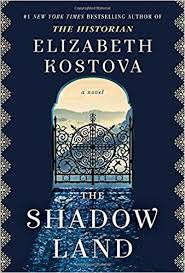
So I was so excited to get an advance digital copy of Elizabeth Kostova’s third novel, The Shadow Land. The publisher’s blurb said only that a young American in Bulgaria is left holding an “ornately carved wooden box” and inside? “… an urn filled with human ashes.” The girl, it seems, mistakenly takes the bag of a handsome gentleman she bumps into in a taxi line. Sounded to me like I might go on another romp to Vlad’s stomping grounds–could this be another (true) vampire story? Because, remember, at the end of The Historian, the narrator gets a small velvet book that isn’t hers …

But no. This is a story about that American, Alexandra Boyd, and her attempts to return those ashes. She’s befriended by taxi driver Bobby Iliev, who drives her from the city of Sofia to a monastery to the mountains to another village … and they’re always just behind (or maybe it’s ahead of) the Man Who Lost His Bag. Kostova alternates several tales: the race to return the ashes, Alexandra’s childhood, Stoyan Lazarov (he of the ashes), and, eventually, Bobby’s background. The only horror in the novel is the horror of Bulgaria’s past as a Soviet bloc country. For my reading taste, it was a patchwork of stories that never quite came together. And, sadly, didn’t hold my interest.

I’ve become quite familiar with the disappointment of reading books that don’t meet my standards for good storytelling. So I think what bothers me the most is this–was my dislike of Shadow Land based on the story itself–or the writing–or the fact that for months I had been anticipating a return to The Historian? It’s happened before. I was captivated by The Thirteenth Tale and then aghast at Bellman & Black. (Maybe “aghast” is a little strong … ) If you read enough, you’ll read plenty of clunkers.

The Shadow Land will be released on Tuesday, April 11, and I’m impatient to read what other reviewers have to say. Who knows? Maybe it’s just me.

He waited in staging, number 24 whitewashed on the back window. A ’65 Plymouth. Powder blue, white top. He’d wrenched and torqued and greased every inch under the hood. He was ready. He figured he’d at least get 85 out of her. Maybe 90 if he timed his shifting just right. The Tree held at yellow, then flashed green. He popped the clutch, started down the straightaway, then doubled it into gear. Too much, too soon. “Damn!” and it was over before he could figure out what had gone wrong.

The flagman dropped the red and he pulled off the track until his next run.

Weaving through the crowd, he looked for her. She was still in the stands, he hoped. She hated the race track. Hated spending every Saturday night under the lights, under a cloud of gas fumes. Hated the sound of tires peeling off at the start, the heat of the blacktop, the dust hanging heavy.

GmanViz@Flickr.com

He found her, finally. Sitting at the top of the stands as far away, it seemed, as she could possibly get. Her hair fell over her face and when he called her name she quickly slid a paperback under her leg and looked up.

“Oh! All ready?” she asked.

“One more–I haven’t qualified.” He knew she wasn’t counting. Probably hadn’t even watched him, but she smiled.

And he carried it with him, warm and radiant, as he found his way back to the Plymouth. Pulling the car around to the start again, he waited.

[The flash fiction “The Drags”, 2016 draft, appeared first on This Is My Symphony.]

Hello Bicycle (Blogging For Books)
Anna Brones
Ten Speed Press

Six years ago I treated myself to a new bicycle. I read reviews, talked with biking friends, browsed online, and finally went to a local bike shop to make my purchase. It was the Real Deal: a shiny black and chrome city bike. I was in love. Twice a week I rode two miles to the Farmer’s Market, packed up my saddle baskets with goodies, and pedaled back home.  I biked to the library. To neighborhood association meetings. And sometimes up to a nearby technical high school just to delight in the winding roads of their campus.
This little gem by Anna Brones, Hello, Bicycle: an inspired guide to the two-wheeled life, makes me long for those lazy summer days when I can get pedaling once again. The book definitely isn’t for the snooty serious rider–those spandexed, be-numbered riders with calves of steel who hunch over handlebars like it’s the Tour de France. Rather, it’s for the rider who might still be a bit daunted riding in traffic and is just getting used to having helmet hair. Hello, Bicycle is like sitting down with a chatty friend who has a few good tips to share. You know, the kind of friend whose enthusiasm is so catching you can’t resist joining their latest adventure.

There are tips I’d put in the everyday advice column: wear a helmet, pack a rain jacket, use bike lanes. And then Brones turns into that chatty friend I mentioned. She oh-so-casually-like-it’s-no-big-deal writes about touring and slow rolls and S240s. Before you know it, I have the Peterson’s Official S240 Packing List” asterisked, as well as arrows drawn on the page “Pantry and Kitchen Essentials for Cyclists.” Who do I think I am?! My longest ride has been all of five miles. But that’s just it–Brones makes it seem doable for even the novice cyclist. Add James Gulliver Hancock’s cute illustrations and catchy graphics, and Hello, Bicycle is both a how-to manual and an inspirational all-in-one. (The photos on this post are from the illustrators website.)

In my own Great Lake state, we’ve put winter behind us. The robins arrived a few weeks ago, and days have lengthened. The snow is long gone (we hope!) and the littlest bit of sunshine has us swapping out our down jackets for windbreakers. I’ve a mind to take my bike out of winter storage this weekend. Hello, Bicycle would be the perfect gift for Someone Special who is thinking about getting back in the saddle seat or who has that new bicycle and is ready to roll.

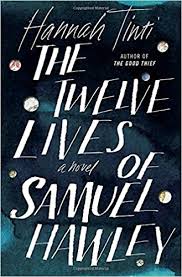
The Twelve Lives of Samuel Hawley (NetGalley)
Hannah Tinti
Dial Press
release date: March 28, 2017

The story opens with Samuel Hawley teaching his twelve-year-old daughter Loo how to shoot a rifle. While she knew not to touch tThe twelve lives of Samuel Hawleyhem, guns were part of the backdrop of her life, hidden all over the house and cleaned nightly at the kitchen table. Her father never left the house without one, and he was always “listening for something else … always watching. Always waiting.” So it probably shouldn’t surprise the reader to learn that those twelve lives referred to in the title parallel twelve bullet scars that Samuel carries.

For as long as she can remember, Loo (short for Louise) and her father have rarely stayed in one place longer than a few months. They’ve crisscrossed the country in his truck, settling down in hotels long enough for her to attend school, often picking up and moving on before the year is over. They live on ramen noodles and take-out Chinese, play card games at night. At each stop Loo unpacks her few belongings while Samuel sets up a shrine in the bathroom to her dead mother’s memory: a bottle of shampoo and conditioner on the edge of the bathtub; a lipstick and compact; a parking ticket, shopping list, and scribbled notes propped on the mirror. The “dead woman” we learn, “was an ever-present part of their lives.”

Samuel and Loo finally come to settle in Olympus, Massachusetts, her mother Lily’s hometown. A house in the woods, ocean fishing, grandmother nearby–it sounds almost idyllic after twelve years of gypsy living. But that grandmother won’t acknowledge Loo, and the girl is often in trouble at school. Samuel is shunned by the small town and at odds with more established fishermen. Alternating chapters between Loo’s present and Samuel’s past, writer Hannah Tinti uses the bullet scars to tell Samuel’s back-story. And it’s not a pretty one.

Since he was barely sixteen, Samuel has made his way in the world by stealing and killing. The loving father and grieving widower is a criminal on the run. (I tried to figure out a way to slant that fact–some way to tell the truth a little more gently–but there it is.) Samuel Hawley has delivered stolen goods and been a hit man. He’s a runner for mob types and has good reason for all those guns. It seems that criminals keep score.

Now I’ve never shot a gun, and I can hardly think of a situation in which I’d shoot one. I don’t like violent movies–even those that get critical acclaim. I’m a law-abiding school teacher. (How’s that for status quo?!) But I was riveted by The Twelve Lives of Samuel Hawley. Tinti created a character I loved, whose actions I despised … but maybe came to understand.

And as luck would have it, yesterday’s Weekend Edition on NPR featured an interview with the author that might also pique your bookish interest. Published this week, The Twelve Lives of Samuel Hawley is an engaging read.

Elle leaned against the fender of the Plymouth watching fireflies blink over the field across the highway. She had pulled onto the shoulder over an hour ago with a flat tire; it was nearly nine, but the air was still close. Her tank top stuck to her back where it had been pressed against the vinyl seat. She pulled her hair into a pony and rolled her neck.

Doug Kerr @ Flickr.com

Forty-five minutes to home and now she’d be later still. Sighing, she kicked a gravel from her flip flop and shifted onto her hip. A tow truck slowed on the other side of the median and pulled into the emergency turn-around. She waved and he flicked on his flashers. As the driver pulled up behind her, she straightened. Smoothed her hair for whatever reason. Wiped sweaty palms on her skirt.

“You gotta spare?” he asked. The name stitched on his pocket said Wayne. She’d called for a tow, knowing the spare was circa 2000, same as the car, and probably shot to hell.

“Cheaper to fix it than have to drive you to the station and wait until we find a new one.”

“Well try then, I guess.”

Fifteen minutes later she was on the road again, Wayne following her as he’d promise.

“You’re right. She’s a bugger,” he’d admitted. “I’ll follow as long as I can back towards town in case this one blows.”

Two exits before her own, Wayne flashed his lights. She saw him wave as he pulled off the exit, so she gave her horn a couple sharp “thank yous” and hoped he heard. Most of the time she used a fictional husband to keep mechanics (and electricians and plumbers) honest. But Wayne’s quiet smile and the careful way he made his way over made her drop her guard from the first.

“I don’t get it,” she had told him while he worked. “This is the second flat I’ve had in the past month.”

“Probably potholes,” Wayne said.

“Shouldn’t be–I drive to work the same way every day.”

“Well, then, maybe you need to take a different road.”


[The flash fiction “The  Spare”, 2016 draft, appeared first on This Is My Symphony.]