This is my symphony

What I read & what I lived …

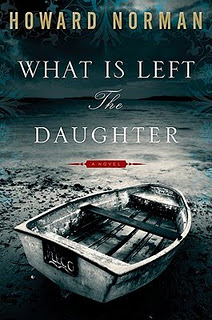
What Is Left the Daughter
Howard Norman

I chose this book, plain and simple, for the title. I have a kind of fascination with daughters, being one and all. And so it was with some disappointment that I realized the novel was really a father’s letter to his daughter, a daughter he had never lived with and hadn’t seen for twenty-some years. Now Wyatt’s story is compelling–I was just expecting a female protagonist. Set in Nova Scotia, I loved the bleak sky, grey sea, and heavy salt air that clung to every event and seeped into each character.

Wyatt Hillyer is orphaned at 16 when both his parents commit suicide, jumping to their deaths from bridges separated by only a few miles. Both, it seems, loved the same woman. (Now that got my attention!) Wyatt accepts an offer from his aunt and uncle to move to small town Middle Economy and become apprenticed in Uncle Donald’s tobaggon shop. Wyatt immediately falls in love with his (adopted) cousin Tilda in true unrequited love fashion. Tilda, intent on becomming a professional mourner, is preoccupied and hardly notices Wyatt. Tilda eventually marries Hans Mohring, a student from Germany, just as Canada poises on high alert at World War II’s advent.

Uncle Donald becomes obsessive about possible U-boat attack in Canadian waters–so much so that he and Aunt Constance separate, Uncle Donald moving into his workshop. Tragedy does finally strikes in the Northumberland Strait and sets the plot unraveling. Both Wyatt and Donald spend time in prison, baby Marlais (she of the “daughter” in the title) is born, and Wyatt finds himself seperated from Tilda by an ocean.

I must admit, though, that I struggled for over one hundred pages to keep reading the book–not because of any plot or character weakness, but because of the writer’s voice. The characters speech was quaint, overly formal, or maybe just Novia Scotian. It was off-putting. But I was so drawn to Wyatt and the setting that I let go the fight. And glad I am that I did.

Next up: Swamplandia! by  Karen Russell–so far, a bit John Updike-ish, which is not a bad thing!

The Coffins of Little Hope
Timothy Schaffert

Give me an octogenarian obituary writer–and one named Essie, at that–and you’ve got me hooked. And while it took nearly the entire book to figure out the title (and, quite frankly, I don’t really understand why it was chosen–although the wordplay was clever), I wasn’t disappointed. Essie Myles, twice-widowed, lives in small town Nebraska where she makes a family with her grandson and great-granddaughter. Essie (or Ess or simply S) writes her obituaries with the same attention of an investigative reporter. The novel pivots on Essie’s trying to ascertain whether or not young Lenore has been abducted and killed by her mother’s boyfriend–or whether the girl is merely an invention of her pitiable mother.

Spinning around Lenore’s absence is the story of Tess, a thirteen-year-old whose life is upturned when her long-absent mother returns; of Doc, whose job as editor of the County Paragraph hasn’t fit him since he tried it on after his beloved father died; of W. Muscatine, author of a series of gothic children’s books, who secretly corresponds with Essie while the town tries to ferret out who has leaked the series’ latest installment. If you love characters as Charles Dickens and John Irving love characters, you won’t be disappointed with Little Hope.

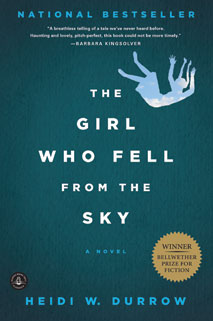
The Girl Who Fell From the Sky
Heidi w. Durrow

The review was glowing, the novel won the Bellwether Prize for Fiction, it was on Best Fiction lists for the year–and yet I passed over this one for months. I shouldn’t have. I’ll be honest–I like plots that haven’t been done before (although I suppose in some ways there’s even a brush of Hunchback of Notre Dame here) which is why the book appealed to me. Rachel Morse, 11-years-old, survives her young family’s murder/suicide: a jump from the roof of their Chicago apartment building. Rachel’s Danish mother had recently moved her children to the United States to be with her boyfriend, a man who has difficulty accepting her biracial children. Mourning the loss of her marriage to an African American GI, struggling to keep her alcoholism under control, homesick for Denmark–it was all too much. And now young Rachel must live with the gruesome truth that she lived because the bodies softened her landing.

As if losing mom and siblings wasn’t enough, Rachel is taken cross country to live with her paternal grandmother in Portland, Oregon. There, Rachel, light-skinned and blue-eyed, is immersed in black culture–her white mother and Danish roots never mentioned. Rachel’s quiet longing for what she has lost threads its way through her life as she grows to love (and, sadly, lose) vivacious Aunt Loretta and her activist husband Drew, and, of course, her demanding Grandma. The only biracial girl in school, she tries to find her place despite the taunts and teasing of other girls. Dare she reveal her quick mind and devotion to school? Can she hold on to the fragments of Danish sometimes surface–and tie her to her mother? Is she black? Or white?

Parallel to Rachel’s story is the story of the only witness to the family’s fall: young Brick. Devastated by what he saw, Brick becomes devoted to the memory of Rachel. He eventually leaves his addict mother on a cross-country quest to find the girl who fell from the sky. And it is their eventual meeting becomes the catalyst for both to heal.

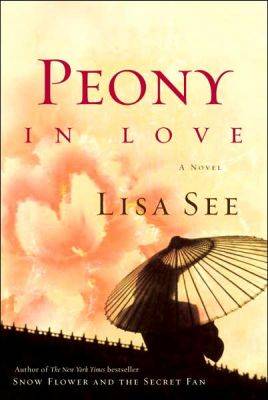
Peony in Love
Lisa See

[spoiler alert]

This was a quick Kindle purchase–I needed something light and breezy and  (in true Kindle fashion) I needed it now! Having read Lisa See’s Snow Flower and the Secret Fan I anticipated another story of love and friendship–and was eager to gain more insight into 17th century China.  I didn’t read a lot about the novel, but glimpsing the words “poetry” “opera” “rocky path of love” in Amazon’s synopsis, I was sold.

But a ghost story?! Really? I was (initially) so disappointed. Yes, Peony meets her true love, keeps it secret, becomes betrothed, mourns the man she could never have … and then proceeds to die before her wedding  to, you guessed it, the man of her dreams. I was tempted to end right there, a mere 7 chapters into story, but something kept me reading.

And in the end, Peony in Love was worth it. Here the reader gets a glimpse into to fascinating spiritual world of Chinese culture, the stages of death, the levels of the after-life. I have another layer of thinking about what might come next, something that has always drawn me to wondering. The image of Peony and her grandmother hovering, trailing behind on the shoulders of some beloved family member is both beautiful and comforting and I sometimes find myself wondering on whose shoulders I will drift.

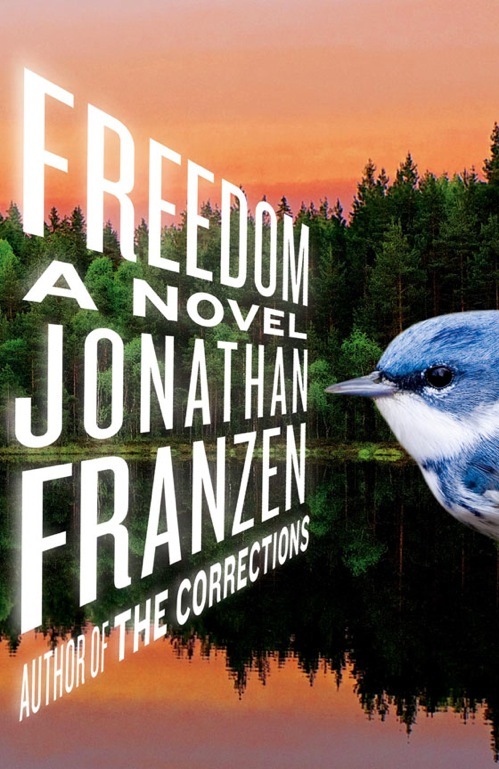
Freedom
by Jonathan Franzen

A few years ago, following the recommendations of almost every book reviewer, I opened Jonathon Franzen’s Corrections with high expectations–winner of the National Book Award; Time’s Great American Novelist. About 40 pages later, I was done. Now I’m no wimpy reader, but Franzen’s prose was dense and I didn’t feel that “Me! Me!” tug from the characters. A fellow English teacher, and an abashed Franzen fan, dropped the book off at my house saying, “No rush–whenever I got to it … ” Such a soft sell. After getting tired of  the 3 inch tome staring back at me from my reading shelf, I broke down. How bad could it be, after all?

Let me begin by saying that this time I finished the novel. And I’m actually quite proud of that because I was tempted many times to quit. Was the prose still dense? Yes–though maybe not so much. Did I feel that tug from the characters? Yes–although when Patty and Walter Berglund showed their true colors I felt hornswoggled. The summary in PW is accurate enough for anyone not familiar with the story: two young liberals build an idyllic life together: model marriage, precocious kids, This Old House renovations–they had it all and did it all. Or so it seemed. But sugar-coating only cracks and crumbles under the weight of reality,and what lies beneath is often rotting. And so it was with Patty and Walter. Their lack of emotional intelligence led to repression, jealousy, betrayal, adultery.

I don’t need Pollyanna or happy endings. But I do need to feel as though characters I live with throughout a novel have some redeemable characteristics. And here I found none. After their lives collapse, both Patty and Walter try to reinvent themselves, but still find little happiness, and their reunion at the novel’s end feels thin. In many ways, Freedom was the twin of We Were the Mulvaneys by Joyce Carol Oates. But I left Oates’ novel satisfied at the family’s reconciliation and reinvention. I don’t know what I’m missing with Franzen’s novels, but I just don’t get it.

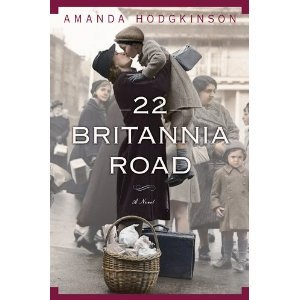
22 Britannia Road
by Amanda Hodgkinson

A book-loving friend of mine commented recently on my blog: “Don’t you like anything?!” But I think that reading with discrimination doesn’t mean I don’t like certain novels; it just means I tend to notice stylistic or plot devices that just don’t promote story. I am an avowed story glutton–give me a narrative that rings true any day. And in Amanda Hodgkinson’s 22 Britannia Road I found an almost perfect story.

Set during and immediately after World War II, the novel follows the Nowak family. Husband Januscz worked in the Polish underground and roamed Europe while his young wife Silvana and toddler Aurek stay behind (briefly) in Warsaw. But as the Germans and Russians advanced, they, too, left for the countryside. Both their experiences destroyed much of their hope for the future and left them far different people–Januscz loved again, and lost; Silvana lives an almost feral life in the forests of Poland. At the war’s end, Januscz miraculously finds his young family in a refugee camp and brings them to England–22 Britannia Road, to be exact–to continue their lives where they had left off.  But can they?

One of the things I loved about this story is that it was clear from the beginning that there was a secret of some sort–which I promptly figured out, then doubted, and finally learned the truth. Januscz’s desire to return to the family they once were was so very much like a man. Silvana’s distance as she tried to make sense of her past and present was so very much like a woman and her fierce attachment to their son Aurek made sense, given the horrors they had experienced. Or did it? (And so the secret begins to unravel …)

22 Britannia was a quick read because it was so compelling–I can’t imagine any reader unsatisfied.

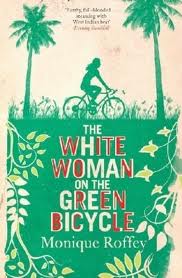
White Woman on a Green Bicycle
by Monique Roffey

The love story of George and Sabine Harwood begins as most love stories do: passionate and built on dreams. Their story ends as some marriages do: brittle, shattered, and, yet, somehow still connected. The whimsical cover threw me as I started the novel, which begins in the present with the 70-something couple leading lives separated by mistrust and alcohol. The caustic tone wasn’t what I’d expected. But a few chapters in, Roffey rolls back the years and we see George and Sabine arrive in Trinidad, fresh from England. They are on an adventure, young, and in love. But the heat oppresses one and invigorates the other, and the racial animosity thrills one and deadens the other. Their unraveling is bittersweet,  poignant–and only made more so when the author returns to the present at the novel’s end.

Private Life
by Jane Smiley

Margaret is a spinster, plain and simple. At age 27 her prospects are dim: she was a bit too plain, a bit too frank, and a bit too intelligent to settle. But when Andrew Early, a celebrated, yet eccentric scientist, arrives in town, Margaret’s wily mother Lavinia encourages their friendship. Confused at times by Andrew’s bizarre behavior, Margaret sets off with him for life in San Fransisco shortly after World War I. Margaret learns to play the dutiful wife, typing her husband’s book drafts, listening to his rants, enduring long nights alone while he researched. Initially bedazzled by her husband’s mind, Margaret eventually comes to recognize Andrew’s narrow-mindedness and paranoia. While she gains confidence and a wider circle of support, he is drawn into himself, seeing conspiracy at every turn.The novel could share a title with one of  Doris Lessing’s collections: We Are the Prisons We Live Inside.
 
Battle Hymn of the Tiger Mother (nonfiction)

Amy Chua

Book club selection for August–I read it in a day. Author Amy Chua wanted to raise her daughters as a Chinese mother would, not a Western one. Chinese child-rearing, Chua feels, engenders successful children who excel in school and music. Western parenting … lets just say we don’t come out so well, and most of the time, justifiably so. Chua came under incredible criticism when the book was published–mostly from those merely reacting to a sound bite. The book ends up being more a treatise on what not to do as we watch Chua and one of her daughters battle to what might have been the end of their relationship. Well worth reading and plenty of points to discuss.

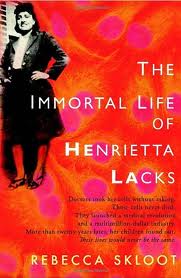
The Immortal Life of Henrietta Lacks
by Rebecca Skloot

In 1951, a researcher at Johns Hopkins Hospital, took a tissue sample from the cervix of Henrietta Lacks. She was indigent, African-American, and weeks from death. The cervical cancer she had been diagnosed with was a particularly virulent form, and Lacks spent her last days in agony. Those HeLa cells, as they came to be known, went on to change medicine, providing endless opportunities for research into cancer, polio, AIDS, and radiation poisoning. Quite a legacy–except for the fact that Lacks knew nothing of the tissue sample taken from her, nor did her family. And that is where the story of Henrietta Lacks becomes tragic and unforgettable.

To be sure, taking the tissue sample did not require Lacks’ permission. But her cells quickly became famous, behaving in a way that no cells ever had before: they survived and reproduced rapidly, making them the most-used cell-line in medical research. Lacks’ cells were the first cells ever mailed by the U.S. Post Office and they are cultured and stored in research labs the world over. In fact, author Rebecca Skloot estimates that nearly 50 million metric tons of the cells have been cultured, becomming a mult-million dollar industry.

Before Henrietta’s cells became immortal, she was mother, sister, wife, and daughter. Her laugh was said to be contagious, and her love of children legendary. As a child she lived on her grandfather’s tobacco farm, but later moved to Baltimore with her husband David “Day” Lacks. Henrietta dressed to the nines when she went out, loved to dance, and favored red lipstick and nail polish. She fed family and friends from a bottomless pot of spaghetti and meatballs. In short, Henrietta Lacks was more than HeLa–she was a flesh and blood woman who loved and lived in the embrace of her family.

Lacks’ family never learned of the HeLa cell line until nearly twenty years after her death–and even then the knowledge was clouded by misunderstanding and emotion. Her children, none of whom had much schooling, did not understand the most basic concepts of biology, and imagined their mother cloned or parts of her living on, enduring even more abuse at the hands of the medical community. When articles appeared about scientists fusing animal cells with HeLa cells, they imagined with horror that their mother was now a mouse-human. It was astounding (and perhaps horribly naive) of me to think that adults in the year 2000 would lack this understanding. The family also became outraged when they learned the cells were bought and sold–and that they never saw a cent of the profits. Indeed, sixty years after Lacks’ death, her family still couldn’t afford basic health care.

Skloot spent ten years writing the book, most of those years cultivating relationships with Lacks’ relatives, especially her daughter Dorothy. Dorothy suffered from high blood pressure, back problems, diabetes, depression, and perhaps bi-polar disorder. She was a handful, but Skloot was never condescending, and almost tender in educating Dorothy about cell structure and reproduction, and modern research science. Memorable also was Johns Hopkins researcher Christoph Lengauer, who brought Dorothy and her brother Zakariyya face-to-face with their mother’s cells in his laboratory; and Paul Lurz, administrator-cum-historian, who respectfully shared with Dorothy the fate of her older sister Elsie, who died in Crownville State Hospital. In a story filled with bad guys, these three were testaments to honesty and character.

I was shocked at the end of Skloot’s book–never saw it coming. The author used some of the book’s profits to set up a scholarship fund for the Lacks family, and in 2011, Sonny Lacks accepted an honorary degree in his mother’s name. A fitting postscript to an American tragedy.

tinkers
by Paul Harding

So much of what the blurbs on the back cover of tinkers relate is true; the novel is “elegiac”, “heartbreaking”, “compelling”. I would add meditative. Tinkers is beautiful, plain and simple, and the first sentence had me immediately: “George Washington Crosby began to hallucinate eight days before he died.” What follows is three pages of George “seeing” his house crumble around him, settling and sinking, tile by tile and brick by brick. As one whose mind nibbles around about the mystery that is death, whose husband works with hospice patients weekly, I found the descriptions of George’s death strangely comforting, although admittedly outlandish.

Harding strings the stories of George, his father Howard, and Howard’s father, the minister, like charms on a bracelet. The older men both harbor unmentionable diseases. Great grandfather slid into dementia, and slides out of Howard’s life, one day vanishing entirely. Years later, Howard, besieged with grand mal epileptic seizures, finds a brochure for a mental asylum on his wife’s dresser, and he, also, rides (quite literally) out of his son’s life. Both men wrote enigmatic observations about nature, baffling to the reader in sense–but beautiful and dream-like all the same. It is George alone who remains surrounded by his extended family at life’s end, breaking with his father and grandfather. All the men tinker in some way, Howard most literally as a rag and bone man. George tinkered with clocks and taught building trades; the minister tinkered with words. All were gypsies of a sort.

It is perhaps those lovely passages themselves that hindered me from falling headlong into tinkers. I found the passages distracting, interfering with the movement of the story. Perhaps that was Harding’s purpose? To blur the lines between narrators? Gorgeous writing. Satisfying characters. But while that may be the way of oh-so-unconventional and outre, the novel wasn’t as compelling as more traditional narratives–it kept getting in the way of the story.

[And who cares what I think, anyway?! The book won the Pulitzer Prize for Literature, so who am I to say?]

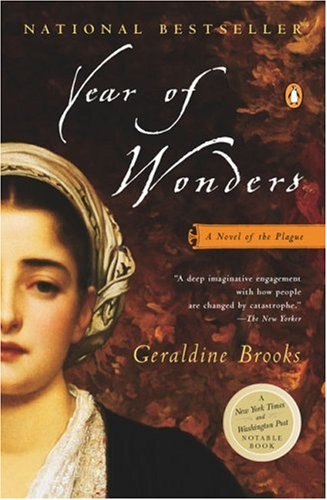
Year of Wonders
Geraldine Brooks

The year is 1666; a small village tucked in the English countryside welcomes a new lodger–George Viccars, a tailor from London. Viccars luxurious bolts of fine cloth, however, harbor the unseen “seeds” of the Plague. After his death, we watch the lives of the villagers quickly spiral into despair. Anna Frith, the young widow who took the tailor in, works for the rector of the village, Michael Montpellion. With Montpellion and his wife Eleanor, Anna nurses the sick, attends to the survivors, and helps bury the dead.

The title was misleading–I expected to read a novel where the horrific plague brought out the best in people, and bound them together in community and a renewed spirit of brotherhood. Instead, we have witch hunts, swindlers, religious fanatics, and, rather than grave robbers, a grave-digging robber who swoops in hours before a death and charges outrageously for a decent burial. I guess one’s true nature does surface during adversity. But through it all, Anna Frith somehow prevails, and, as she watches the world around her fall apart, tells her story with wisdom and insight. Eleanor Montpellion teaches her to read and becomes a fast friend, and Michael Montpellion relies on her courage and skill in nursing the sick.

Year of Wonders provides a fairly accurate (albeit cliched) look at England in the seventeenth century. My interest never flagged and the novel was a quick read. But I have to wonder why oh why contemporary writers insist on some sensational ending, one that isn’t in tune with the time, place, or character of the novel? Is it because a quiet, thoughtful story of grace and dignity won’t sell? I won’t put a spoiler alert here, but to say the far-fetched end of Anna’s story was disappointing is putting it mildly.

Currently reading : tinkers by Paul Harding; next up The Immortal Life of Harriet Lacks, our July book club selection.