This is my symphony

What I read & what I lived …

Seth Anderson@Flickr.com

Reading is always difficult for me during the school year–hours of grading and planning leave little time for recreation, and my exhaustion at 9 each evening doesn’t lend itself to reading more than a page or two. But I recently noticed a disturbing habit that has crept into my reading life. Because I have the New Yorker and some novels on my iPad Kindle app, I’m only a button push away from Facebook and Pinterest and blogs and Etsy and eBay and Amazon and email and … I’m guessing you get the idea. So the reading that I do do, takes considerably longer and I’m horribly distracted. Who knew this could happen to me, a lifelong reader and book hoarder?

So for a period of time (I don’t know how long) I’ve decided to go back to reading print only; my iPad will be in another room, not resting alongside me as it usually is. I’ve gone back to Elizabeth I (again!) and have a couple books arriving from Amazon tomorrow. For a while I’ll be turning pages, not swiping a screen. 

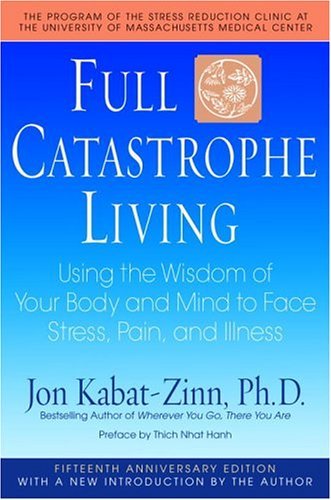
Full Catastrophe Living
Jon Kabat-Zinn

[Note to my readers: this post is a bit more personal than most of my book reviews.]

Nearly twenty years ago I was diagnosed with a chronic pain condition; almost ten years ago I sought treatment. For the most part I’ve dealt with it by alternately ignoring it, plowing through, or spitting in its face–whatever my response I would not give in and put a label on myself. I browsed some books on living with pain holistically over the years and did take a peek at Jon Kabat-Zinn’s primer Full Catastrophe Living. Almost just as quickly, I crammed it back into the store’s bookshelf: “My life is not a catastrophe, damn-it.” How much better had I known the back story, that Nikos Kanzantazaks’s character Zorba the Greek was the book’s inspiration. At one point in the novel, Zorba was asked whether or not he was married, to which he replied (roughly) “Am I not a man? Of course I’ve been married. Wife, house, kids, everything … the full catastrophe!” Life as full and joyous catastrophe.

And as I practiced yoga over the years, I also read my fair share of books on mindfulness and meditation. More that one teacher would begin the class with “meditation”, at which point I’d sit quietly and … what? Sit with my eyes closed. Sit still. I had read that meditation was supposed to help chronic pain, but this sitting business did nothing for me. Fast forward to a Facebook post by a local mindfulness center offering a meditation class that was also taught by my very first yoga teacher. And in the still, small center of my heart I knew it was time.

Kabat-Zinn is the founder and former director of the University of Massechuset’s Stress Reduction Clinic. Centered on breath work and disciplined practice, MBSR (as it is known) is now the gold standard for meditation programs. Full Catastrophe Living Part I explains the course in detail; Part II introduces the idea of mindfulness and describes the paradigm shift needed to deal with stress, pain, and dis-ease.  Throughout, the book is rich with testimonials from individuals for whom meditation was transformative. (There are two chapters on pain, both of which I’ve read twice–so far!)

I read the book in tandem with taking a course based on Kabat-Zinn’s program, taught by MBSR teachers, and while the concepts in the book are easy-to-understand, they are not as easy to practice. Guided mindfulness meditation CDs must be purchased separately–but it’s the “guided” part that is so critical to success, I think. While Kabat-Zinn explains the beginning practice of the body scan, there is no substitution for actually experiencing the sometimes grueling practice and being held accountable to your homework: 45 minutes of MBSR practice each and every day for 8 weeks.

Read the book. Maybe start with Part II to understand the philosophy behind the practice better. If you’re moved to begin mindfulness meditation, seek out a MBSR program to begin your journey with guidance and support.

As I read Full Catastrophe and began to practice sitting, I felt as though I was stepping into a flowing stream–the energy of mindfulness meditation swirled and eddied around and against every aspect of my own full catastrophe. And the pain? Suddenly, it’s not the point at all–the meditation seeps into your very center.

And it changed my life.

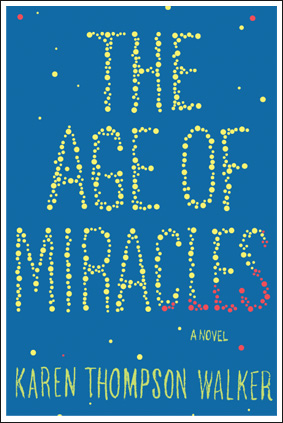
Age of Miracles
Karen Thompson Walker

My bookstore friend had a book for me–“imaginative premise”, she said, “I dreamt about it all night.” Then the suggestion that I just might want to consider it as a read-aloud for my classes. And she was right. Even the New Yorker raved about this debut novel in their August 6 issue, saying author Karen Walker “creates lovely, low-key scenes to dramatize her premise”–and it’s that premise that is so compelling. Imagine if the earth slowed on its axis, days growing longer, nights stretching on, magnetic field bending and twisting.

It was called “the slowing.” The world’s top scientists had no explanation, no solutions. In the beginning, all that could be done was to carry on. So eleven-year-old Julia–friendless, flat-chested, and still in so many ways a little girl–continued with the hell that was sixth grade. Her school adjusted start times by the day, trying to maintain the status quo; some neighbors slid into a new rhythm, gardening at midnight and sleeping at noon. Birds died in pairs or by dozens on lawns. Her mother began to stockpile food and suffer “the sickness”: fainting, insomniac, nauseated. Weather shifted and crops withered.

Finally, when light stretched on to nearly thirty-two hours, the president announced that Americans would revert to a twenty-four hour clock. And so Julia tells us, “light would be unhooked from day, darkness unchained from night”– clock time was enacted. Blackout curtains became an essential and sleeping pill use skyrocketed. Not everyone fell into step and “real-timers” began to slip away into the desert, building “shadow communities” that followed a circadian rhythm for this new age.

Through this chaos, Julia lives out her own age of miracles–she becomes fast friends with her crush Seth, watches her parents’ love ebb and grow, and always takes in the dying beauty around her. Karen Walker presents the unimaginable, the idea that the home we call Earth could come to a horrific end, through the eyes of a girl standing on the edge of promise and hope. It is Julia who just might give us a glimpse of why we are here: Though the pace of the slowing had slackened over the years, it had never stopped. The damage had been done, and we had come to suspect that we were dying. But … we carried on. We persisted … we told stories and we fell in love. We fought and we forgave. Some still hoped the world might right itself. Babies continued to be born. 

Miraculous

Stuffed
Patricia Volk

Family is what we first know of the world. Family is the world, your very own living microcosm of humanity, with its heroes and victims and martyrs and failures, beauties and gamblers, hawks and lovers, cowards and fakes, dreamers and steamrollers, and the people who quietly get the job done. Every behavior in the world is there to watch at teh dinner tables. You study them … Family is how you become who you will be. 

I think I love reading food memoirs almost as much as I love cooking itself and the books are starting to line up on my shelves like the cookbooks on my counter. So Stuffed: Adventures of a Restaurant Family fell right into place along with No Reservations, Tender at the Bone, Julie and Julia and others. Writer Patricia Volk lived a life so far from mine it was like a yummy treat reading about the ingredients that went into making her: New York, society family, eccentric relatives–and food, of course.

As the daughter of a successful restaurateur, her extended family was often part of the business in some way, and her father’s many restaurants served as a backdrop to introduce aunts, uncles, cousins, as well as her beloved sister. Volk didn’t shy from revealing her family’s dirty laundry dishes–the shunned aunt, a grandfather’s temper, her mother’s cutting comments about her weight–but I found I loved them all the more … just as she did. The Volks and Morgans had plenty of shortcomings, but family (and a deep, resilient love) trumped all.

Next up: a rave recommendation from my bookstore friend–Age of Miracles. She thinks it might be a great read-aloud for my English classes this year–“coming of age in a time of crisis … imaginative premise … tons of good reviews” and it’s sitting on my iPad just waiting …

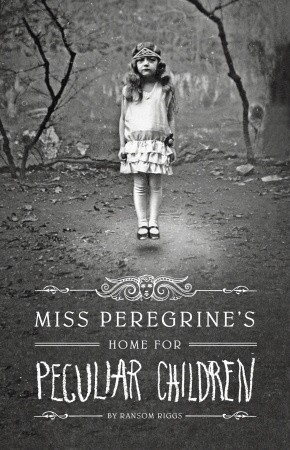
Miss Peregrine’s Home for Peculiar Children
Ransom Riggs

Peculiar traits often skip a generation, or ten. Peculiar children are not always, or even usually, born to peculiar parents, and peculiar parents do do always, or even usually, bear peculiar children. Can you imagine, in a world so afraid of otherness, why this would be a danger to all peculiarkind?

Oh. My. Gosh. I started Miss Peregrine’s thinking (for some reason) it was magical realism–not one of my favorite genres but one that seems a staple of literary fiction. The jacket blurb stated the novel was “an unforgettable novel that mixes fiction and photography in a thrilling reading experience … a spine-tingling fantasy … [for] anyone who relishes an adventure in the shadows.” Sounds a bit “Tiger’s Wife”-y, no? But what I got was Time Traveler’s Wife meets Harry Potter–and I was over the moon!

Jacob Portman is an ordinary sixteen-year-old with all the age’s inglorious traits: he is socially awkward and often lonely; his parents don’t understand him; he hates both school and his job. The one glorious constant in life, though, has always been his grandfather Abe Portman. Grandpa, who spent time in an orphanage after escaping the Nazis in Poland, regaled young Jacob with stories of fellow orphans: a girl who could fly, an invisible boy, and a boy who had bees living in him. And if it all sounded a bit outlandish, out would come a box of vintage, sepia-toned photographs. Sure enough, there were the (obviously staged, trick) photographs to prove it. And then there were the stories of invisible monsters whose tentacled tongues could snatch you up and crush you in their powerful jaws and Grandpa’s love of weaponry of all kinds and his many hunting trips.

(spoiler alert)
But long after Jacob dismissed Grandpa’s tales as “fairy stories” he receives a panicked call at work: “They’re coming for me, understand? I don’t know how they found me after all these years, but they did. What am I supposed to fight them with, the goddamned butter knife?” In a rush, Jacob leaves to ease his senile grandfather’s worries–and finds himself thrown into a world he didn’t even know existed. 

Grandpa’s dying words lead Jacob to a letter and a loop on the other side of an old man’s grave–September third, 1940. Cryptic, to be sure. But once Jacob unravels the clues he finds himself on a remote island off the coast of Wales, standing in front of the very real Miss Peregrine, surrounded by the peculiar children in her charge. Peculiar children–misunderstood, abandoned, and always suspect because of their odd powers–find refuge with a worldwide network of ymbrunes who keep them safe in time loops covering centuries. But are they really safe? For as Miss Peregrine tells Jacob, “…we peculiars are no less mortal than common folk. Time loops merely delay the inevitable, and the price we pay for using them is hefty–an irrevocable divorce from the ongoing present. As you know, long-term loop dwellers can but dip their toes into the present lest they wither and die. This has been the arrangement since time immemorial.”

So Jacob learns the truth about his grandfather–and himself–and must decide whether or not he will be the same man Abe was when those monsters do finally come. Again. Miss Peregrine’s is a novel rich with metaphor and symbol. The biblical Jacob wrestled with angels; this Jacob, monsters. His psychologist’s name is Dr.Golem Golan. The monsters are the Nazis–or aren’t they? I have no idea whether or not the novel is labeled as Young Adult fiction and it matters not. Miss Peregrine’s Home for Peculiar Children is a delight for any reader–peculiar or not.


Orange is the new black (non-fiction)
Piper Kerman

Piper Kerman’s life was comfortably suburban and solidly upper middle-class–she was a Smith graduate with all the door-openings and privilege that a Seven Sisters degree can convey. But Kerman also yearned for the adrenalin rush that came with living on the edge. And less than two years after graduation, the twenty-three-year-old found herself running drug money for a wealthy African drug lord. Aghast at how far her reckless abandon had taken her, relieved she had escaped undetected, and paranoid that just maybe she hadn’t, Kerman left that life behind, moving cross-country to San Francisco, a job in TV production, and supportive new friends. Ten years later, she got the proverbial knock on the door. Someone higher up on the drug smuggling chain had named names and charges had trickled down even to her.

And so began Piper Kerman’s years long navigation through our judicial system, eventually serving fifteen months in a minimum security prison in Danbury, Connecticut (the prison everyone assumed would house Martha Stewart). Kerman was a ‘self surrender’ on that February day, driven to Danbury by her fiance, and left as he walked back through the doors that locked behind him. Kerman’s first task was to learn the tedious and often arcane rules of prison, both spoken and unspoken: count five times a day, no physical contact between prisoners, only calls from your approved phone list (limited to 25 names), yes to crochet but no to knitting, never ask about another inmate’s crime. Prison staff ran from helpful and accommodating to confrontational and abusive–and the kitchen food was most often inedible.

But in the end, this was really a story about relationships. Kerman’s family, understandably shocked, were nothing if not supportive; friends kept up a steady stream of mail and books for mail call; her fiance (now husband) Larry Smith visited weekly, never wavering in his unconditional love. The women she shared her life with for those long months, however, were even more memorable. Annette and Nina and the group of Italians who took Kerman under their wing from her first day, sharing toiletries and shower shoes until she had an account in the prison store, and welcoming her into their Rummy games. Pop and Miss Natalie, older women who took care to bring her into their circle.And all those younger women, barely out of their teens–Jae and “Pennsatucky”–who looked to her for guidance.

I appreciated Kerman’s readiness to serve her sentence and refusal make excuses for herself. I loved the humility and acceptance she showed her fellow inmates, never thinking herself better or her crime any less than theirs. I applauded Kerman’s open acknowledgment that her life after prison (loving partner, awaiting job) would be everything theirs was not, giving her an advantage other inmates would never know. She suffered the loss of her grandmother while in prison and didn’t get the funeral furlough for which she applied–her darkest day.

Piper Kerman came out of the closed confines of prison a more open woman–and I never stopped asking myself how I would react, what I would do, how I would return home if I was in her steel-toed black work shoes.

Next up: I’ve got three books arriving tomorrow via Amazon–Miss Peregrine’s Home for Peculiar Children, Stuffed: Adventures of a restaurant family (non-fiction), and This Old Dog (a guide for owners with elderly pets).I think I’m going to start with Miss Peregrine–it sounds both bizarre and magical and I’ve passed it over on my wishlist for over a year already. If I don’t read it soon, I just might chicken out.

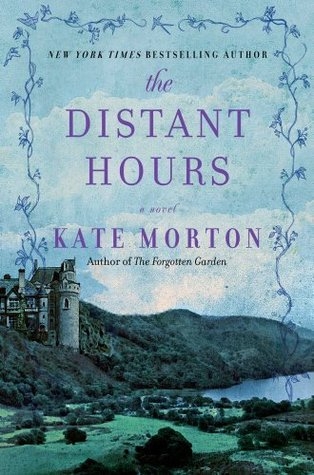
The Distant Hours
Kate Morton

“… stories are everywhere. That’s all writing is, apparently, capturing sights and thoughts on paper. Spinning, like a spider does, but using words to make the pattern.” 

As soon as Edie Burchill confessed she kept a copy of Jane Eyre in her bag should she “need to queue unexpectedly” I knew she was my kind of girl. Add to that the fact she works for Billing & Brown Book Publishers in Notting Hill and I was hooked.

It’s 1992 when Edie’s mother Meredith receives a letter written (and sent) nearly fifty years ago–and that’s when Edie hears the story of her mother’s evacuation during World War II to the English countryside and the castle (yes, castle!) Milderhurst, home of eccentric author Raymond Blythe. As luck would have it, business takes Edie right past Milderhurst only a short time later … and peering through the gates she realizes she had stood there as a young girl with her mother.

Drawn both by the mystery of the castle and her mother’s reticence in revealing the story behind the letter, Edie visits the village book shop where she learns that sometimes the elderly Blythe sisters allow for private tours. And an afternoon later Edie stands before Persephone Blythe, eighty-something, tall and lean and still commanding. Her twin, Seraphina, softens her edginess, all pink nail polish and silk flowered dresses. The youngest of the Sisters Blythe is Juniper–delusional, but most often in a stupor.

With that, Edie is off to uncover the truth of those years her mother spent at Milderhurst–and perhaps solve a murder or two as she does. I couldn’t have asked for more in a light summer read: a castle, winding country lanes, a dark wood, a deep pool, unexplained bumps in the night, writers galore, and a madwoman in the attic to boot. If you loved Jane Eyre (and it’s one of the few novels I’ve read repeatedly) Distant Hours has whispers of Jane and echoes of Rochester and lovely “ancient walls that sing the distant hours.”

A Red Herring Without Mustard
Alan Bradley

I have a real problem with mysteries. I don’t like them. Add to that the fact that I’m an Anglophile and my problem gets curiouser and curiouser–for who does mysteries better than the British? Miss Marple? No thank you. Poirot? I’ll pass. Sherlock Holmes? Not so much. And I admit I’ve never even cracked a P.D. James. My husband just shakes his head. I think it may be the fear factor (I don’t do scary anything–books, movies, amusement park rides, Halloween horror houses) or it may be I get weary trying to keep every character straight. As for the clues–when they’re revealed at the book’s end, I find that I missed them entirely.

But for some reason, little Flavia DeLuce has just wormed her way into my heart and I’ll go anywhere for her–even into the heart of a mystery. I must say that the first novel was slow going what with all the chemistry references (so what the heck is magnesium silicate hydroxide anyway? And why should I care?!) But the house–glorious Buckshaw, all back stairways, damp wallpaper, musty Victorian (literally!) furniture–made the going easier. And Father–absent-minded, stamp-loving, grieving widower–drew me in. But of course it was 11-year-old Flavia–tormented little sister, precocious, desperately missing her mother–who has brought me back again and again.

Flavia befriends a gypsy after burning down (accidentally, of course!) her tent at a church fete. Offering  shelter on Buckshaw’s meadow lands, the Palings, Flavia visits the old woman the next day only to find her nearly bludgeoned to death. Enter the gypsy’s granddaughter Porcelain, add another body (Brookie Harwood, town swindler), a secret religious sect, the Hobblers, and you’ve got a Bradley-style mystery. And while in  Flavia encounters real danger in The Weed That Strings the Hangman’s Bag, this time she escapes with only a sprained ankle.

In Red Herring we also get more from Flavia than ever before about her mother Harriet when she discovers a portrait, never claimed because of Harriet’s death and long stored at the artist’s cottage. Flavia describes her first look at the painting:“Harriet. My mother. She is sitting on the window box of the drawing room at Buckshaw. At her right hand, my sister Ophelia, aged about seven, plays with a cat’s cradle of red wool, its strands entangling her fingers like slender scarlet snakes. To Harriet’s left, my other sister, Daphne, although she is too young to read, uses a forefinger to mark her place in a large book: Grimm’s Fairy Tales. Harriet gazes tenderly down, a slight smile on her lips, like a Madonna, at the white bundle which she holds supported in the crook of her left arm: a child–a baby dressed in a white, trailing garment of elaborate and frothy lace–could it be a baptismal gown? I want to look at the mother but my eyes are drawn repeatedly back to the child. It is, of course, me.” 

I love the moments when Harriet reaches out to Flavia somehow–first her abandoned car; now the portrait. It is the mystery of Harriet that intrigues me more than lost heirlooms or murder. Something is left out of the story of Harriet’s death. But what? Take this from Flavia after she studies the portrait that first time: “Something about the portrait nagged at my mind: some half-forgotten thing that tried to surface as I stood staring at the easel … But what was it?” I’m guessing that we’ll find out what that “something” is, and perhaps even (some book soon?) find out more about the circumstances surrounding Harriet’s death disappearance. (See? Perhaps I’m getting into this mystery thing after all.)

And if writer Alan Bradley can get this mysteryphobe to return again and again–and soon another again!–then maybe I’m not so averse to mysteries after all. I just needed to find the right one.


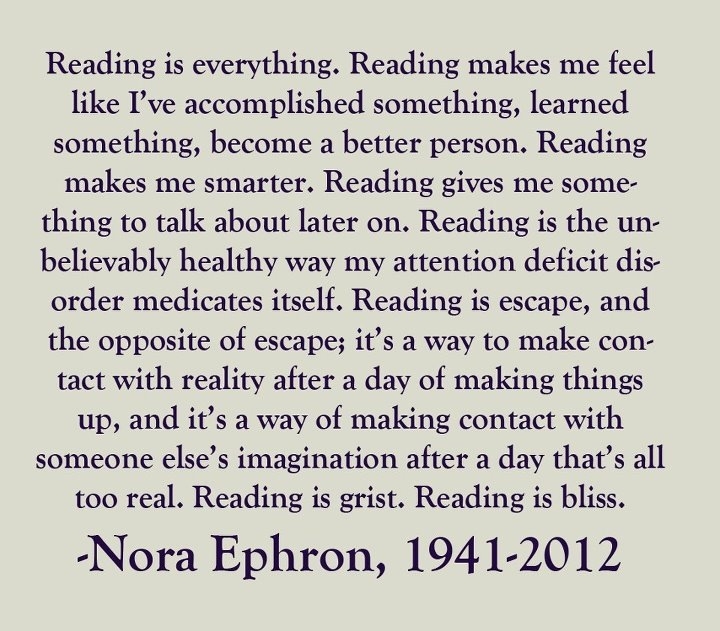
I remember reading Nora Ephron’s Heartburn in the mid-eighties … and I remember my (mental, anyway!) gasp when I read that the delightful novel was Ephron’s revenge after her marriage to journalist Carl Bernstein failed. Here she sums up the deliciousness that is reading. I should probably frame it.

May you find endless stacks in your life beyond, Nora. Happy reading forever. 

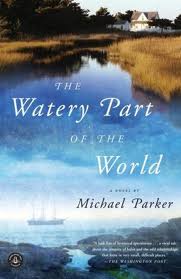
The Watery Part of the World
Michael Parker

“Whaley said to her sister, ‘Maggie, I’m sorry all these years I never acted like I love you but I do,’ and her sister didn’t say anything just made that hush sound with the s’s streaming out of her mouth like water lapping the beach at night … that noise Maggie made with her mouth took her back across to the island.” 

It was in some English Education grad class that I watched an episode of PBS’s Story of English and was enchanted by the segment of the documentary that featured an old woman speaking Gullah. (If you’ve never heard the dialect, here’s a clip of a Gullah storyteller) I found the language lyrical, rhythmic, and if I didn’t always understand the speaker, I was content to listen, awash in the music. And while that’s a pretty circuitous introduction to the novel, the echo of Gullah rang in my ears (accurate or not) as I read Michael Parker’s Watery Part of the World.

Set on an island in the Outer Banks, the novel straddles two centuries. We have the story of Theodosia Burr whose ship is run aground by pirates, many of the passengers raped, captured, and killed. Theodosia, adult daughter of Vice President Aaron Burr, is spared only because her crazed ranting about her famous father and her fierce grip on her childhood portrait, led the pirate leader Daniels to think “her touched by God”. Imprisoned by Daniels who moved her from family to family on the island, Theo eventually is befriended by Whaley, a man below her station with a mysterious past.

One hundred and fifty years later, Parker brings us to the island’s last three residents–sisters Maggie and Whaley, Theodosia’s descendants, and Woodrow Thornton, a black man upon whom the sisters rely for survival. We learn only some of their history; the novel’s focus is more on how its hold on the three is as powerful and relentless as the moon’s pull on the tide.Two “Tape Recorders” appear occasionally, academics determined (oh so foolishly!) to understand island culture. It is probably these characters that brought to mind The Story of English and Gullah.

I found Theodosia’s story more compelling: the privileged wife of a govenor (said to be the country’s most educated woman) given up for lost but in reality living the hard scrabble life of an island woman. Parker took what we know about Theo’s life before her disappearance and molded the woman she became by necessity. I am curious enough about her that I plan to read more–always a good sign that a novelist has done a competent job of blending fact with fiction.

The last two pages–beautifully poetic–I’ve already re-read; they are my type of ending in more ways than one.

Next up: So I guess it’s pretty evident that my ‘next up’ last time wasn’t really Elizabeth I. Or it was … but I put it aside for now. Summer is a reading frenzy for me–I’m like a shark with a string of chub. Don’t get me wrong–Liz is a good historical novel. But it’s long. And plodding. I’ve read 188 pages and Elizabeth went from age 50-something to 60. I just can’t stay with it right now and might save it for those endless winter nights. So Watery Part turned into my next up. My next next up is A Red Herring Without Mustard–yes, another Flavia DeLuce delight! (I’ve already one chapter behind me and I’m determined to adopt the girl somehow. How I love her little sleuthing self.)