This is my symphony

What I read & what I lived …

Pocket Full of Dreams
David B. Burch

Writer David Burch and his young family were  God-sent neighbors for me when I was a struggling single mom twenty years ago. David tied my boys’ ties and played catch with them; Joan and I spent many summer hours heart-to-heart while the kids ate picnic lunches in the driveway and played the afternoon away; we ate countless Little Caesars pizza specials while playing cards late into the night. And at a time when my own faith was rocky, I’d watch Dave, Joan, and all three of their little ones drive off to mass each Saturday evening or Sunday morning.

People who struggle through life’s hardships may turn one direction or another. They can harden their hearts and clench tight to whatever blessings they’ve received, or they can open their hearts and share freely and generously. The Burchs are givers. And now David’s memoir Pocket Full of Dreams is his gift to a wider audience. In it he shares with us the abuse he suffered, the poverty he endured, and the wrong turns he took. He remembers with gratitude the men and women who were so instrumental in shaping him. And perhaps best of all, David speaks poignantly about the love of his life, Joan, and the faith they share. Dave and Joan have seen tough times and abundance, but in whatever circumstance they found themselves, they knew their greatest treasure was love.

This self-published book can be ordered online davidbburch.com  or purchased at Schulers Book Stores. David also has booked speaking engagements at northern Michigan Rotaries, libraries, craft shows, and bookstores,  Pocket Full of Dreams is competently written–although its real beauty is the story of a life gone right.

Glass of Blessing (NetGalley)
Barbara Pym
release date: January 22, 2013 (ebook)

“Oh Wilmet, life is perfect now! [said Mary Beamish] I’ve got everything that I could possibly want. I keep thinking that it’s like a glass of blessings …”
“That comes from a poem by George Herbert, doesn’t it? I said. ‘When God at first made man, Having a glass of blessings standing by …” 
“But don’t forget that other line … how when all the other blessing had been bestowed, rest lay in the bottom of the glass. That’s so very appropriate for a harassed suburban …” 

I first read Barbara Pym twenty-some years ago as I worked my way through the fiction stacks at the bookstore where I worked evenings. The novels had everything I loved in a good book: a quaint English village (or post-war London), devout spinsters (or agnostic office workers), toast for tea (or grapenuts and Nescafe at breakfast). Plot was thin and not really the point, after all–Pym’s world was truly a comedy of manners. I started with Jane and Prudence and Excellent Women, moved on to Crampton Hodnet and Quartet in Autumn and life was good. It got even better with the gift of A Very Private Eye, Pym’s life in diaries and letters, with a forward by her sister, Hazel Holt.

Glass of Blessings tells the story of thirty-year-old beautiful Wilmet (“But Wilmet, life is like … your name–so sad, and you so gay and poised.”), wiling her life away by attending daily mass, keeping tabs on the vicar, and longing for … something. Husband Rodney, stolid and dull, is preoccupied with life in the Ministry. The couple lives with his mother Sylvia, a rather eccentric seventy-year-old with an interest in archaeology. Best friend Rowena has three children and a life in the suburbs to hold her in check. But Rowena’s brother Piers, single, handsome and unsettled, holds some allure. An autumn walk along the river, luncheon, afternoon tea–and soon Wilmet allows herself to believe they might have the enigmatic “something more”.

Yet Wilmet, and I would imagine Pym’s readers in 1958 when the book was first published, was in for a shock. For Piers has a flat mate. Keith. A sometimes model who works in a coffee bar. And decorates the flat. Whose friends Tony and Ray are ballet dancers. Oblivious for a time to the obvious, the realization of Piers’s sexual orientation hits Wilmet one night while perusing a magazine for a glimpse of Keith’s work–then she closes the “book and took a sleeping pill.” Dear Wilmet.

As in most Pym novels, the characters end, if not exactly happy, then at least coming to some sort of understanding. Mary and Sylvia both find true love (or at least willing partners). Rodney confesses he had dinner some two or three times with a Miss Bates, but she reminded him of Wilmet. Keith helps Wilmet decorate her new flat (“Wilmet, I like the lime green. It goes will with antique furniture–sets it off …”) A priest retires, a new vicar is installed. And life goes on.

  “… There was no reason why my own life should not be a glass of blessings too. Perhaps it always had been without my realizing it.”

Fever (NetGalley)
Mary Beth Keane
release date: March 2013

 Mary Mallon, the main character in Mary Beth Keane’s soon-to-be-released novel,  is known to most of us as Typhoid Mary, thought to be the first asymptomatic carrier of typhoid fever in the United States. Mary left a wake of illness and death as she moved from family to family, serving in wealthy New York households. Eventually, health department worker Dr. George Soper (a “sanitation engineer”–how ominous does that sound?) follows the patterns of outbreaks and convinces the City she must be arrested and housed in a TB hospital outside the city on the East River. [Adding a bit of real-life drama to my reading of Fever, I finished the novel while recovering from being a participant in the Great Flu Epidemic of 2013. I had my own literal fever and the accompanying fears of spreading what is a nasty, nasty bug.]

Mary Mallon was, at times, willful and outspoken. Those qualities served her well as she quickly made her way in service from laundress to head cook at a young age, but worked against her when she defied convention and social customs. She lived with her companion Alfred without being married; she lied her way into her first job as cook. And her violent outbursts when captured were the thing of headlines: “‘Typhoid Mary’ Most Harmless and Yet the Most Dangerous Woman in America”. 

Known also as Germ Woman, Mary was held two times on North Brother Island. During her first isolation she sought legal help and won release on the condition that she never cook for hire again. Unfortunately, the joy of cooking proved too hard to resist and Mary found a job as cook at a maternity hospital and a New York bakery where she worked under the name Mary Brown.  Caught again, Mary was housed in a small clapboard cottage  until her death at age sixty-nine. 

Keane created a sympathetic character in Mary: she was smart and headstrong. I was puzzled, however, that one so intelligent could be so obstinate: Mary repeatedly denied to her jailers, the public, and herself that she was a carrier, saying, “I’ve never been sick a day in my life.” I also felt the integrity of the novel was shaken by the addition of Alfred’s own “fevers” in the last few chapters–his fever for Mary, alcohol, and finally heroin. That might have been the author’s attempt to create a grand sweep of a novel, but story was always Mary’s–and she was grand enough to carry it on her own. 

Mary Coin (NetGalley)
Marissa Silver
Release date: March 7, 2013

“We never really knew [Grandfather],” Isaac says. 
“Some people don’t want to be known,” Walker says.
“That’s stupid,” Alice says. “Everyone wants to be known. Otherwise it’s just fucking depressing.”
Of course, she is right. Everyone wants to be known. Perhaps the ones who conceal themselves most of all. The question is: Who is foolhardy enough to go in search of them? 

Mary Coin is one writer’s attempt at searching for the woman behind Dorthea Lange’s iconic photograph from the Dust Bowl era: the mother,suspicious and weary; the children, shy and shameful; a baby at her breast. Although the actual subject of the photograph has been identified as Florence Owens Thompson, Marissa Silver renamed the woman Mary Coin and created a past  for her from the black and white image so many of us know.

Mary Coin and her husband made their way from a small farm in Oklahoma to California in search of a better life. And for a time, life was as good as might be expected for uneducated laborers during the 1930s–they had a company house and love enough to go around their six children. A mill fire set the young family onto the road again until husband Toby’s death of TB demanded that Mary, ever indomitable,  pick cotton and vegetables and citrus fruit–anything to keep her family going.

Two other lives intersected Mary’s–that of historian Walker Dodge, grandson of a man who once hired Mary Coin, and photographer Vera Dare, Silver’s stand-in for Lange. Both stories looked at family secrets, missed opportunities, and flawed fathers and mothers through the revealing lens that is time. I’m not certain how essential Vera Dare’s story was to the novel, other than her life as a mother was shadowed by some of the same issues that darkened Mary Coin’s life. Walker Dodge had a more direct connection with Mary Dare, and he only came to know her through newspaper clippings, letters, and his grandfather’s accounting records.

Mary Coin was a satisfying read and thought-provoking at the same time, although perhaps attempted too much plot-wise in 330 pages. One of my favorite scenes is when an elderly Mary Coin attends an exhibit of Dare’s work in San Francisco where the photograph is displayed, and listens to the comments of the people around her: “Mary saw her reflection in the glass. There they were. Two women named Mary Coin. If they met on the street in the high heat of a summer’s afternoon, they would be polite in the old-fashioned way to show they meant each other no harm. ‘Hello,’  they would say in passing. ‘My, but isn’t it a wretched day.'”

Quite coincidentally I finished the book after a marathon session scrapbooking my family photos for the past few years. As I backed photos with coordinating colors, added borders and embellishments, and carefully captioned each page, I wondered if anyone would stumble upon these books long after my own children were gone. Would they recognize the joy, pain, and confusion on the people smiling into the sun, clowning with family, sitting down to holiday meals? Or would they recognize that “It is a photograph, an alchemy of fact and invention that produces something recognizable as the truth. But it is not the truth.”  And would they try to seek anything out about those lives on the page? Because “everyone wants to be known. Perhaps the ones who conceal themselves most of all.”

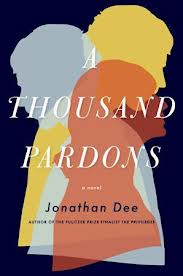
A Thousand Pardons (NetGalley)
Jonathan Dee
Release date: March 2013

Helen had a gift: she could induce even the most powerful to follow her directive–apologize for their misdeeds, real or imagined. Sincerely, with candor. Without thoughts of manipulation. And as part of a crisis management team at a large public relations firm, she excelled. But despite this talent, Helen couldn’t keep her own crisis at bay.

Husband Ben Armstead’s mid-life crisis was not all that unusual. What might be unusual is the swift trajectory of his downfall: once a successful lawyer living in a posh New York suburb, he finds himself in the space of a year disbarred, charged with DUI and sexual assault, and serving a brief stint in prison. So with the marriage dissolved and the family home on the market, Helen and their daughter Sara escape to a new life in Manhattan hoping to reinvent themselves–which they do with only limited success. Because Helen can’t quite figure out the unspoken rituals of the corporate world and single life. And thirteen-year-old Sarah is still too young to know who she wants to invent herself in to.

The irony that Helen could bring other men to their knees, yet not her husband, is obvious. But it’s also ironic that it is Ben who realizes first that reinvention might not be the cure-all we think it to be–that perhaps returning to the center is where healing takes place. While some readers might think Ben’s answer to his disgrace is too pat (and, in fact, Ben himself didn’t really understand the why of his actions), it felt right to me. What also felt right was the family’s tentative attempts at the end of the novel to rise from the ashes of their collapse.

I was not at all certain why the publisher compared Dee and Thousand Pardons to Jonathan Franzen or Richard Russo. I’ve read both writers and I am off put by what so many readers and reviewers call ‘social commentary’–the characters in both Franzen’s and Russo’s work have few redeeming qualities and they remain mired in their shortcomings. I found Thousand Pardons more comparable to Joyce Carol Oates’ We Were the Mulvaneys–it spoke of healing and hope

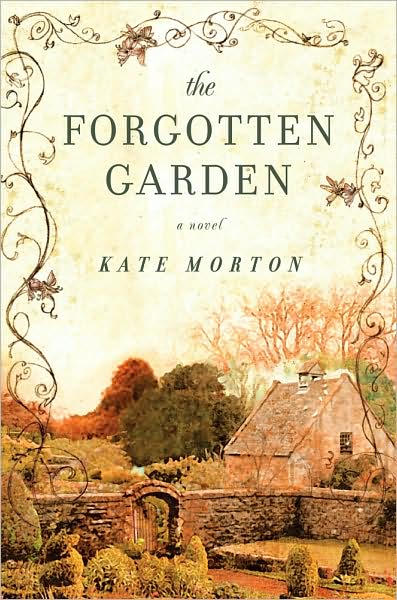
The Forgotten Garden
Kate Morton

I loved Kate Morton’s The Distant Hours (link), but found her Forgotten Garden even more satisfying. Only a quarter way through the novel, I was happy to find a story about a lady writer, an orphan, English aristocrats, and mistaken forgotten identity. Set it all at the English seaside, throw in a sprawling manor, a walled garden, and an invalid (or two), and you’ve got the stuff of every ten-year-old bookworm’s dreams. Add forty plus years and it’s the stuff of mine.

The story opens with a little stowaway, tucked behind crates on a ship’s deck, watching “the Authoress” walk briskly away. Weeks later that same nameless stowaway is found alone, perched atop a suitcase on a dock in Australia. Hustled home by the portmaster to his childless wife, the girl is renamed Nell and lived until her twenty-first birthday not knowing of her origins.

Fast forward seventy years and the one-time stowaway has died, leaving her granddaughter a legacy: a long-abandoned cottage on the Cornish coast. And from there we weave from Nell’s story in Australia to the wealthy Mountrachet family’s to the Authoress’–all bound not only by secrets, but blood as well. I was hooked as granddaughter Cassandra tried to unravel the mystery of Nell’s life.

It was only in the last quarter of the book when a Mrs. Hodgson Burnett attended a garden party at Blackhurst Manor and remarked on the secret garden “hidden on the grand estate” that I understood the visceral appeal of Morton’s novel–so very much a version of Burnett’s Secret Garden (a story I read many times as a child) but for adults’ eyes only.

With that, there’s really no need to give a synopsis of Morton’s book. Be assured it’s compelling and comforting to curl up in a chair and slip between the pages of a mystery about love and loss across generations.

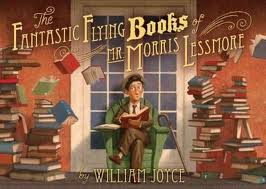
The Fantastic Flying Books of Mr. Morris Lessmore
William Joyce

I really have no need to browse children’s books anymore, but long ago in a life far away, I did work in a children’s bookstore–and sighed over more powerfully sweet stories and gorgeous illustrations than I can remember. So as my daughter and I were leaving the mall bookstore on the weekend before Christmas, I wasn’t expecting to be stopped in my tracks by a children’s book. Nor was I expecting to hear one call my name so loudly. But Mr. Morris Lessmore, bless his heart, not only spoke to me, but reached out and grabbed my arm: Morris Lessmore loved words. He loved stories. He loved books. His life was a book of his own writing, one orderly page after another. He would open it every morning and write of his joys and sorrows, of all that he knew and everything he hoped for. 

And as happens in most of our lives, the skies darkened and trouble blew in and around Mr. Morris Lessmore. It was the books who saved him … as they’ve saved me so many times. I’ve read The Fantastic Flying Books of Mr. Morris Lessmore several times in as many hours. It is my story, too.

[Surprise, friend D!]

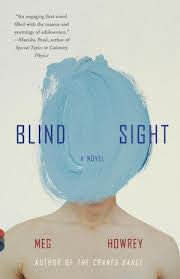
Blind Sight
Meg Howry

Luke Prescott’s life is pretty standard for an average middle class seventeen-year-old in small town Delaware–he’s a successful high school athlete, working on college admission essays; he has a small group of close friend and a part-time girl friend. His single mom and grandma have raised Luke and his two sisters; his father was little more than a sperm donor. Until, that is, his mom slips him a scrap of paper with his father’s name and phone number–and the man he knew only apocryphally as Anthony Boyle is revealed to be the (now) famous Hollywood actor Mark Franco.

And quick as you can say “school’s out for the summer”, Luke is on his way to Los Angeles and a life far from his own. Mark and Luke’s relationship starts out polite and tentative, both men looking for their missing piece in the other. Before long, Luke finds himself included in Mark’s red carpet premier, he’s on the set of Mark’s latest movie, he walks through an interview with a journalist for a People-like magazine. And true to all good stories, both Mark and Luke imagine themselves living happily ever after. But will they? Because like many good stories, secrets also abound that just might destroy this The End.

While the story of Mark and Luke was satisfying enough, I was enthralled by the dynamics of Luke’s life at home. Mom is a yoga teacher, called Sara by her children. The New Age milieu  unfolded onto the pages: Luke went on a Sacred Journey at age thirteen, Sara spends a month of silence at a retreat center. Self-actualization is the apple pie to this mom. In fact, I was so taken aback at the New Age references that I thought at first it might be ridicule, but I don’t think so. It was, rather, a rare peek into a world not often pictured (surprisingly) in contemporary fiction. And even more luscious to me was the fact that Luke’s grandmother is a Bible-believing, testifying, prayerful New Brethren who lives with and loves her oddball family in a wonderful East-meets-West kind of way.

This is not a book for which I’ll insert that [spoiler alert]. Quirky characters in worlds very much like and unlike our own–what could be better?

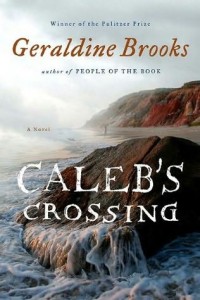
Caleb’s Crossing
Geraldine Brooks

Caleb was a hero, there is no doubt of it. He ventured forth from one world to another with an explorer’s courage, armored by the hope that he could serve his people. He stood shoulder to shoulder with the most learned of his day, ready to take his place as a man of affairs. He won the respect of those who had been swift to dismiss him. 

Strong-willed and intelligent, Bethia Mayfield often chaffed against the rules that bound her. Learning Latin and Greek second-hand as her minister father taught brother Makepeace, Bethia longed for more but was scolded by her father when she revealed her literacy: “…why do you strive so hard to quit the place in which God has set you? … women are not made like men. You risk addling your brain by thinking on scholarly matters.” The reader knows from the first pages that this is a woman sure to have no end of trouble.

But not only was Bethia quick-witted, she was also open-hearted towards the Indian people that lived in settlements throughout the island, even developing a secret friendship with young Cheeshahteaumauk, or Caleb, as she renamed him. For a few short years as children they shared the beauty of the island–and learned about each others’ foreign worlds. At the same time, Bethia’s missionary father makes inroads with the Wampanoag, bringing them Western “civilization” with its Puritan religion and lifestyle.

But life in Great Harbor on the island of Martha’s Vineyard was spare and loss was a close companion. In the space of little more than a year, Bethia lost her beloved baby sister as well as both father and mother. Orphaned and without prospects, Bethia is indentured so that Makepeace can attend  prep school in the hopes he will one day attend Harvard. Caleb, who as a teen had become her father’s protege, followed, hoping to be one of the first native young men to be admitted to Harvard’s Indian School.

One of my reader friends remarked that while she like the book, she wanted more of Caleb’s story, and the title is a bit misleading, for this is clearly Bethia’s story. Caleb only figures as a background character after the first section of the novel and he is always seen through Bethia’s eyes. So is the title a reference to Caleb’s crossing into New England society? Or his crossing over in death which figures so prominently at the novel’s end?

I loved that Brooks demanded her reader follow the language of Bethia’s time: salvages, rather than savages; bever, rather than lunch; chirurgical, rather than surgical. I was a bit disappointed that the author’s view of the Wampanoag shaman was so one-sided, focusing only on his dark medicine and making him the novel’s boogeyman. For all of her ability to present the dark and light sides of both English and Indian culture, Brooks fell a bit short here, especially since Bethia apparently understood and accepted the shaman’s power for Good.  Bethia’s last thoughts of Caleb open to a wider world:
“I do not know which home welcomed him, at the end. Whichever is was–the celestial English heaven of seraphim, cherubin, and ophanim, or Kietan’s warm and fertile place away in the southwest, I believe that his song was powerful enough for Joel to hear and to follow him there.”

A beautiful look at what unites rather than divides us humans, race, religion, and culture aside.


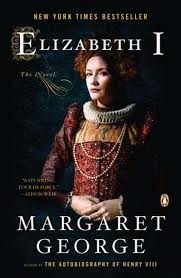
Elizabeth I
Margaret George

The imperial votaress passed on, in maiden meditation, fancy-free. ~ William Shakespreare

I felt a close kinship with many of those who surrounded Elizabeth during her long reign. Like those whose lives were held in check by her capricious iron will, who waited long years for overdue titles and positions at court, who tried again and again to breach her borders, I, too, asked myself, “Will this woman never die?!” And while I don’t regret reading Margaret George’s tome Elizabeth I, I was overjoyed to set it aside, happy that Elizabeth had crossed over, and I could get on with my life. (Now lest I sound too harsh in my reaction to Elizabeth I, the author covered only the last thirty years of her life, from her early 50’s to her death in 1603.)

The novel is plodding; there’s no other word for it. Chapters crawled by at the pace of an Elizabethan Progress–George packed dozens of wagons filled with Elizabeth’s days, traveled slowly over English countryside, only to unpack it all and begin over again. And I have to say I learned much about life in the Queen’s private chambers and how life at court unfolded. (I also think contemporary politicians–scandals and all–can’t hold a candle to the deals, bribery, and subterfuge of Elizabeth’s court.) But George couldn’t roll a carriage down the street without pointing out, house-by-house who lived where and what their relationship with the Queen had been, and the detail, at times, was burdensome.

Interwoven with Elizabeth’s story were chapters narrated by Lettice Knollys nee Devereaux nee Dudley, Elizabeth‘s cousin, long banished from court, and also the wife of Elizabeth’s (perhaps) true love, Robert Dudley, Earl of Leicester. Lettice was as controlling and conniving as Elizabeth–but without the power and status–and I assume that was the real reason behind the women’s long feud. Interesting was George’s speculation that William Shakespeare was Lady Devereaux’s lover for a time. I loved the few behind-the-scenes glimpses we get of Shakespeare, his “new” plays as they were performed, and London’s reaction. 

A definite must-read for Anglophiles and a great companion to the recent films about Elizabeth starring Cate Blanchett, Elizabeth and Elizabeth: the Golden Age. Just give yourself plenty of time. 


Next up: In the time it took me to finish Elizabeth and write this post (3 days), I’m already plowing through the Pulitzer Prize winner by Geraldine Brooks, Caleb’s Crossing. (And reading printed hard copies again has brought my reading back into focus.) Next, next up is Blind Sight by Meg Howrey. I think I heard a review of it on NPR.