This is my symphony

What I read & what I lived …

Ok, so if you’re still reading after that post title, I give you credit. But I really just couldn’t resist. I’ve read two books this week that provide us with a glimpse of what might happen to us after death–at least for a short time. Both novels see the dead lingering for a bit, maybe wrapping up loose ends or simply waiting for what might come next.

_________________________________________________________________________________

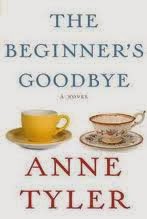
The Beginner’s Goodbye
Anne Tyler

The strangest thing about my wife’s return from the dead was how other people reacted. 

Aaron Woolcott had just lost his wife Dorothy in a freak accident: an enormous oak tree fell on their house,

crushing her and destroying the better part of his world. He is a publisher at a small vanity press; she, a doctor. They met when Aaron was researching for one of his titles–The Beginner’s Cancer–and was immediately smitten by the self-sufficient, frumpy Dr. Rosales. Anne Tyler gives us yet another peek into the lives of folks who fumble their way through life, pushing through a tangle of frailty and foible to somehow find their way to love.

So we have their courtship, their matter-of-fact marriage, Dorothy’s untimely death. And then we have her return. Dorothy stands outside their home, watching repairs; she sits in the alley outside Aaron’s office, looking up at his window; she walks alongside him on his way to lunch at the corner cafe. Others turn away when they see the two approaching, or they avert their eyes and duck past quickly–uncomfortable, pretending she isn’t there. But is she? She spoke only to Aaron and only a few times, but it was enough. Enough for Aaron to make sense of what their marriage was missing. And what they had.

Tyler’s other characters are just as flawed: Gil, the contractor , a recovering alcoholic, who repairs Aaron’s house; Aaron’s sister Nandina, still in her thirties and seeming to will herself into spinsterhood with the housecoats she dons after work; the staff at Woolcott Publishing, especially Peggy, the office House Mother who is a-flounce with ruffles and lace and curls. Although maybe not as fuzzy-around-the-edges as Tyler’s earlier characters (who can forget Macon Leary from Accidental Tourist?) I adored them all–because, in the end, Tyler understands we are all of us pushing through our own tangles. And some of us–in what might be our finest moments–do find love.

The Uninvited Guests
Sadie Jones

In a Downton-ish Abbey time and place, Emerald looks forward to celebrating her birthday with a grand dinner, but only a few guests. Her family, of course (more on them later), a neighbor who, although he is a farmer, just might be a prospective suitor, and her childhood friends Patience and Ernest Sutton. What she gets is a houseful of survivors from a late-night railway crash–a few dozen (lower class all) huddle together, waiting for a Railway representative to transport them home.

And as period pieces often are, this is a comedy of manners. The Torringtons, funds rapidly failing, their privileged life falling to ruin, maintain their dignity by looking down at others–in this case, the survivors of that railway crash. The passengers are herded (there’s not other word for it) into the morning room, the fire lit, the door shut, and just as quickly, forgotten. Out of sight, out of mind Except more keep arriving and after hours of isolation, start to roam through the house. The guests are tired. They’re hungry. They are restless.

One guest, however, joins Emerald’s party, much to the dismay of her mother Charlotte, who seems to know the man, one Charlie Traversham-Beechers. Bawdy and crass, Treaverish-Beacon  Traversham-Beechers brings all sorts of mischief with him. The gentleman drink too much and wave cigars about at the table; the conversation is decidedly not posh; the women are insulted. And when a party game of Hinds and Hounds turns malicious, terrible family secrets are revealed.

And all the while there are the guests, who, increasingly, will not be contained. They appear on the landing; they stand in the hall–and then they don’t. Who are these passengers and where are they going? Ah! Their drab colors, sallow faces, the shivers, the drafts … Author Sadie Jones leaves a crumb trail of clues along the way–a trail that is delicious to follow and even more intriguing to think about.

_________________________________________________________________________________

And so just what exactly does await us? I’m hoping I won’t know for a while yet–which is why I’ve loved Peony in Love and If I Stay and Mrs. Perrigrine’s Home for Peculiar Children. They give me pause for thought. I’d like to think I’ll be back–hopefully not as empty as Jones’s wandering souls or as peevish as Aaron’s Dorothy. Perhaps just trailing behind my loved ones, hitching a ride as I hold loosely to their shoulders, not a hungry ghost like Peony, but one more satisfied–content to be close to, but not necessarily with, the ones I love.
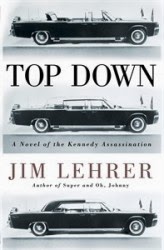
Top Down (NetGalley)
Jim Lehrer
release date: Oct. 8

I’ve kind of had a Jim Lehrer crush for a number of years–I watched him nightly on the NewsHour, appreciating his insight on all things newsworthy. And although I knew him to be a fiction writer, I’ve not read even one of his novels. Some fan I am, right? But last year I read Stephen King’s 1964, and with the upcoming fiftieth anniversary of JFK’s assassination, I thought Lehrer’s novel would make a great bookend.

The story turns on two men: Jack Gilmore, reporter for the Dallas Tribune at the time of Kennedy’s death, and Van Walters, secret service agent responsible for giving the order to leave the bubble off

Kennedy’s limousine. Gilmore, in fact, was present at the airport when Walters ordered the top down, and a few years later, helps Walters’ twenty-year-old daughter unravel the story of that awful day.

Marti Walters is on a mission to bring her father back from the brink of death. After the assassination, Van Walters is clearly a shattered man, blaming himself for Kennedy’s death. The Secret Service transfers him numerous times, his designation as a special agent is removed, and he is finally retired from service. Suffering from what we now know as PTSD, Walters is a shell of a man–drugged, depressed, and almost catatonic. And because “victims usually come in pairs”, his wife depends on alcohol to dull the loss of her once-happy home-life.  The Walters move to Singapore, Van works for a time as a private security agent, and Marti enlists Jack’s help to re-enact the scene to determine if “top up” would have deflected the bullet as Van believed–or wrecked more havoc with shards of plastic spraying everywhere.

A fascinating premise for a novel, told by an author who was on the scene, just as Van Walters was. Lehrer spoke in early November at an event commemorating the anniversary of Kennedy’s assassination. Seems that Lehrer himself was the reporter who asked the secret service whether or not the limo top would be up or down–and it was his question that triggered the phone call setting the events in motion.

Lehrer should have stuck with the straight news on this one. His characters are wooden, the dialog cliche, and the plot plods dutifully along to a anticlimactic end.  I actually stopped reading the book in the middle of the last chapter and set the novel aside for nearly three weeks–something unheard of for me.  Only a niggling doubt that I might be missing some “gotcha!” sent me back to finish it. But sadly, there wasn’t.

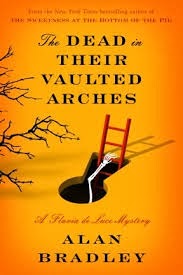
The Dead in Their Vaulted Arches (NetGalley)
Alan Bradley
release date: January 14, 2014

SPOILER ALERT: Don’t read a word further if you’re worried about a spoiler because on page 4 we find out about Harriet, and the rest of the novel turns on that news. I’ve included a jump break for your protection.

Father’s last words in Speaking From Among the Bones were, “Your mother has been found”, and I spent the past several months gloating and high-fiving myself for having been right all along. I knew it! And so I raced through the first pages of Alan Bradley sixth Flavia DeLuce mystery, all but craning my own neck with
the crowd gathered at the railway platform at Buckshaw halt, peering down the tracks for the train bringing Harriet home. Until–“gently, almost tenderly …
a wooden box was handed out to the double column of waiting men, who shouldered it and stood motionless for a moment …it was a coffin which … gleamed cruelly in the harsh sunlight. In it was Harriet. My mother.” And there went my smugness, right there.

Despite the fact that Harriet has come home to lie in state in Buckshaw and her funeral will take place in a just a few days, this little chemist-cum-detective has big plans, although a they might be a tad macabre. Because it’s Flavia’s belief that she can resurrect Harriet (who had been found frozen in a Himalayan glacier) with a simple bit of adenonsine triphosphate and a pinch of carboxylase hydrochloride. So we watch–with horror? with heartache?–as Flavia pries the lid off her mother’s casket and tenderly kisses her cold corpse. Poor lost little girl.

But even in the midst of all her sorrow, Flavia meets her match in a six-year-old visiting cousin, Undine, who speaks Malay and has a vocabulary–and energy–that rivals her own. She finds, develops, and watches an old home movie of Harriet and her dad picnicking on the lawn of Buchshaw; she flies over Buckshaw not once, but twice, in Harriet’s famous two-seater Blithe Spirit. Aunt Felicity reveals enormous secret. And an (evil) distant cousin shows up to mourn with the family.

By novel’s end Harriet is buried and Flavia seems resolute. She’s growing up at last. And then Father drops a bombshell, just as he did in the last book–it seems Flavia is off to Canada.

Forgive Me, Leonard Peacock (NetGalley)
Mathew Quick

First they ignore you, then they laugh at you, then they fight you, then you win. 

The blurbs on this YA novel are pretty impressive: “riveting”, “harrowing”, “beautifully written”. And with a starred review in Publisher’s Weekly and a movie deal in the works, I worried the hype was too much. But I read it. In one sitting. Yep–it was that good.

The book opens with Leonard Peacock looking at himself in the mirror after he has chopped off the long hair that has curtained him off from the world. “How long as this guy been hiding under my hair? I don’t like him. ‘I’m going to kill you later today,’ I say to that guy in the mirror, and he just smiles back at me like he can’t wait. ‘Promise?'” Chills. Then he wonders whether or not the P-38 WWII Nazi handgun sitting beside his bowl of oatmeal just might be modern art … so he snaps a photo of it.

The boy, simply put, is not all that likable–he’s sarcastic, rude, and dismissive of just about anyone outside of his small circle of acquaintances. Not friends (in the true sense of the word) because Leonard doesn’t really have any. But he does attempt to date Lauren, a home-schooled Christian girl evangelizing outside the
train station. And there is Baback, the Iranian immigrant who allows Leonard to listen as he practices violin in the auditorium every day at lunch; Herr Silverman, the young Holocaust history teacher who can see through teens’ nonsense; and Walt, the elderly neighbor he watches hours of Bogart films with.

Leonard Peacock’s parents are absent (Dad left the country to avoid drug charges and Mom–or Linda, as he prefers to call her–lives in New York, busy with a career in fashion) and so he’s on his own, physically and emotionally. Leonard is also pretty darn smart, and he knows it. He has memorized extensive lines from both Hamlet and Bogey films, he takes Advanced Placement classes, and he’s expected to ace the SAT. But he’s a teenager for whom school is a burdensome formality and so he spends most of his day challenging his teachers, being a smart ass, and alienating himself from just about everyone.

Leonard also has a secret that has tormented him since he was twelve. While we don’t immediately know what happened to isolate him, we can guess pretty accurately. So after years of pain Leonard decides on his eighteenth birthday he’ll put an end to it. Literally. He plans to murder the object of most of his fury and then commit suicide. The story covers what is to be Leonard’s last day on earth as he gives good-bye gifts to his four friends.

This novel is not for the feint of heart. It’s raw, profane, and sexually explicit at times. But it’s powerful stuff. Although Leonard Peacock may not be a very clinical look at a school shooter, the book gives great insight into the mind of a troubled teen.

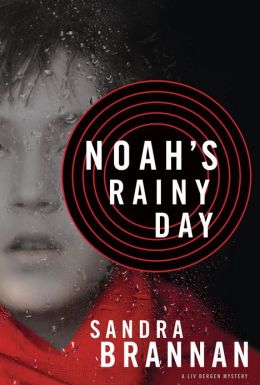
Noah’s Rainy Day (NetGalley)
Sandra Brannan
release date: Sept. 3, 2013

Although normally being called a vegetable or broken might hurt my feelings, for the first time in my life, I was relieved that someone thought of me that way. I knew that if the scaredy-cat neighbor believed I couldn’t think or speak -being nothing more than a vegetable–the little boy would stay safer somehow. I sensed this … I went into spy mode and pretended to be a vegetable, since invisibility was out of the question.

Noah opens his story with, “The good news is I think I broke my leg. The bad news is I don’t know if anyone at school would ever believe how it happened. Or worse, I’m not sure it anyone will ever figure out how I got here.” The boy is obviously in some pretty steep trouble, but backs up his story to tell us a little about himself: he’s a 40 pound 12-year-old with cerebral palsy who can’t speak and is blind in one eye. He spends his days in his wheelchair or on the floor–missing nothing that goes on around him. His younger sister Emma is one of the few people who communicates overtly with him, using the “five finger method” where each digit and each knuckle represents a letter. She tracks his eyes and “reads” his spelling. The rest of the

family relies on intuition to “talk” to him.

One of his favorite people is Aunt Liv Bergen, special agent with the FBI. And her arrival on Christmas Eve to celebrate with Noah’s family makes the holiday that much more special. Until, that is, she’s abruptly called away as on an assignment: five-year-old Maximilian Bennett Williams III, son of a multi-millionaire and supermodel has disappeared from Denver International Airport. Liv’s investigation lasts long into the night and she misses Christmas morning. Still hoping for her return before Christmas dinner, Noah and Emma play in the snow and meet a chatty little boy who’s visiting “Papa”, Noah’s creepy next door neighbor who live alone, rarely goes out, and never has company. Hmmmmm …

Liv works the airport with her tracking dog Beulah; we meet a whole cast of agents, officers … and a possible love interest or two. Brannan keeps the story moving quickly as the FBI and local police try to piece together any clues that might lead them to recover little Max. Alternating narrators between Noah and Liv, Brannan lets us solve the crime as they do. And then she lets little Max narrate a chapter, and next Noah’s creepy neighbor Jason Fletcher. And then Noah disappears, too.

I’m not one for detective novels (except for my much-loved Flavia DeLuce!), but this one kept me swiping my Kindle pages quickly. Although this is the fourth Liv Bergen novel in a series, I wasn’t lost jumping in. The characters were engaging, the plot was fast-paced–you add a tracking dog and a kid who’s one smart cookie, and you’ve got Noah’s Rainy Day. 

I’m guessing if you read my post from about a year ago, it would sound very much the same as this: the summer is waning, I’m hustling to get ready for school, my reading has slacked off, I’m behind posting (read: I haven’t blogged a darn review all month!). Am I right?! So here are a few brief looks at the books I’ve been reading.

Mrs. Poe (NetGalley)
 Lynn Cullen
 release date: October 2013

The idea behind Lynn Cullen’s Mrs. Poe, due to be released October 2013, is intriguing. Lady poet (because that’s how they were characterized in 1845) Frances Osgood crosses paths with Edgar Allan Poe–and his curious wife Virginia–just as his poem “The Raven” is all the talk in New York. Estranged from her philandering husband, Frances is drawn to Poe’s intensity and Virginia’s fragile devotion. But as Frances and Poe grow closer, Virginia’s devotion reveals its dark side. I might just have reached my historical fiction limit (what with Aviator’s Wife, Dressmaker, Fever, Mary Coin) but I only made it through about three-quarters of the book before flipping to the end. It isn’t a horrible read; it’s just not a memorable one. I was curious enough about Frances Osgood, though, to do a little bit of “research” about her on the interweb. And, truthfully, my reading there–complete with poems the two had written to each other–was more compelling than the novel.

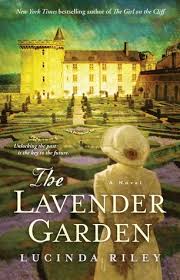
The Lavender Garden (Galley Alley/Atria Publishing)
Lucinda Riley

Now this was a story that kept me page-turning from the get-go. My husband calls it a “book divorce.” Emilie de la Martiniers buries her mother and a few days later the London veterinarian finds that she’s inherited an apartment in Paris and a rambling chateau and vineyard in southern France–and immediately begins to regret having to sell it. Enter a handsome stranger who appears just as Emilie is dealing with a break-in at the chateau. Worming his way into her life, the two are soon married. Although I was suspicious of Sebastian from the start, Emilie seemed so intelligent, so level-headed, I didn’t for a minute think she’d fall for a cad. Hah! Emilie and Sebastian are connected somehow through his grandmother Constance–and so author Lucinda Riley begins to alternate between the two women’s stories. There’s another crumbling estate in England, a brother-in-law in a wheelchair (Mr. Rochester!), secrets and mysteries from World War II, and an orphan. Book divorce for sure!

Gone Girl
Gillian Flynn

A hint for buying Christmas books for friends and family–always get them books you think you might like but don’t want to spend money on. And when, say, six or seven months have passed, you casually ask to borrow the book. That’s what I did with Gone Girl which I gave to my daughter this year. I realize I might be the last person in the US who hasn’t read the book-of-the-year (oh, wait–Denice is!) but read it I finally did. And loved it. Until the last page. I’m not even going to give a synopsis, since everyone surely knows the gist of the book at this time. And if you don’t, the inside flap blurb will give you enough to go on or you can read more here. The book twisted and turned, and I alternately figured it out, then didn’t, then figured it out for sure, then didn’t. It was a page-turner (as everyone says), fascinating insight into the mind of a sociopath–or is it psychopath? Whatever–they were both screwed up.

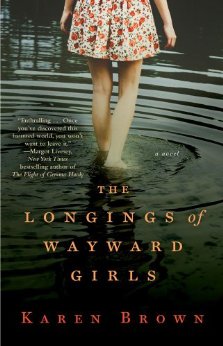
The Longings of Wayward Girls (Galley Alley)
Karen Brown

Karen Brown’s Longings of Wayward Girls is one of the only chick lit titles I’ve read this summer … and it’s a great one! Brown tells the story of Sadie at twelve and Sadie years later as wife and mother. Because what happened to Sadie then was haunting the Sadie now.

Sadie then was a bright, imaginative, and pretty girl–the ringleader of the neighborhood children in her hometown of Wintonbury. She writes the Christmas chorale, organizes the annual Haunted Woods, and plays endless hours of Old-Fashioned House. Her best friend Betty ever at her side,

Sadie’s life in suburban Connecticut in the seventies is idyllic. Except for her pill-popping, alcoholic mom and the teenage boy she seduces. And the girl, Laura Loomis, who disappears one day, never to be found. Or the neighborhood outcast who, Sadie learns, is abused by her father. How about the unfathomable torment one girl can inflict upon another?

Sadie now is a pulled-together, fashionable stay-at-home-mom who still lives in Wintonbury (albeit in a newer upscale neighborhood) and whose life continues that idyll. Except for her grief over the still born daughter she mourns. Or her ineffectual paperdoll of a husband. And the suffocating boredom she feels. Enter Ray Filley, a crush from her tween-hood, back in town after his father’s death–single, handsome, infatuated with Sadie, and dangerous. It’s when Sadie takes up with Ray that her then and now collide in a harrowing way. I must admit that at times I thought I’d mistakenly picked up a suspense novel and I read the end of the novel flipping pages as quickly as I could.

Karen Brown has a keen eye for the inner world of women–our boredom and frustration, the endless demands and stalled careers–and the tolls we pay to live out the life of June Cleaver. I can’t think of a better book to discuss in Book Club. It would be one long night.