This is my symphony

What I read & what I lived …

Today is day 6 of the Blogging from A to Z Challenge.  The challenge began with A on April 1 and continues the alphabet throughout theJust Plain Fancy
month, except on Sundays. My theme for the month will be this blog’s tagline: life, books, and all things bookish, so you can expect a little bit of this ‘n that. I’m still reading, though, and I’ll add reviews whenever possible. Thirty days of blogging is a huge commitment for me, but I’m looking forward to meeting and greeting new blog friends.

Today’s word: Fancy


What I read
Little Naomi’s plain life sometimes chaffed a little, like a wet mitten cuff on a cold wrist. She wonders aloud to her papa why, for instance, her fancyfamily has no car like the English, or why their hens and henhouse had to be so plain. Ever-patient Papa always replies that it’s just not their way. Even little sister Ruth scolded Naomi when she confided that just once she wanted “something fancy”.
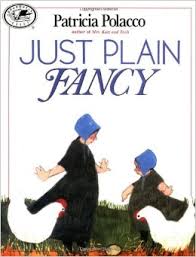
Then the girls find a strange looking egg abandoned in the field. Knowing that an egg needed a mama, Naomi slips the it under one of her own plain chickens, Henny, and is amazed at the little chick who emerges. Compared to the other chicks, this big guy is obviously very different. Naomi keeps what turns out to be the peacock chick a secret as long as she can–until Fancy escapes and wows everyone with a beautiful display of the fancy God gave him. If only everyone would live out the unique fancy God planted in each one of us.

In typical Patricia Polacco fashion, this story teaches oh-so-much about being human without a trace of preachiness.

What I lived
This week I toured Amish country in Shipshewana, Indiana. The area has the third largest Amish population in the country after Ohio and Pennsylvania. The highlight of the trip for me was a stop at an Amish school where the teacher spoke with us after the children had left for Amish schoolroomthe day. Because most Amish no longer farm, the Amish community is growing in northern Indiana; our tour guide said that at the current rate, it’s expected that their population will double every 20 years.

It’s probably no surprise that I was fascinated by the school since I’ve spent nearly twenty-three years as a teacher in the public schools. The teacher, a young man of thirty, had been teaching for seven years. He had no training–in fact, he had the same 8th grade education as his oldest pupils. He said he read and studied after he was asked by the school board to serve.

The school has fifty-eight students in one room; a curtain down the middle of the room puts four grades on each side. The children learn arithmetic, history, vocabulary and phonics, English, and German. The room was spartan by our English standards: desks were circa 1970s and very well-loved; overhead propane lights burned gas lamp mantles; the coat room floor was poured concrete, the schoolroom floors wooden.

Despite the lack of modern conveniences, though, by grades 6-8, most of the students in this school scored above grade level (often by 2-3 grades) based on the yearly Iowa Skills test they take. The report card average for this teacher’s students was 94%. There were no discipline problems–and if any should arise, he said they would be taken care of at the monthly PTA meeting. Both parents attended; participation was … 100%.

Community is more important than the individual in Amish way of life. Maybe that’s what we’re missing.

Today is day 5 of the Blogging from A to Z Challenge.  The challenge began with A on April 1 and continues the alphabet throughout theE
month, except on Sundays. My theme for the month will be this blog’s tagline: life, books, and all things bookish, so you can expect a little bit of this ‘n that. I’m still reading, though, and I’ll add reviews whenever possible. Thirty days of blogging is a huge commitment for me, but I’m looking forward to meeting and greeting new blog friends.

Today’s E word: Louise Erdrich


What I read 
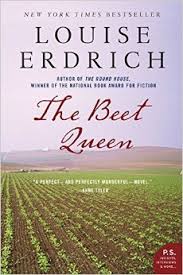
I went through an Erdrich phase after I started working at the bookstore, which means I was a little obsessed. I read her books, knew about Beet Queenher kids, her husband, and her bookstore.  The first novel I read was The Beet Queen, followed by Love Medicine, which is the flip flop of their release date. Every now and then, I’d pick up another book: Tracks, The Bingo Palace. I also read two of her husband’s books, Yellow Raft in Blue Water (fiction) and The Broken Cord (non-fiction). And of course I read the novel they co-wrote, The Crown of Columbus.

I wouldn’t be honest if I didn’t admit I had to follow the narrative carefully because it zig-zagged through time and characters like a honeybee in a clover patch. And while I know it’s not the case, for some reason when I think of Erdrich’s novels, it’s always summertime. (Have you ever done that? Placed your memory of a book square in a season, whether it’s accurate or not?)

I loved the idea of two married writers spinning similar tales with themes more alike than different. Until they weren’t and they didn’t–then they were like the rest of us who couldn’t get the idea of marriage straight.

It’s probably very sad that the little I know about contemporary Native Americans comes from Erdrich’s novels, but thank her muse that she’s brought that world to light. The poverty we sometimes saw was stark and real, but more often the tiny houses or trailers stuffed with tchotchkes were more like my Great Aunt Alice’s house than not. Maybe we weren’t so different after all. The Kapshaws, Nanapushs, and Morriseys weave a tangled web of family love, hate, confusion, and abuse–but somehow, somehow there was also belonging and a kind of ferocious energy.

What I lived
Our backyard had a tree fort and a huge sandbox and what we called a “monkey swing”, a round wooden seat on a rope that swung like a tire swing. A tree shaded nearly the whole yard, but there was still some sun left for the deck and growing raspberries behind the garage.

In summer, there was always a kiddie pool out–even when the kids were technically too old for a kiddie pool. Because then the pool was for filling squirt guns and pails good for water fights. Our little Bischon mix Muffy (aka Little Miss Muffet) tried to jump on the kids as they swooped past on the swing, but could never quite make it. She was in and out of the pool almost as much as the kids.

The boys had their games with swords and bats, a superman mask and cape–all that tough talk coming from skinny-legged heroes with striped tube socks pulled up to knobby knees.  The girls pushed stuffed animals and dolls in bitty strollers, usually shaded by a plastic umbrella, a patent leather purse slung over their shoulders, tres chic four-year-olds.

There was belonging and a sweet kind of love that was real.

Today is day 4 of the Blogging from A to Z Challenge.  The challenge began with A on April 1 and continues the alphabet throughout theD
month, except on Sundays. My theme for the month will be this blog’s tagline: life, books, and all things bookish, so you can expect a little bit of this ‘n that. I’m still reading, though, and I’ll add reviews whenever possible. Thirty days of blogging is a huge commitment for me, but I’m looking forward to meeting and greeting new blog friends.

Today’s D word: The Dollmaker.


What I read
No one has agreed on the Great American Novel yet, although many have set out to write it. I think The Grapes of Wrath and The Scarlet Letter are certainly contenders. Maybe Huck Finn. For me, though, Harriette Arnow’s The Doll Maker can’t be topped. It’s not a story, though, of our beginnings as a nation–but a story of how we came to be the productive super power that we are once were.

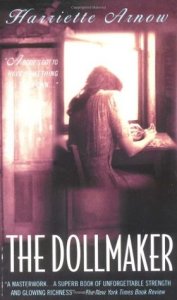
dollGertie Nevels is a power to be reckoned with. From the opening pages she’s turned down again and again after asking for help getting her gravely ill little boy to the doctor. Not a Good Samaritan to be found, she finally performs a makeshift tracheotomy in order to save his life. In Appalachia you make do. She’s also been secretly saving out money for years to buy her own farm by selling eggs and whittling dolls to sell. Wen her parents offer her a windfall (relatively speaking), she’s set to make an offer on a nearby farm.

Clovis Nevels, Gertie’s husband, has been called to Detroit to take his army exam. And while he’s turned down for the army, he does take a job in a Detroit factory. Because her mother thinks a woman’s place is with her husband, Gertie and her children set off to join him. Life in Detroit is a far cry from their simple home in the mountains. Crowded cheek-to-jowl in company housing, buying all their food from the grocery, unaware of the dangers of buying on credit, the family’s life becomes more tenuous than their hard-scratched life back home.

Through it all, Gertie holds on to a block of cherry wood brought from home, carefully planning her most exquisite carving, her life’s work. But life gets in the way and Gertie nearly loses everything. The novel  poignantly captures the move from rural life to the city–The Great Migration– where we see the cruelty of rural poverty set against the cruelty of urban poverty. Seventy-five years after the novel takes place, most Americans live in towns and cites. And, like Gertie, maybe we’ve lost as much as we’ve gained.

What I lived
It was the early 80s and Jane Fonda’s TV movie The Doll Maker was coming out. (Jane Fonda was big with On Golden Pond and her workout video.) Book clubs really weren’t a thing, yet, but one of the women in the babysitting coop wanted to read The Dollmaker and talk about it before the movie. Our discussion centered, I think, on the novel’s end which is powerfully symbolic.

My own world hadn’t yet crashed down around me–I was a married, stay-at-home mom with two little boys to care for. I can still see that pretty little house. An ordinary late-sixties colonial in most ways, the floors were refinished dark and shiny walnut, and the living room had a gorgeous Vermont Castings wood stove. The light in the house was clear and bright no matter the time of day. I had refinished a mission oak rocker I got for a song at a garage sale. The brass lamp was perfect.

Then, like Gertie I said, “All my life I’ve been doin’ what I was told. You’ve gone your own way always … and I’ve had to go too … don’t you tell me to do it your way. I ain’t doin’ it no more.” I cried when I left that house.

Seven years later I had a mortgage of my own. It is a near match for that beloved house, only a bit smaller. Like Gertie, I found my way home again.

Today is day 3 of the Blogging from A to Z Challenge.  The challenge began with A on April 1 and continues the alphabet throughout theA-Z Challenge month, except on Sundays. My theme for the month will be this blog’s tagline: life, books, and all things bookish, so you can expect a little bit of this ‘n that. I’m still reading, though, and I’ll add reviews whenever possible. Thirty days of blogging is a huge commitment for me, but I’m looking forward to meeting and greeting new blog friends.


Today’s word is [84] Charing Cross.


What I read
While I’ll always have an affection for bookstore stories like The Storied Life of A.J. Fikry and Readers of Broken Wheel, 84 Charing Cross Road is my favorite. If my copy is any indication of my affection, I’d say the book rates True Love. The nearly thirty-year-old binding glue holds together until about page 36 where the pages start slipping out. The paper is mellowed and musty and the corners dog-eared.

84CharingIn the first years after World War II, American Helene Hanff, playwright and TV screenwriter, begins a correspondence with Marks & Co., Booksellers in London after reading their ad in the Saturday Review of Literature. Rather than frequent New York City’s Barnes & Noble’s for her rather obscure titles, she relies on Marks & Co. for ordering.  Hanff’s list of classics (non-fiction, mostly essays, some Latin) suggested her eagerness to deepen her understanding of the world and explore the life of the mind. (Hanff was not college educated.) She was, she said, “a poor writer with an antiquarian taste in books”.

I’ll admit that I had no appreciation with the books that Hanff so desperately wanted: Landor’s Imaginary Conversations, Quiller-Couch’s The Pilgram’s Way, Walton’s Lives. But never mind. This is a story about the friendship that develops between a reader and a bookstore. After only a few months, Hanff is sending the store staff gift boxes with fresh eggs, meat, and coveted nylons for the ladies (England is still rationing even five years after the war). Fast friendships develop, but Hanff doesn’t have the means (nor, apparently, the will, due to a fear of travel) to visit London, despite promises to the contrary.

And when she does over a decade later, she is too late for many reasons. The 1987 film by the same name starring Anne Bancroft and Anthony Hopkins is a great companion to the book. Hanff wrote a sequel to Charing Cross about her visit titled The Duchess of Bloomsbury Street. It’s good, but not nearly as charming.

What I lived
I had probably only worked at the small independent bookstore for a couple months in 1987 and was reading as fast and furious as the staff could recommend. 84 Charing Cross Road was a must-read, I was told–and a bookstore book to boot. I was 28. My part-time job at the bookstore was only my third job anywhere–I had been a teen bride and an almost-teen mom and I had just spent eight years at home with my three young children. Today they’re called SAHMs and young women blog and boast about it. Back then, I just wanted some relief from the 24-7 nose-blowing, potty-training, play-doh squishing, and park-sitting. I needed a break and some autonomy–what a coup to snag a job where I could work among aisles and aisles of books. And was told to read books–oftentimes for free!–whenever I wanted. Every staffer there was a kindred spirit and I was simply over the moon at my good fortune.

That job changed my life in ways I couldn’t begin to have imagined and was an anchor in some pretty rough waters. Divorce. Single-parenting. College. And finally, a new job: teaching. But it’s a time of my life that I still treasure today.

Today is day 2 of the Blogging from A to Z Challenge.  The challenge began with A on April 1 and continues the alphabet throughout the A-Z Challengemonth, except on Sundays. My theme for the month will be this blog’s tagline: life, books, and all things bookish, so you can expect a little bit of this ‘n that. I’m still reading, though, and I’ll add reviews whenever possible. Thirty days of blogging is a huge commitment for me, but I’m looking forward to meeting and greeting new blog friends.

Today’s word is Buddy.


Ten years ago we were looking for a new addition to our family–our three-year-old lab Trixie needed a buddy to keep her company. Our local Humane Society was hosting a Bow Wow Meow Luau (I kid you not!), so it became our first (and only) stop. When I stepped through the door that led to the kennels, I was hit by a wave of sadness. The barking and yelping, the jumping–all  pups with no ball tossed in the backyard. No nights by the campfire. No sunbaths on the deck. No people. One of the volunteers greeted us after we had walked around a bit, listened to our story, then stopped and said, “I think I have just the dog for you.”

We turned down another row of kennels and stopped in front of a quiet run. Slumped against the chain link was a fat little beagle mix with a dull brown coat. He wasn’t jumping or pacing. Just waiting. My husband Brent bent down to pet him, then said, “Let’s take him outside.” The volunteer said she thought he was the best dog they had–that she had tried to get other families to look at him, but they wanted a puppy or a lab or a terrier. The best dog?! Our Trixie was a princess of a dog. Impeccable grooming, mannerly, eager to please with a twinkle in her eye. This was a … blob of a dog. He smelled. And his name was Spud–as in the potato.

When we took him to the outside run, the little guy played chase with a squeaky toy and paddled in a kiddie pool. Brent looked over at me and said, “He shouldn’t be in here.” What could I do but trust him? This is a man who could be called the Dog Whisperer, he’s that good with animals.

IMG_0480 (1)So Buddy came home that afternoon. (Yeah, I couldn’t deal with the “Spud” so we changed it–an overused dog name, I know, but Bud sounded enough like Spud to make the transition seamless.) He adored Trixie and would have curled up next to her every night if she had let him. (She didn’t.) They were best buddies and he was by her side as she aged and grew fragile. He was by her side as she passed over the Rainbow Bridge.

Trixie needed Buddy and Buddy needed us. And we needed Bud. He’s taught me that a great love can take root the second time around.  He’s taught me that looks don’t speak to what lives in the heart. (And truth be told, that makeovers are real–he’s a new and improved Buddy now.) Buddy has shown me that the best things in life are the small ones, that a ride to the grocery store, a green bean, a biscuit before bed are exquisite treasures.

He’s taught me that everyone needs a Buddy.


Today marks the first day of the Blogging from A to Z Challenge.  The challenge begins with A on April 1 and continues the alphabet A-Z Challengethroughout the month, except on Sundays. My theme for the month will be this blog’s tagline: life, books, and all things bookish. So you can expect a little bit of this ‘n that. I’m still reading, though, so I’ll add reviews whenever possible. Thirty days of blogging is a huge commitment for me, but I’m looking forward to meeting and greeting new blog friends.
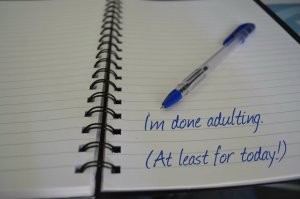

 

I’m guessing most of us have seen the I-can’t-adult-today-don’t-make-me or adulting-is-hard memes that pop up on Facebook or Instagram. And let’s face it, although they may sound a bit whiny, I sure can relate. I’m tired of my 5 A.M. wakeys and weekends grading papers. Eating healthfully can be boring. (Anyone care for some delicious broccoli quinoa bites?) My house payment sure would buy a whole lot of clothes or a nice vacation.

Adulting

modified from pdpics.com

It is rather amusing that what millions of sixteen-year-olds long for seems like a terrible idea after ten or twenty (or forty!) years of responsibility.

But flip that adulting idea on its head for a minute. Never mind the complaining. Forget the grumbling.

I’m done with adulting so I can wear sensible Olive Oyl shoes because being comfortable is more important than looking fashionable. I’m done with adulting so I can laugh with my students when they try to explain naughty lyrics to me as gently as possible–because through my eyes they sometimes see a celebrity’s silliness without me saying a word. I am done adulting so I can count a candybar as lunch and not worry because, after all, I’m really saving calories by only eating 260 for my “meal”. I’m done adulting when I bump-and-grind old school at line dancing because a little stompin’ and steppin’ is a whole lot classier than twerkin’ and doing the nae nae. I’m done with adulting when I talk to the geese at the park because, let’s face it–we’re all God’s creatures and on some level, they must understand. Right? I’m done with adulting so I can hit sticks on the sidewalk with my year-and-a-half grandson because … well, what else are sticks for, if not for smacking on the concrete?

So I won’t be adulting today, thank you very much. I’ve got a million things to do.

The Madwoman Upstairs (NetGalley)
Catherine Lowell
Simon & Schuster

Reading teaches you courage. The author is trying to convince you something fake is real. It’s a ridiculous request, and it questions the sanity of the reader. The extent to which you believe the author depends on how willing you are to jump in headfirst.

Madwoman upstairsSamantha Whipple arrives at Oxford University and finds the room she’s been assigned is an odd one: known as “The Tower”, it is five flights up, cold and damp with peeling walls, and reserved for famous students only. A painting titled The Governess hangs over a boarded up fireplace. The room, in fact, is so noteworthy that it is on the university’s historical tour.

Sam’s claim to fame–and the reason she’s followed her father’s footsteps to study literature Oxford–is that she is the last living relative of the Bronte family. The Charlotte, Emily, and Anne Brontes. Sam’s father, an author himself, nearly drove himself mad seeking to understand the lives of his relatives … and their famous works. Now, it seems, Sam is on the same path–trying to find meaning in every turn of the phrase and obscure biographical event. She is very much in danger of becoming the madwoman upstairs herself.

Her tutor, Professor J. Timothy Orville III will have none of it and tries to steer Sam to approach literature with more academic rigor. And she, in turn, will have none of that! (She does, however, fall in love with him along the way.)

Oddly, this is the second novel about a modern girl searching for the Brontes that I’ve read in the past few months–but God bless the interwebs because now it makes perfect sense. The 200th anniversary of Charlotte’s birth is 2016. The novel might be more fun for those of us who are fans of the Brontes because the references fly fast and thick. (While I’ve read Jane Eyre and Wuthering Heights, some of the more arcane references to the other novels were lost on me.)

Other than the Bronte references, it’s a light and breezy read–and Jane and Kathy fan girls will not be disappointed in this novel addition to Bronte lore.

Icely88

Icely88

After stumbling across William Henry Channing’s beautiful manifesto several years ago (you can read it on the sidebar over to the right) I knew that  if I wrote about what I truly loved, I would echo his call with my very own “This is to be my symphony!”

My reading life, my writing life, is an integral part of who I am. It took me over fifty years to embrace that, but better late than never, right? So I’ve taken a writing workshop. I’m reading about the craft (a grateful nod to Ray Bradbury and Stephen King and Annie Lamott). I write about books here.

I suppose it’s a readerly thing to say, but, it’s books and the characters in them who’ve lifted me and turned me and held me steady over the years. Stories. Those hundreds upon hundreds (thousands?!) of lives I’ve lived with have taught me what is important. More than friends and family. (Sorry, Mom.) More than any teacher. (Sorry, me!) Maybe, even, I’m rather sad to say, more than my church.

Here’s what I know from what I’ve read.

I know that when we’re disappointed in life, in people we’ve loved, and we’re tempted to look back at the good times and say “It was all a lie”, well, I know that’s not the case. I know that all those good times were just a genuine as the bad. We’re neither good or bad, one or the other. We’re all of us both-and.
Queenie and Harold  The Love Song of Miss Queenie Hennessey

I know that because I’m a faulty human with imperfections and shortcomings whose greatest desire is to be loved and accepted, then I must also embrace others, regardless of their own frailties and how they’ve disappointed us. I need to give what I’d want to receive.
Helen and Ben      A Thousand Pardons

I know that, in the end, what matters most is the people we live with. Not even our closest friends see us day after day, week after week. Tired. Weepy. Impatient. Oh, we confide in friends and have therapeutic heart-t0-hearts. That’s, after all, what friends are for. But do friends have to deal with our mud on the carpet? Hair in the bathtub? Bad morning breath? Toe-tapping when there’s still no milk in the ‘frig? Of course not. But it’s that daily grind that rubs us wrong that, in the end, polishes our rough edges and transforms us.
Red and Abby    A Spool of Blue Thread

I know that all of us, regardless of age, need to feel we’re necessary. That we have a role to play–that we matter. So I want to know that the time I spend making lesson plans and scrubbing out the sink count for something. That only I can give the hug that will make everything right. That if I suddenly wasn’t here, I’d be missed.
Ove    A Man Called Ove

I know that nothing is impossible. That there’s always either a way to make things better or a way out. Because I write my own story just as you, my friend, write yours.
Paloma  Elegance of the Hedgehog


With special thanks for writer and motivator Jeff Goins for his challenge to bloggers to write their manifesto. You can read his here.

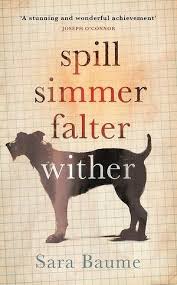
Spill Simmer Falter Wither (Edelweiss)
Sara Baume
Houghton Mifflin
release date: March  8, 2016

I realise that you were not born with a predetermined capacity for wonder, as I’d believed. I realise that you fed it up yourself from tiny pieces of the world. I realise it’s up to me to follow your example and nurture my own wonder, morsel by morsel by morsel.

There are not many books that leave me sobbing great heaves, my heart in my throat. Not many books that touch some deep darkness that not even I know exists. There are not many books that speak of the sweet tenderness that connects us to all creatures great and small.

But Irish writer Sara Baume’s first novel Spill into Falter Wither was just such a book.

spill simmer falter wither Once upon a time there was Robin and Ruby and Ray. But Ray doesn’t remember that time and since then has suffered neglect and despair. Ray never attended school. He never played with other children. His world was the little salmon-colored house in the village and the view he had from upstairs was his only window on the larger world. His father came and went (but mostly went), and Ray grew into some sort of understanding of his difference.

Ray had his books. The wide sweep of the ocean outside of Tawny Bay. Weekly visits to the post-office and grocery. Sometimes church.

Long years passed. Fifty-seven, to be exact. And a year after his father died, Ray brings home One Eye, a terrier mix from a sad excuse of an animal shelter. Like Ray, One Eye is damaged goods. Like Ray, One Eye is skittish, afraid even of tinfoil crinkling. Ray tries to win him over with sardines and chocolate buttons; he cobbles together a dog bed from a child’s easy chair so they can watch out the window together.

And so One Eye and Ray set out to rescue each other.   But can they? Is it possible to rescue another from sorrow and misery that has cut to their very center, leaving their spirit nicked and torn? Is it possible to make whole a heart that never had a chance to grow in the first place?

As if the story itself isn’t enough, Baume’s writing is evocative, her voice resonant. At times the pages read like poetry and it is a powerful and wonderful gift to come across a novel that allowed me to “nurture my own wonder, morsel by morsel by morsel.”


We’re only a day or two this side of MarchRobin, and the temperature in this cold Great Lake state was pushing the Big 6-0. The sun was bright, the sky blue, the clouds scattered–postcard perfect. I walked a couple miles in Riverside Park and no matter where I was along the trail, at least ten people were both ahead and behind me. (And nearly as many dogs!) Frisbees. Bikes. Strollers. The wind blustered and whipped around, but no one seemed to care. I stepped in puddles because they were … puddles (!), not banks of snow.

And it was one of those days that gave me a case of the pretty soons.

Pretty soon I’ll ditch my down coat and mittens–I’ll shiver my way to work at 6:30 a.m. without a coat (maybe a sweater if I’m feeling cautious) and sashay out the door at 3:30 as comfy as can be. Pretty soon it will be grilled ‘burgs on Sunday afternoon instead of pot roast. Pretty soon we’ll hear the Orioles calling “We’re home, we’re home!”, always a few days before we actually see them dipping into the grape jelly at the feeder.  Pretty soon the weekend soundtrack will be the voices of Jim Price and Dan Dickerson calling the Tigers game. Pretty soon we’ll grumble about cutting the grass.

We still have a few snow storms to weather, I’m sure. Ice-cold mornings mean I’ll keep sweaters and wool socks in rotation. I won’t put the Ice Melt away just yet. But the geese were flying low along the riverbank looking for a place to nest, I spied two robins in the park, and the sun still shines after dinner.

Pretty soon now, pretty soon.

Categories: Life