This is my symphony

What I read & what I lived …

Himself (NetGalley)
Jess Kidd
St. Martin’s Press
release date: March 14, 2017

himselfJess Kidd’s first novel Himself is a poignant and darkly funny story about a Mahony, a n’er-do-well Dubliner, who travels clear across the island to the idyllic village of Mulderrig to discover what happened to the mammy who (apparently) abandoned him on the steps of an orphanage when he was still a babe in arms and left without a trace. When an aged nun dies she leaves behind an envelope for Mahony with a photo of his mom Orla holding baby Francis–his given name. On the back is penciled “Know that your mammy loved you.”

But the quaint village, like small towns all over the world, is a place of rumors and lies and cover-ups. Mulderrig isn’t as innocent as it appears and Mahony soon suspects that his mother, rather than abandoning him, was killed. As Mahony sets about asking questions about Orla, he is greeted with disdain or curiosity, at best, and at worst, hostility. Orla was not a welcomed or respected member of the town. She was the “wild bad girl of the village” with a missing pappy and an drunk mam. By the time she was a teen, the wayward Orla had to survive using whatever means she could. And then there was her baby.

Mahony has the gift of second sight, and Kidd’s description of the world he sees is magical. Ghosts frolic on the lawn, play cards in the parlor, skip through the woods, and drift up to sit on the roof–and the author makes it seem so commonplace. The reader realizes about halfway through the novel, though, that those ghosts are clues. (Clues, I must admit, that this reader couldn’t unravel until the last few pages.)

Add to the other-worldliness of the story living characters who are endearing–or despicable. There’s Mrs. Cauley, the eccentric elderly actress who immediately takes Mahony under her wing; her winsome housekeeper and companion Shauna, who falls quickly under Mahony’s spell. There is a jolly barkeep, an unlikable priest, a grieving young mother, a mysterious recluse …

And darker forces are at work when someone first leaves a plate of poisoned scones for Mahony, then a bomb in the letterbox, and finally tries to bribe him to leave for America.

Kidd’s cast of characters–living and dead–are all brought together as Mahony and Mrs. Cauley stage a play, Hamlet-style, to flush out the killer. And, much like Hamlet there’s a fight, murder, a raving woman who knows the killer, and too many secrets to count.

If you’ve a friend who is a Hibernophile (Did you even know that was a thing?!), Himself would make a perfect St. Paddy’s Day surprise. Pop it in a bright green bag with a bottle of stout, a packet of crisps, and you’ll be fast friends forever.

I’m participating in Taking On a World of Words blog hop this week by answering three Ws: what I’m currently reading, what I just finished reading, and what I think I’ll read next. Comment with your own Ws below, and be sure to hop over to Sam’s blog to connect with other readers on her WWW post.

Release date: March 14, 2017

Currently reading:
I started Himself  by Jess Kidd (NetGalley) last week and it’s taken me to a time and place I’ve never been. Twenty-something Mahoney travels from Dublin to the small village of Mulderrig. He left as an infant, but it’s the circumstances of his leaving that rub. His mother, the village wild thing, disappeared without a trace one day, and Mahoney with her. So how did he end up on the doorstep of a Dublin orphanage? And with a photo of his mum with cryptic note penciled on the back: “Your mammy loved you.” Add to that the fact that Mahoney has a gift: he sees spirits. Right alongside the visible world, Mahoney sees ghost figures walking about, lingering nearly everywhere. Mahoney sets out to uncover the mystery of his mother’s disappearance with the help of an elderly eccentric Mrs. Cauley. The duo is sure to make friends and enemies, in the village and the spirit world, is my guess.

Release date: April 11, 2017

Recently finished:
The last book I finished was Elizabeth Gilbert’s Big Magic which really resonated with me. I’m lucky in that the writer’s studio I attend has a facilitator who believes in the serendipity of creativity, so the book itself was more gift than revelation. I’ve read some pretty harsh review of Big Magic (can you say New York Times?), but I think even the first few chapters are worth the price of the book.

Reading next:
I’ve been waiting for how many years for this one? Let’s see. The Historian was published in 2005, so that would make it an even dozen. Elizabeth Kostova’s new novel The Shadow Land is due to be released in April. The story is set in Sofia, Bulgaria once again, and from the publisher’s blurb, it includes an urn, some ashes, mystery, and danger. I’m taking bets on whether or not Vlad will make a reappearance in this novel. I can’t get to this one soon enough.   

Work has been busy (we’re mid-marking period, and I just collected an essay!) so I’m behind on my List; the sad fact is reading slows down considerably during the school year. The struggle is real, my friend. But thanks to Taking On the World Of Words and Sam for allowing me to tag  blog along every few Wednesdays.

Green is my heartThe rug was rolled and pushed with the bed up against the far wall. A chest of drawers sat catty-corner the door,  drawers emptied. She hadn’t painted a room since they tried to sell the house after the kids left for school, so she poured the paint into the tray with a too-quick slosh. Dipping the roller she started laying on wide swaths.
The latex stung her nose and made her eyes water. She reached and stretched and bent and dipped. The gray walls disappeared more quickly–and easily–than she had imagined.
“Prickly pear” the paint chip said. She hadn’t bothered with any other paint swatches once she read the name. Just the shade for a fresh start.
A roll up for all the times he’d slept at the office.
Down again for the nasty voice mails.
Another roll for bottles stashed behind the nightstand.
Back again for the smell of Listerine.
“Prickly pear” they called it. Prickly for her heart. Pears–unripe and bitter–for the leaving. And the paint fumes made her eyes tear again, just a little.

[The flash fiction “Green is my heart”, 2017 draft, appeared first on This Is My Symphony.]

big magicA few years ago I was cleaning out my file drawers. I use “file” here loosely because the drawers are an odd collection of miscellaneous ephemera: ticket stubs, campground maps, prayer cards, receipts ($12.97 at Meijer, and I saved this?!), and unopened mortgage offers. I’d just slogged my way through some serious upheaval and organizing is my go-to ritual. If I can’t put my life to rights, I can certainly put my papers in order.

At the bottom of one of the drawers I found a folder with a few stories I had written nearly thirty years ago. In another life I’d have been a writer, but I pursued a more practical path instead. I had kids to feed, a mortgage to pay, and ain’t nobody got time for make believe. Part of the fallout of these last hard years was that I had to put off retirement and pay the bills. I was the breadwinner once again–but a heartsick and weary one.

The stories reminded me of what could have been, I was mired in the misery (self-inflicted, mind you) of the wouldas and the shouldas, and I just wanted to forget the dreams. I flipped through the typed pages. Wondered if they should stay or go. And threw them in the trash.

As I did, I remember having some strange sense that those stories could never really be trashed. “They’re out in the universe somewhere–living on in some other dimension. I only set them free.” Maybe I’d done enough to just write them; maybe keeping them wasn’t the point.

So imagine my surprise when I read Liz Gilbert’s Big Magic last weekend and she confirmed my intuition. Ideas, says Gilbert, are “an energetic life form … ideas have no material body, but they do have consciousness, and they most certainly have will.” Ideas will tap us on the shoulder, knock impatiently on our hearts–waiting, waiting for us to give them welcome. Whenever we create (whether it’s story or quilting or painting or dancing) we embody those ideas and they come to make their home with us.

Now am I sorry I tossed those poor stories out? Of course. I think they know that I did so from a very sad place. But I also think they forgive me. Their brothers and sisters–story sprites!–come sit next to me and whisper sweet nothings in my ear.

And we are all of us happy to be alive.

She sat next to the bed in the same chair where she had first rocked the boys when they were teething and sleepless and then years later waited for them to come home, trying not to watch the clock hands make their way towards midnight. The shades were down, but she could see the August afternoon peeking in around the edges. The air was quiet and the AC had cooled the room until it was almost damp, cellar-like. She thought she could smell the damp earth crumbling beneath the house.flash fiction

She stared straight ahead, not moving. Dry-eyed, even now. It might be some sort of good luck that If she kept still enough, she wouldn’t break. If she focused on the closet door across the room, she might slow time. Maybe even turn it back–back to when she rocked those babies and fretted over teenage wildness.

“Mom?” It was Joe, whispering in the hall.
“Mom?” he said a little louder, daring to crack the door.
“No.”
“But, Mom … “
“Joseph Daniel, leave me be.”

And so the door pulled back, knob turning gently into the latch. Down the hall she heard dishes sliding onto the table, heard the silverware drawer rattle, smelled onions and garlic. But none of it for her. They kept their voices low, for that she was thankful.

“Maybe tomorrow I’ll be able to forget,” she whispered to the dark.

[The flash fiction “Remembering”, 2016 draft, appeared first on This Is My Symphony.]

He created them male and female, and he blessed them and called them “human.”
Genesis 5:2 New Living Translation

It was one of those late night conversations, just friend-to-friend over two (or it was three?) glasses of wine. My good friend turned to me and tossed out this zinger: “You approach life like a man.” I didn’t know whether to be insulted or take it as a compliment. Me, masculine? I was a single mom whose sole purpose at that point in her life was to nurture three kids through childhoods encumbered with all the messiness that divorce brings. I had loved a man as dearly as was humanly possible. I baked brownies and simmered homemade chicken soup on cold Sunmale and femaleday afternoons. I cross-stitched, for heaven’s sake!
But as much as I wanted to deny her assertion, I recognized the truth in what she said. I could be blunt and sharp-tongued. No nonsense.Get-down-to-business and let’s-not-talk-too-much-about-feelings. Impatient. Short-tempered. Kind of like my dad on his good days.

It only took a couple more decades for me to figure out that nature sometimes is nurture, and I was molded by what my mother and father modeled. But nature is also sometimes just … nature. And those masculine qualities were traits I was born with.They could serve me well in times of crisis when a cool he
ad needed to prevail. They could work against me when a more vulnerable approach was necessary. More importantly, I think, I’ve come to see that when humans are at our healthiest, we’re all of us male
and female, yin and yang.

When it comes to LGBT issues, I’m not well-read–and I’m certainly not savvy enough to be political about the issue. I do know people whom I love and admire and maybe that’s enough. I’m also drawn to stories of women and men who must come to terms with their feminine and masculine. Sometimes this is made even more difficult by the times in which they live, or the rules they believe they must follow to be normal or good. Which isn’t a thing, really.

There’s just you and me and all of the muss and muddle that makes us human.


Great reads about interesting human beings who bend gender rules:

Misfortune (Wesley Stace): A baby boy is thrown out on a trash heap in London, and his benefactor rescues him, only to raise the baby as Rose. Is this misfortune? Or is Rose Miss Fortune? (See what Stace did there?) It’s a romp of a read.

The Rebellion of Miss Lucy Ann Lobdell (William Klaber): Based on a true story, Lucy Lobdell initially disguises herself as a man after she runs away from an abusive husband. But after a time, Lucy comes to see herself as Joe.

Neverhome (Laird Hunt): A Civil War story with a twist. Johnny doesn’t go marching home; his wife does. Ash longs to go off to war–and adventure–but her husband Bartholomew does not. So she binds her chest and goes off to join a Union regiment, hoping to pass.

Middlesex  (Jeffrey Eugenides): I put off reading this Pulitzer Prize winner for a long time. I shouldn’t have. This three generation family saga tells the story of a Greek immigrant family’s journey to the U.S. The narrator X is diagnosed with a rare genetic mutation. So at age fourteen the child who was raised as the girl Caliope becomes Cal, the young man. Cal’s story is engaging, poignant, and not at all voyeuristic. It’s a must-read.  

In One Person (John Irving): If you’ve read me for any length of time, you know I love me my John Irving. This novel, however, isn’t his best–I just couldn’t leave it off the list.

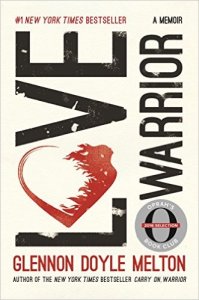
Love Warrior
Glennon Doyle Melton
Flatiron Books

“The journey is learning that pain, like love, is simply something to surrender to. It’s a holy space we can enter with people only if we promise not to tidy up … the courage to surrender comes from knowing that the love and pain will almost kill us, but not quite.”

love warrioI dragged my feet reading Glennon Doyle Melton’s latest book Love Warrior, even going so far as to skip over the title on my last two book orders because I was “in the mood for fiction”. (Hah! Can you say “ostrich”?!) Even though I’d watched Melton on Oprah’s Super Soul Sunday. Even though I loved her podcast on Elizabeth Gilbert’s Magic Lessons. Even though my very own therapist had recommended it.

Because who wants to read about a marriage that failed and then didn’t when your own can be like a ride on the Blue Streak? But read it I did, and I survived. In fact, after I finished it, I went back and re-read the end, marking up pages that need some more reflection.

Love Warrior is that good.

The first seven chapters bring us to the Big Divide in Melton’s marriage, the thing that made Melton a Warrior. She reveals that she became bulimic when only a tween and struggled with alcohol addiction in college and after until she got sober. The catalyst that brought her twenty-something-year-old self to recovery was a little blue line on a pregnancy test. Not sure what part her boyfriend would play in their future, Melton was certain she would have this baby. A whirlwind engagement and wedding followed and the two played their roles as faithfully as they knew how. Eventually, Melton wrote about the messiness of family and relationships on her popular blog Momastery and also in her first book Carry On, Warrior.

Three kids and a cross country move later the bottom fell out of the world she tried so carefully to create: Melton discovered her husband had a series of affairs throughout their entire marriage. She was done. It was over. There are no do-overs in the face of such betrayal.

And so what started as Melton’s own personal quest for wholeness without her husband became the very glue that patched them back together*. Melton is brutally honest, insistent. Women have for too long separated themselves from their breath, their bodies, their Life’s Work; we end up an empty shell that serves neither our families or our own happiness. Coming back into our own skin and embracing even our pain is the only way to save ourselves.

And when she recognizes the Grace that had been extended to her, she realizes it is her great privilege to extend it to her husband.

Glennon Doyle Melton has given women committed to faith and family a much-needed treatise for a new kind of feminism, one with fewer ties to politics and more to the spiritual.

“Love, Pain, Life: I am not afraid. I was born to do this,” writes Melton on the final page. Them’s fightin’ words, Love Warriors.


* The  after-afterword to Melton’s story is one about which, I’m sure, she’ll write. You can find it on her August 1st blog post, and even more of her story on her Facebook page.

She was ready, almost. Her hair was sprayed and she had Dippity Do’d two perfect spit curls by each ear. Her lips were glossed over with Bonnie Bell. Her jeans, riding low, were wide and scuffed along the floor, just right. When she turned to look in the mirror, her peasant blouse gathered in all the right places. Her first ever 7th grade mixer and time to run down the street to pick up Terri, then around the corner for Karen. Their clothes and hair had been planned over too many back and forth phone calls to count and they each had a wish list of which boy would ask them to dance.
Catching some of her excitement, the dog yipped and ran circles around her feet. Before she  banged out the back door, she stopped in the kitchen, opened the baking cupboard and reached behind the nutmeg for the little brown bottle. She unscrewed the red cap and breathed in the heady sweet smell of being thirteen. Then she dabbed a spot of vanilla behind her ears, on her wrist. And she was out the the door and on to bigger things.

[The flash fiction “Mixer”, 2016 draft, appeared first on This Is My Symphony.]

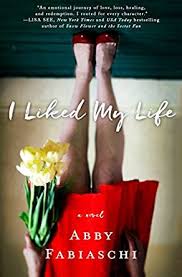
I Liked My Life (NetGalley)
Abby Fabiaschi
St. Martin’s Press
release date: January 31, 2017

Maddy is dead. Jumped, apparently, from the campus library where she worked. Or I should say, volunteered. Maddy’s full time job is was I liked my lifetaking care of her CEO husband Brady and their teenage daughter Eve. She was one of those Super Moms: dinner at the table set with china each night, PTA workaholic and team mom, cheerleader for a husband preoccupied with work. Maddy not only did it all, she did it well. And as if those accomplishments weren’t enough, she was kind, insightful, patient, and understanding. Then why did she jump?

That’s what Brady and Eve are trying to figure out as they make their way through their grief. They are angry and brittle. Short-tempered and quick to blame. Since Brady was so often at work, he and Eve never had to navigate the waters of their relationship. Maddy was always there to plan their time together, to smooth things over. Brady hasn’t ever managed household tasks, let alone a teenager. They eventually come together over Maddy’s journal where they discover that she often felt unloved and unfulfilled–and both realize they had taken her for granted.

Writer Abby Fabiaschi lets dad and daughter each tell their story in alternating chapters. And Maddy also narrates–you see, Maddy is dead, but stuck somewhere between her life on earth and the afterlife. She watches Eve and Brady and even “talks” to them which they somehow feel, if not hear. And once a Super Mom always a Super Mom: Maddy is also trying to choose her husband’s next wife.

I Liked My Life is the tale of a wealthy suburban family with its entitled kids and alcohol and swingers and more alcohol and corporate climbers. It’s not always pretty world. But even though Brady and Eve lost what held them together, they come to realize that Maddy not only liked her life, she loved her life.

Then why did she jump?

Fabiaschi’s first novel is a quick read that kept me turning the page. A perfect weekend read to escape from the busy workaday world.

I liked it.


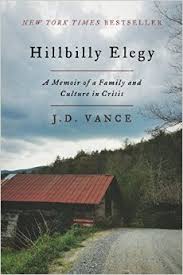
Hillbilly Elegy
J.D. Vance
Harper Collins

I first heard J.D. Vance talk about his memoir on Fresh Air last August–a month later, my The New Yorker  featured Vance and the book. hillbilly elegyThrough the summer and into fall, I could hardly listen to a newscast or talk show without hearing his name. This thirty-something Appalachian native was man of the moment, and his experience was said to provide an explanation for the rise of Trump and the Alt-Right movement.

I’m not sure I’d go that far.

But I do think Vance lays open the lives of people we don’t see on TV (unless you count the Beverly Hillbillies which could hardly be considered as social commentary) or read about in Newsweek. Vance’s family roots are in the hills of Kentucky and southern Ohio, where life is hard-scrabble enough without the added stress of coal and steel plant closings, unemployment, and the opioid drug epidemic. Vance speaks lovingly (but honestly) about his maternal grandmother, Bonnie Vance, who gave him the structure he so desperately needed growing up–even though Mamaw was a gun-toting hillbilly who had a gift for foul language and wouldn’t think twice about throwing a punch if she thought it was warranted. He grew up idolizing the men in his family who drank and drugged and womanized, but would fight to the death for their family honor. People who are not only suspicious of outsiders, but of the culture and values of Middle America.

But I think his revelations have as much to do with poverty as with geography. Most teachers are familiar with the work of Ruby Payne, whose influential work Framework for Understanding Poverty differentiates between situational and generational poverty and explains how upper, middle, and lower class values are at odds.  I heard echoes of Payne’s work in Elegy. Over the twenty-some years I’ve been a public school teacher, it’s clear that many students (even those in my small Midwest district) don’t fare well in school because they grow up in many of the same circumstances as Vance’s hillbillies: unemployment, drug and alcohol abuse, the glorification of violence and sex. And students succeed in school–even despite adolescent rebellion–if they’ve been taught to value hard-work, delayed gratification, self-discipline, and ambition. If you’re unemployed through no fault of your own (say, a plant closing), no amount of hard-work will bring back that factory–and any ambition is useless. That cycle–the one Vance grew up in–is an incubator for abuse, addiction, and family disaster. It’s not the color of your skin or where you live so much as it is learning what must be valued to move ahead.

What I found most compelling was Vance’s life after he left college and law school when he comes to recognize that the ways he had coped for years weren’t working. That isolation or lashing out or running away weren’t going to serve him well as he developed relationships in the wider world. What works in Kentucky doesn’t in D.C. or Chicago. Payne would say he had to learn the hidden rules of the educated middle and upper classes to be successful. It was Vance’s refusal to accept the dysfunctional coping mechanisms he learned growing up that touched me most.

For all that Vance has been in the spotlight, he’s also received some criticism, most notably from Progressives–Sarah Jones’s article in New Republic provides an interesting counterpoint and more food for thought. Hillbilly Elegy is a fascinating look into a world I knew little about.

But in the end, this is one man’s account and it might best be read as a story of his transformation.