This is my symphony

What I read & what I lived …

Knit Two
by Kate Jacobs

Another round of Friday Night Knitting Club and I’m buying it all the way. Take up knitting? Me, too! Bake some muffins? Me, too! Go to Rome? Me, too! Open a bakery? Me, too! Live in New York? Me, too! Kate Jacobs strength is not necessarily in fine writing–but in making her readers care about her characters. I want to be part of their world … and so I power-read through Knit Two, happy all the way.

Several years after the death of Georgia, Dakota has finished a year of college, teetering on the edge of adulthood. The rest of the ladies have moved on–Darwin has twins, Lucie struggles with single parenthood, Anita anticipates marriage to Marty, Peri runs the shop. It is perhaps Catherine who transforms herself the most–going from self-absorbed socialite to a woman who gives up the mask she’s worn, finding, at long last, who she wanted to become.

Improbably, half the club find themselves in Italy for the summer. Dakota accompanies Lucie to nanny, James tags along to watch over Dakota, Anita searches for her long-lost sister, and Catherine goes … just because she can, I think! Nowhere but in a novel would such circumstances evolve–but somehow, it doesn’t seem far-fetched. Jacobs touches on some big issues–single-parenting, aging parents–and knits each situation up neatly with no raveled edges. Certainly not very much like life, but satisfying enough for a spring weekend. In fact, should there be a third Knitting Club novel … I’d very likely pick it up again and willingly let myself be transported to Walker and Daughter on the Upper West Side.

Cutting for Stone
by Abraham Verghese

From the very first pages, I heard echoes of John Irving in Verghese’s first novel: the exotic setting, strangers in a strange land, and unbelievable (and yet SO believable!) twists of fate. Imagine–a British doctor and an Indian nun work together in Ethiopian mission. Sister Mary Joseph Praise finds herself pregnant with Dr. Thomas Stone’s baby, and dies giving birth to Siamese twin boys. Stone, attending the birth only in the latter moments of Sister’s life, attempts to save her by (unsuccessfully) crushing one of the baby’s skulls. The mission’s obstetrician arrives at the last moment, safely delivering the twins by C-section. The boys’ conjoinment, it turns out, is minor–they are attached only by the flap of flesh on their foreheads that is easily detached.

Preposterous. Yet totally reasonable in this convincing novel. The story of Marion and Shiva Stone is a riot of Ethiopian sounds and smells and tastes and
sights. Stone, devastated at Mary’s death, leaves the mission with only the clothes on his back, and isn’t heard from again for twenty-some years. Indian obstetrician Hemlatha is at one of life’s crossroads, and fostering the boys, mothering the boys, gives her a life she dared not imagine. Hema and internist-cum-surgeon Ghosh (who is Stone’s replacement in more ways than one) create a family and find joy in each other. The boys share a magical bond–Marion, ever practical and often altruistic; Shiva, a genius who lives in the moment with seemingly little concern for others.

Events and a woman (isn’t it always a woman?) find Marion in New York, finishing his internship at an inner city hospital. Rudderless, Marion tries to reconnect with his Beatrice, only to have that connection bring him close to death. It is Shiva who comes to Marion’s rescue, along with Hema and Thomas Stone. N0 spoiler alert here–but suffice it to say, with only 75 pages to the end my guess as to who would die was wrong.

If I have any criticism of the novel, it is that Verghese leaned a little too heavily on medical technicalities; I didn’t need to know quite so much about the repair of fistulas or TB or even cirrhosis of the liver. I’m guessing the doctor in the author (for he IS one of those physician authors) got the better of him at times! And near the end, when, say, I STILL couldn’t figure out how the novel would end, I did tire of the plot twists–every corner I turned, it seemed, held another gut-wrenching event. But I reminded myself that Irving writes in much the same manner, seems preposterous himself at times, and still brings me back for more.

It was not without surprise, then, that as I read the author’s meticulous acknowledgments I found the following: “I am grateful to John Irving for his friendship all these years. I have learned so much from him both in our correspondence and in his published work.” Abraham Verghesse has obviously done more than one successful internship, and his mentor’s influence shines brightly.

Next up: finish my February New Yorker! This was a long one at 657 pages.

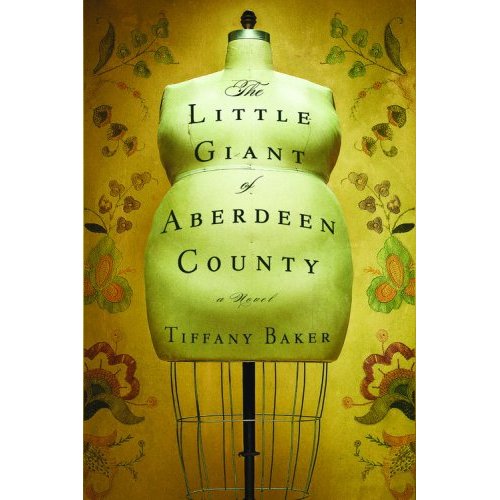
The Little Giant of Aberdeen County
by Tiffany Baker

–but not the kind in the cable series! Truly Plaice’s life would be extraordinary whatever her circumstance. Born with acromegaly, she is, indeed, a giant. Truly’s mother Lily, sick with cancer, struggles to deliver this incredible child, all the while composing a letter in her mind to the baby she assumes will be a boy. Her dying words are that letter’s closing, “Yours truly” … but the doctor catches only a whisper, and assumes Lily had named the child.

As in most stories where a mother dies leaving her infant children and grieving husband, Truly’s childhood was the stuff of fairy tales: a drunken father, poverty, separated siblings, and menacing authority figures. What distinguishes Little Giant from fairy tales, though, is Truly’s medical condition and her village’s reaction to her. Shunned, hidden away, and mercilessly teased, Truly sees herself as others see her: ugly. While Truly adores her older sister Serena Jane, even that love is rejected. Instead, Truly bonds with Aberdeen’s other outcasts–a speech-impaired girl and an eccentric young genius.

Time is not kind to Truly; she eventually seeks out medical care from one of the very boys who bullied her throughout childhood, but the prognosis is not good: Truly will continue to grow (in both height and heft) until her organs give out. While her life sounds grim, Truly does make a kind of truce with the circumstances that surround her. She gently raises her sister’s child and falls in love of a sort.

Even more important, Truly finds she possesses a gift. Housekeeper to Dr. Bob Morgan, last in a long line of Morgan doctors who ministered to Aberdeen residents, she uncovers the family’s long lost secret. That first Dr. Morgan had married the town witch who secreted away her spell book before she died. Truly discovers that Tabitha Morgan had “hidden” the spell book in plain sight–and she begins to unravel the dangerous secrets of herbs and potions.

To be honest, I was worried that, as the story grew grim, the novel’s ending would be unresolved, even unhappy. But while I wouldn’t say the ending was happy in a fairy tale type of way, it was satisfying enough. Little Giant is the type of book I love to love–a pinch magic, a dash of love, and a good dose of healing. A cover review compares Baker’s story to Alice Hoffman’s and I couldn’t agree more.

Just started: Cutting for Stone by Abraham Verghese. What few pages I’ve already read are compelling. Quote I think I’ll always remember: “Remember the 11th commandment. Thou shalt not operate on the day of a patient’s death.” Can’t wait to give this book some more time–I’ve finally got my AP class’ essays graded, so I might be in luck tomorrow! (Except then I’ll have my yearbook proofs nagging away …)

Mornings on Horseback
by David McCullough

I was intrigued with McCullough’s premise–to unfold TR’s life to the point where he “came to be” the TR we know from history. And so McCullough writes of Roosevelt up to his run for mayor of New York. I have to admit I knew so little of Roosevelt–mainly, the caricature we have of him in our 8th grade history books: he of the spectacles, bushy mustache, and toothy grin. So with a day off school after we were blanketed with 10 inches of snow, I finally finished the biography I’ve been chipping away at since Christmas.

McCullough spends a great deal of time on TR’s incredible childhood. Wrapped in love and privilege, his interests in science and nature were nurtured and encouraged–in part, because his frequent asthma attacks sometimes brought him to death’s door. Small, bookish, incessantly curious, and wonderously intelligent, Thee (as family called him) was adored by his sisters and brother. The family of six (plus the requisite servants) toured Europe for a year and spent months on the Nile.

I also had no idea that Roosevelt was married to the beautiful Alice, only to lose her four days after the birth of their child. It was in the three years after her death that he spent in Dakota, living the life of a rancher. Baby Alice was left in the care of her Aunt Bamie. Pushing himself to the brink physically, Roosevelt drove cattle, chopped wood, and hunted grizzlies at a furious pace in an attempt to bury his grief. TR never spoke again publicly about his first wife and felt he had failed when he married again three years later. He had hoped to “he would never remarry–as a testimony of love for his beautiful, dead wife, his first and only great love.”

A page later and the book is ended–TR is off to England to marry his second wife, Edith Carow; he has just lost the race for mayor of New York. McCullough felt that at that moment, the historical Roosevelt was finally formed and he would go on to become the Rough Rider, Governor, Secretary of Navy, Vice President, and, finally, President who made his mark on American history.

Next up: The Little Giant of Aberdeen County by Tiffany Baker


Comfort Food
by Kate Jacobs

If a book could be a grilled cheese sandwich with tomato soup, this novel by Kate Jacobs would be just that. Nothing special, no fancy twists or turns–but satisfying all the same in a … comfort food kind of way. Rather typical chick lit, we’ve got the single mom (a widow this time), a young woman with a mysterious past, an even younger beauty queen trying to scratch and claw her way to fame, and, of course, the requisite hunk. What probably made the book work for me was the fact that the main character had a show on the CookingChannel–a slightly veiled stand-in for the Food Network. As a foodie who follows any number of celebrity chefs, part of the charm of the novel was trying to spot “my” celebrity chefs in the novel–but I have to admit the connections were pretty limited. If you’re in the (reading) mood for a light snack, Kate Jacobs novel just might hit the spot.


–for blogging, at least. Sometimes frugal to a fault I hesitated buying this NPR recommended book–but my husband ordered off my wish list as a bit of “Happy Winter Break” reading material and it’s definitely a keeper. While I was initially drawn in by the stories of the help, it was Skeeter Phelan’s story that continued to draw the narrative forward. The lives of Abileen and Minny didn’t really change (although we understood with the death of Medgar Evars that Change was on the way), but Skeeter, a Junior League member standing just on the outside of the Southern Belle circle, evolved as she took down the stories of the colored women who served her family and the families of the other League members.

Skeeter begins her journey mourning the loss of the black woman who raised her and also her status as a “spinster” at age twenty-four. Thinking that since marriage wasn’t currently an option she’d find meaning in a career, Skeeter gets a part-time job at the local newspaper writing a household advice column. Knowing nothing about homemaking (since the help had done all things domestic in her family) Skeeter turns to Abileen, the maid of her best friend for help. Ablileen provides the substance Skeeter needs to write her column–and ends up throwing Skeeter the lifeline she needs. We see Skeeter as she comes to understand the lives of the black women she lived with side-by-side, as she gives up her chase to find a husband, as she throw off the propriety of the fifties to embrace the freedom of the sixties.

A compelling good read.

Finn
by Jon Clinch

I’ve prevaricated and stalled, I’ve come to a standstill, postponed, and delayed writing another post about Finn–and last night I finally gave myself permission to put it on hold until I’m not in school. I think during the school year I’ll need to go light and, if not exactly, cheerful, then at least redeeming in some way. Now I’m not saying that Finn won’t end on some revealing and uplifting note (though I have my doubts), and I’m not one who has to read all things sweetness and light. But I came to the conclusion that it was just too much right now. So I’m off into Kate Jacob’s world again in Comfort Food.

Finn, the story of Huck Finn’s father, is dark and menacing. We see the Widow Douglas, the huckster preacher, and the judge who welcomed Finn into his house in an attempt to reform him–all through Finn’s eyes. Though the boy Huck does appear in the book at the halfway point, he is a flat character–almost a placeholder. It is Finn’s twisted mind and sinister spirit that prevail, and we see him battling his cold and powerful father, falling into a relationship with a slave, and conceiving a son by her. Yes, Huck is, in Clinch’s novel, biracial–he is Huckberry because at birth he was dark as a huckleberry. A strange twist, a bit unbelievable, but certainly fitting in this novel. Sometimes poignant, often violent, and misogynistic throughout, Finn is a heavy read. And so I’ll need to return another day.


Crow Lake
by Mary Lawson

I started reading Crow Lake the Friday before school started and put it down reluctantly after only a few chapters–and, of course, the busyness of the new year kept it lying on my dresser for the past five days. With B. gone all day, I was able to take it up again–and couldn’t stop.

The hinted-at Greek tragedy wasn’t as monumental as I would have thought–although, I suppose, that just may have been Lawson’s point. Kate Morrison took her brother’s fate to a realm that was more her fantasy than his reality, and so what she leads us to believe is a tragic fate is simply … life happening. Lest I sound glib about orphaned children, an unplanned pregnancy, murder, and a university education left behind, the “life happening” was difficult. But difficult in the way that our lives are messy, complicated, and often fall short of our expectations.

What I found most disturbing was Kate’s emotional vacuum–until I realized that I’ve done the same when living through a crisis. In fact, I would be hard-pressed to recall my own emotional life during those years of single-parenthood. Most compelling was Kate’s realization that the family history she had created was more fiction than fact–based on the life she had wanted them all to live, on the people she had wanted them to be. That’s probably the single-most important lesson I’ve learned in the past several years–that love is much easier (and rich and satisfying) when you love the person who IS, not the person you think you want them to be.

Crow Lake is a good read–and Lawson’s insight is spot on.


Murder at the Watergate
by Margaret Truman

I may be the last reader on earth to try one of Margaret Truman’s Washington “Murder at …” series. A colleague who moved on to another job left it in a crate of books for me to use at school, and I snagged it at the end of the summer while setting up my room. Murder at the Watergate was a surprise–light, breezy and entertaining. Truman shamelessly “place drops” (rather than name drops), so it’s a perfect fit for a news addict like me. I read it over Labor Day and it was a fun cap on my summer reading. I’ve long been a Grisham fan for light reading, but have been disappointed in some of his more recent law books. (Does anyone else think he’s lost his knack for an ending with a twist?) I think when I need fluff, I just might move through some of Truman’s other Murder at … titles.


The Photograph
by Penelope Lively

So while the piles of papers hooked me, I’ve not read a book since Olive Kitteridge where the main characters are so very unlikeable. Elaine is a driven, hardened woman–really such a cliche–while her husband is a feckless ne’er do well who rides on her coattails (another cliche!). TV historian Glyn is really Elaine’s counterpoint, and all the while, Kath (we were to assume she was the shallow character) was the lost, misunderstood soul whose gorgeous exterior hid a bleak interior life. Because of the cliches (perhaps) I really didn’t feel compelled to read pell mell, which was sad, considering the summer is ending and reading time will become dear; rather, I soldiered on and finally finished.

But those piles of papers slipping and sliding out of the landing cupboard did keep me going. Glyn’s pursuit of the truth (one, mind you, that he didn’t care to find while his wife was living) was manic–and I thought of dad’s tortured retelling of his early years. He, too, was manic–and also skewed, I’m guessing, every nuance he found in the photos. Glyn did the same, perhaps hoping to find himself the sympathetic one after living years of self-absorption. Hmmmm. Sounds disturbingly similar to dad’s account–and perhaps for the same reason.

Sidenote: Isn’t “detritus” one of the best words in the world? I just love it!