This is my symphony

What I read & what I lived …

https://youtube.googleapis.com/v/0sPr4snZqcM&source=uds

Rotten Tomatoes: 46%. IMBD: 7.6/10. Odd discrepancy, maybe. Of course, the focus of Rotten Tomatoes is more movie critics–I read just a couple and, for the most part, they were disappointing: “Death as a tooth fairy“, “not a little dull“, “no real feeling for the catastrophe“. The blurb on the site reads, “A bit too safe in its handling of its Nazi Germany setting …” And it was–too “safe”. As I wrote about in my review (link), the novel had twelve-year-old children shouting “Heil, Hitler” and burning books and marching in Hitler Youth parades. In today’s politically correct climate, I couldn’t see any of that translating to the screen; and, quite frankly, it just might have been too inflamatory for a world that still hasn’t worked through our issues of otherness and hatred and oppression.

But I couldn’t help but wonder if the reviewers had read the book. I suppose that should be beside the point because the film should be able to stand on it’s own–and, according to many reviewers, it didn’t. My husband hadn’t read the book, but when I filled in some blanks for him, the movie worked. It was certainly beautiful–all in shades of brown and gray and taupe with a sky almost always pale, rarely blue. Geoffrey Rush was a perfect Papa and Sophie Nelisse played up the contrast between Liesel’s angelic side with her feisty approach to life’s disappointments. Rosa Huberman was perhaps a bit too soft–the reader waited nearly half the book for Mama to become sympathetic.

I was not disappointed in the movie, but it couldn’t even begin to touch the poignancy of the book. In Markus Zuzak’s Book Thief, Death was most definitely not a tooth fairy, but a character in his own right, one who dawdled and bantered, laughed and cried. And Zuzak didn’t give us Nazi Lite. He showed us life under the Third Reich through the eyes of a German citizen–sometimes burdensome, often constricting, but overall pretty routine after a while. And isn’t that, really, the horror of Nazi Germany? Or any evil empire, for that matter? It becomes unexceptional. And when we accept evil as commonplace, we’ve begun to lose our humanity.

So read the book. Then enjoy the movie.

The Book Thief
Markus Zusak

The Book Thief  has been on my Amazon Wishlist for ages; published several years ago and a New York Times bestseller for now a second go-around, it seemed like good summer reading. Okay, so a novel about Nazi Germany might not be everyone’s idea of a beach book, but what can I say? And from the first page, I was (dare I say?) enchanted by the narrator: Death. A kinder and gentler death, to be sure, but Death all the same. It was a poignant and powerful device.

Liesel Meminger is on her way to a new life with a foster family. The year is 1938; her father, a communist, has disappeared with the advent of Nazi rule, and her mother fears she’ll be next. So Liesel and her little brother are off to Molching, a small village just outside of Munich. Hans and Rosa Huberman were anxiously expecting them and the small stipend that would accompany the children, stretching the family dollar a little further. But  little Werner dies along the way, leaving just his big sister to meet her foster family–and refusing, once she arrives, to budge from the placement agency’s car.

We know from the first that Herr Huberman, Papa, is one special man. He coaxes Liesel from the car, shows her how to roll a cigarette for him. He plays the accordion and brings life into their cramped home. He helps Liesel navigate around the treacherous Frau Huberman, whose swearing and yelling and name-calling are legendary. But perhaps most important of all, Papa teaches Liesel how to read–he paints letters and words on the walls in the cellar and pours over the book Liesel found at her brother’s gravesite: The Grave Digger’s Handbook. (Other than that one teensy spoiler, I’ll let you discover who the book thief is and how the books are stolen.)

Liesel navigates school and afternoon soccer matches in the street and wins the heart of Rudy Steiner, friend and confidant extraordinaire. She helps Mama deliver the laundry, attends her Hitler Youth troop–and marches in parades and sings Deutschland Deutschland Uber Alles and shouts “Heil, Hitler.” I think this might be the first novel I’ve ever read set in Germany in World War II where the main character is an active participant in Nazi life and it was a bit of a shock. But very little in this world is black and white, and Liesel soon finds out that life in Nazi Germany is many shades of gray.

Zusak scatters the pages of his novel with unexpected lists, labels, and asides. Here’s the list that begins Part One: “himmel street–the art of saumensching–an ironfisted woman–a kiss attempt–jesse owens–sandpaper–the smell of friendship–a heavyweight champion–and the mother of all watschens”. There are also two handwritten and illustrated books, one written by Liesel and one by a Jewish friend of hers. Which probably should have alerted me to the fact that The Book Thief  is marketed as a Young Adult novel. But because it’s been several years since the book was first published, I either forgot or totally missed the initial hype (Read: I had no idea what this book was really about) and was fairly surprised at the target audience.

Young adult fiction or no, The Book Thief  is poignant and thought-provoking and beautifully crafted.

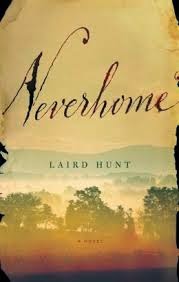
Neverhome (NetGalley ARC)
Laird Hunt
release date: Sept. 2014

Ash Thompson sets off down the road to fight Mr. Lincoln’s War. The family farm in Indiana was an idyllic place–a barn with a hayloft, a grove of trees, horse corral, “good chairs”. A blissful place for a young couple to start their lives together. But one of them had to defend the Republic: Ash was strong; her husband Bartholomew was not. That’s right–her husband. Because Ash was really Constance, and she was fighting her past as fiercely as she would fight the rebels.

So with bound chest and  hat pulled low, she sets off and soon joins a band of other men and boys looking to enlist. Ash arm wrestles, drinks whiskey with them, sleeps under the stars with them and finally reaches a
Union camp by a river where she is rewarded with a muzzle loading Springfield (“and  they said you could use it to kill a man a quarter mile away.”) and a shovel to dig latrines.

Ash sets himself apart as a quick shot and a hard worker–there’s no task he doesn’t undertake with single-mindedness. He becomes legend when he breaks rank to scale a tree to cover a woman who, overcome with fervor at seeing the blue boys marching past, immodestly rips open her bodice.  Later that night, a fiddler starts in with a new tune around the campfire, “Gallant Ash went up the tree and helped a sweet old girl along …”

I was slow to warm up to Ash and his story; it moved slowly. Until author Laird Hunt whispers of Ash’s past and I was drawn in to wonder at the mystery of Ash’s mother’s death and whatever pain had come between Ash and Bartholomew.

Hunt tells Ash’s story lyrically–even the horrors she experiences take on a kind of haunting beauty. Her friendship of sorts with her unit’s commander is a thread that weaves through her story to the last and the respect they showed each other was genuine. When Ash is taken prisoner the novel was a bit reminiscent of Paulette Jiles’ Enemy Women and I don’t as a rule like novels with similar plot lines. But the novel’s last few pages bring Ash and Constance together as they fight off each of their demons, only to lose and win the very same fight.

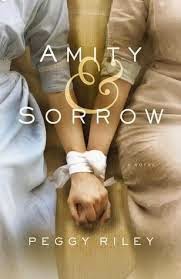
Amity and Sorry
by Peggy Riley

“Two sisters sit, side by side, in the backseat of an old car. Amity and Sorrow. Their hands are hot and

close together. A strip of white fabric loops between them, tying them together, wrist to wrist.” And with those first lines, I’m hooked. The girls’ mother, Amaranth, is running away from her polygamist husband, the Father. As in, “God, the Father.” (Can you say “megalomaniac”?) Amaranth is wife #1 of fifty. That’s right–fifty women with their infants and children, living off the grid on a secluded compound.

My biggest surprise, though, came when it was soon clear that the sisters weren’t six and eight, which was the age I filled in for them. These sisters with the evocative Quaker-like names were twelve and sixteen–and that gave the novel a whole different spin.

Amaranth barely stops along her escape route. Not, at least, until she wrecks the car near the down-on-their-luck Bradley farm in Oklahoma. Forced to stay put for however long, Amaranth is at first an automaton, the rules from her previous life still ringing in her ears: fields are forbidden! enter no man’s house! We watch as Amaranth slowly discards those rules, if only to survive. Twelve-year-old Amity, though skittish of life on the outside, has an easier time throwing off the strictures of her old life. But Sorrow’s scars run deeper than anyone suspects.

Author Peggy Riley’s portrayal of the shattered minds of these women is penetrating. Amaranth, quite rightly, exhibits some of the symptoms of Stockholm syndrome. The girls are totally uneducated and unschooled, unable to read or write, ignorant of television and libraries and computers; Amity doesn’t even know from whence they came–she has never seen a map, doesn’t know the meaning of “Utah” or “Oklahoma”. Their total naivete is jaw-dropping.

Aside from the preacher Father (Riley offers him neither excuse, nor absolution), the men in the novel are treated with sympathy. Bradley also knows loss and heartache. Dust, the half-breed Bradley adopted, lives with the isolation of bigotry. Old man Bradley is trapped by age and infirmity in his bedroom.

But then every character is trapped in Amity and Sorrow, some literally for a time, but then metaphorically. And I’m reminded of the title of a collection of Doris Lessing’s essays, The Prisons We Choose To Live Inside. The question then becomes, who will escape?

All great journeys are made in faith. The pilgrim over dark seas, the immigrant to new lands, the pioneer to a salt-baked lake. Faith calls the native to the spirit walk, the vision quest, but Amananth can only hope, in retrospect, that hers is a great journey.

The First Phone Call from Heaven
Mitch Albom

They teach you, as children, that you might go to heaven. They never teach you that heaven might come to you.

I’m known as a pretty persnickety reader. I do mid-list fiction with a little dose of literary fiction thrown in. That’s about it. You know, books that are well-written-never-gonna-be-a-best-seller good. (I like Wikipedia’s definition because it sounds really important: “complex, literate, multilayered novels that wrestle with universal dilemmas”!) I don’t do romance (although I guess Philippa Gregory’s Boleyn novels would fall into that category–oh, and I did read *blush* the50 Grays!) Mysteries are out, as are vampires and zombies. Even most chick lit doesn’t do it for me. So some of my favorites are waaaaay out in left field. Like Jan Karon (I love me my Father Tim and Cynthia) and … yep, Mitch Albom.

Surprisingly, I didn’t really like his first: Tuesdays With Morrie.  Maudlin, with dialogue that couldn’t possibly be genuine. I liked the sentiment, mind you. But the writing? Ugh with a capital “U”. (What makes my reaction even worse is that I inherited a signed copy when I got married.)  For some reason, though, I turned around and read The Five People You Meet In Heaven. And I liked it … without reserve. The dialogue is still a little dicey for my taste; the syntax a bit too Hemingway-without-the-Hemingway-magic. But the premise? Totally up my alley–just how my minds spins its free time.

So when Amazon offered me The First Phone Call From Heaven for a ridiculously low price (sorry, Mr. Albom) I bit. And, again, totally up my alley, but not quite in the way I expected. Chapter one, “It was the day the world received its first phone from heaven. What happened next [Albom adds] depends on how much you believe.” Tess Rafferty gets her call: from heaven, from her mom; Jack Sellers gets a call: from heaven, from his fallen soldier son; Katherine Yellin gets a call: from heaven, from her mother. Chapter two, we meet Sully Harding ex-fighter-pilot-cum-ex-con-cum widower who needs a call, for God’s sake, but will he get one?

And so it goes. Nothing too complicated or cerebral. Simply, who will get a call next and is. it. real? Which, of course, is exactly what we’d all be asking and is the pull of this story. The media shows up and mucks around a little. Sully Harding (hardened, as it were, by his life’s sad turn of events) mucks around a little. Dear Reader, you’ll get your answers.

Or will you? Albom’s mind spend its time turning over the same questions I do, so, while not my mid-list literary fiction, it was a satisfying read. And sometimes that’s enough.

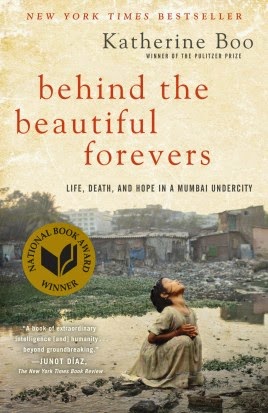
Behind the Beautiful Forevers
Katherine Boo

There’s probably nothing I can say about Katherine Boo’s Pulitzer Prize winning book about a Mumbai slum, Behind the Beautiful Forevers that other reviewers haven’t already–the book gives us a staggering view of the poorest of the poor in India. Annawadi, a sprawling slum that sprung up around the Mumbai airport sometime after 1991, has been described by many as Dickensian. And while it might very well be, there’s a better analogy, I think. Boo presents us with some hamster wheel view of life where no matter how hard and fast one might work, Annawadians were simply going nowhere fast. Oh they might have a few months or even years where life is a bit better, as when the teenaged Abdul’s recycling business was doing well and his family could afford to add a storage room and cooking space to their make-shift home. Or when Sunnil braved garbage picking on a narrow ledge between a bridge rail and the river below to afford himself a silver skull-shaped earring. But in truth, there was no real movement forward, or up, or out of their condition.

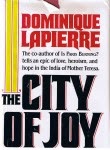
So read the other reviews because they’ll probably say it  better. But I can offer a couple book pairings if you want to go deeper into India than simply watching Slumdog Millionaire. First of all, find a copy of Domenic Lapierre’s 1985 novel City of Joy. (Yes, it inspired the Patrick Swayze movie by the same name, but no, I haven’t seen it.) We see life in the slums through the eyes of Polish priest Stephen Kovalski and American doctor Max Loeb. The book is every bit as powerful as Beautiful Forevers, complete with a cameo appearance by Mother Theresa. I loved it and this might prompt a re-read. For a more contemporary companion, read The Secret Daughter by Shilpi Somaya Gowda–it’s the story of adopted Indian-American Asha, the family who raised her, as well as the family who gave her up.  The past meets the present some eighteen years later when Asha goes back to discover the truth about her birth (link).

Which all prompts me to wonder why I’ve read novel after novel about China. Japan. The Middle East, even. Why so few on India?

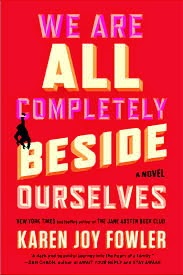
We are all completely beside ourselves
Karen Joy Fowler

Until she was five, Rosemary Cooke had a sister. Fern, her almost-twin. The two girls were inseparable: they jumped and sang and cuddled and competed for attention. They were joined at the heart with a love that was bigger than even they knew at the time. And then, without even a good-bye, Fern was gone. No one in the family talked about her disappearance–Rose ached; her mother crumpled; older brother Lowell lashed out.

But this isn’t a crime novel. Fern wasn’t kidnapped or murdered. She was sent away to the research lab of a Dr. Uljevik in South Dakota. You see, Fern was a chimpanzee. The girls’ father, a psychology professor, wanted to study learning theory and intelligence by raising a chimp child alongside a human child. And so when Rose was one-month-old, three-month-old Fern became her sister. And for a time it worked. Grad students ran test after test on both girls; Dad published scholarly papers and prospered. The girls were featured in a New York Times story. Mom kept detailed journals–baby books for both human and chimp. There was love.

Twenty years later Rose’s memories of Fern were still as clear as if they happened yesterday: corn-on-the-cob kernels stuck in her stubby little teeth, the hairs on her chin, her strawberry smell after a bubble bath. And how, while playing a game of Same/Not Same with the grad students, Fern always gave Rose a red poker chip … for same.  Rose misses her sister with a longing that all but pulses on the page. And Rose also misses the family they were with Fern. Lowel, now a member of the Animal Liberation Front, is wanted by the FBI for fire-bombing a research laboratory. (Some readers will cringe when Lowell relates some of the horrors he encountered in research labs, but Fowler approached the atrocities guardedly.)  Dad frequently loses himself in alcohol, and Mom (who had loved Fern best, Rose thinks) has fended off her depression in a bustle of bridge games and tennis.  The novel is the story of Rose trying to make sense of her loss and find her way back to her sister and brother. What did she remember and what really happened to provoke Fern’s leaving?

I read so much mid-list fiction, that sometimes plots and characters run together. But author Karen Joy Fowler created a story so original, I’m still peeling off layer upon layer. Is it a story about family love? About our love for non-human animals? Is it a treatise for living vegan? Or maybe how our memories are such fragile, imperfect glimpses into our past? An undercurrent of pathos ran through nearly every scene and so while my heart was heavy, I raced through the pages as if it was a thriller. I can honestly say I will remember Fern and Rose for quite some time.

Joyland
Stephen King

Let me start out by saying I don’t do Stephen King. Really, I don’t. I’ve never seen Carrie, even though the original came out my senior year of high school. I also haven’t seen Cujo or or Pet Cemetery or The Shining. I just don’t do horror. Really. Or anything violent or scary or icky. (Believe me, I’ve watched quite a few movies through my fingers: “Tell me when it’s over!”) Of course I have seen Shawshank Redemption and Stand By Me, but who hasn’t? They’re not “real” Stephen King. Oh, and I’ve read The Green Mile, but I put that in the Shawshank category. And then there is Full Dark, No Stars, but I didn’t have a choice: book club. Oops–11/22/63. Ok, so maybe I do read a little bit of Mr. King. But only a little and just enough to make me drag my feet reading Joyland, lent to me by my son, who, it must be said is a King reader bar none (I mean, he’s read the Dark Tower series a gazillion times). Then he promised me I’d cry at the end, so I flipped the King-O-Meter over to the Shawshank/Green Mile category and it was off to the races amusement park!

Dev Jones has little money in the bank and can’t face another summer of work study custodial duty on campus. A little adventure wouldn’t hurt, either. So after sophomore year at a Maine state college, he takes a job at Joyland, an amusement park in North Carolina. (Dev is also soon to suffer a broken heart, but that goes with the territory when you’re twenty.) He’s a greenie–in carnie talk, a part-timer who’s asked to do all the jobs the regulars don’t have time for: mopping up vomit, cleaning out trash, and wearing the fur. Dev happens to have a knack for the fur, which is carnie for playing the mascot. In Joyland’s case, that’s Howie the Happy Hound, a kind of a cross between Clifford and Huckleberry Hound. Kids love Dev’s Howie and Dev loves the kids. In fact, while playing Howie, he saves a little girl and becomes an instant hero.

King’s cast of characters carry the story for the first two-thirds of the novel. There’s fellow greenies Tom and Erin, good kids both. There’s the motherly land-lady Mrs. Shoplaw, the psychic (or was she?)  Fortuna, the Bela Bugosi lookalike owner Mr. Easterbrook, the all-around-good guy carnie Lane Hardy. Throw in an aloof (and drop dead gorgeous) single mom Dev meets on the beach and her young son with muscular dystrophy, and you’ve got a great story right there.

Except this is a Hard Case Crime novel. The series promises to bring “the best in hard-boiled crime fiction, from lost pulp classics to new work by today’s most powerful writers.” Enter an unsolved murder at Joyland four years earlier and the “crime” part of the novel comes into focus. Add the fact that a ghost that haunts the Horror House where she was killed and the little handicapped boy has “the sight” and sees and knows far more than any ten-year-old should … and the Stephen King becomes clear.

So while I’ll still insist I’m not a Stephen King reader, I loved Joyland. Give me tender and sweet with a pint-sized Intuitive, and I can ignore the slit throats. But I did cry at the end, thank you very much.

WebRep
currentVote
noRating
noWeight

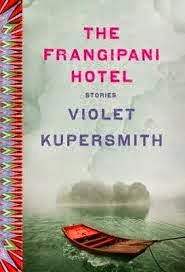
The Frangipani Hotel (NetGalley)
Violet Kupersmith

Our muddy patch of the worlds was already shadowy and blood-soaked and spirit-friendly long before the Americans got here. There’s ancient and ugly things waiting to harm you in that darkness. 

Writer Violet Kupersmith gives us a peek into Vietnam in her short story collection, The Frangipani Hotel. A little bit Peony in Love, a little bit Tiger’s Wife, this debut work is gem. I sometimes find

magical realism a stretch, with its emphasis on lyricism over plot and character. But Kupersmith serves up both. Centered around a hotel that has seen better days in a run-down Saigon neighborhood, her stories brush up against each other, but never collide. The characters are complex, if not always likeable: the self-important uncle who runs the Frangipani, two sisters who (reluctantly) are sent off to explore their heritage one spring break, an old man who turns python, an American expat who leaves Vietnam with more than she arrived, and a nursing home resident whose war terrors materialize.

Novels of China and Japan have long been popular with American readers–think Pearl Buck and Lisa See and Amy Tan and James Claval. Other Asian countries are not so well-represented and I’m left to wonder why, considering the United States has had her fingers in so many Asian pots. The only other book I’ve read about Vietnam was Stealing Buddha’s Dinner, a refugee’s memoir by Bich Minh Nguyen. One review I read said that Frangipani Hotel was little more than a graduate student’s writing project; another said the ghosts stories were chilling. I couldn’t disagree more. It was a satisfying read, told in a fresh voice with just enough magic to reveal a Vietnam I wouldn’t have otherwise known.

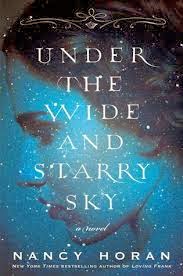
Under the Wide and Starry Sky (NetGalley)
Nancy Horan

Take thou the writing. Thine it is. For who/Burnished the sword, blew on the drowsy coal/Held still the target higher … who but thou? 

I loved Nancy Horan’s first novel, Loving Frank–I got a glimpse into the life and loves of a woman I

knew nothing about, Frank Lloyd Wright’s murdered lover Mameh Borthwick. It was an engaging novel that kept me turning the page. Horan’s latest novel about Fanny Stevenson was not nearly as captivating.

Fanny Van de Grift Osbourne Stevenson was author Robert Louis Stevenson’s American wife. Ten years his junior, Fanny was separated from her husband when the two met in Europe where Fanny and her children were in exile of sorts–Fanny had spirited the children away, finally leaving her philandering husband so that Fanny and daughter Belle could attend a school of drawing and painting in Paris. Louis and Fanny meet after she suffers a personal tragedy and Louis is smitten, despite the fact that she was ten years his senior and married with children. In fact, when Fanny returned home to take up again with (or put off for good) her husband, Louis followed her to San Francisco, traveling at great cost to his delicate health.

We travel with the Stevensons to Scotland and London and Samoa–and I waited for the magic to begin. I had listened to Nancy Horan’s interview on the Diane Rehm show in January and was intrigued with their life. But for some reason, the book didn’t measure up to the interview or Loving Frank. The characters were well-researched, the plot didn’t stray from the facts of Stevenson’s life, but it just fell flat. I am somewhat ashamed to admit (avid reader that I am!) I skimmed the second half of the book after diligently sticking with the first. I skipped to the last few chapters of their life in Samoa and was there when Louis died; the last chapter which covered Fanny’s life after Louis’ death interested me more than many of the earlier chapters.

That said, do I want to re-read some of Robert Louis Stevenson’s work? Yes. Will I think of his life and loves while I read him? Yes. So maybe Horan’s work was successful after all.

WebRep
currentVote
noRating
noWeight