This is my symphony

What I read & what I lived …

Eleanor and Park
Rainbow Rowell
St. Martin’s Griffin

They say kids don’t read anymore. And every school year I do have sixteen-year-olds who swear they’ve never read an entire book. And I sure don’t have many of those kids who (like me!) indiscriminately scan through the fiction Eleanorsection and check out their seven library book limit just so they can be sure to have a book on hand at all times.  But quite a few of my students do read—probably more than in my first years of teaching, even. From what I see in my classroom, the books they choose must pack some punch, either action-wise (Insurgent and Hunger Games) or emotionally (The Fault In Our Stars and 13 Reasons Why).  They read Jodi Piccoult and Chris Kyle, Vampire Diaries and Unbroken.

So maybe it’s safer to say that kids don’t read just any old book nowadays, and quality YA fiction is usually at the top of their list.

I try to read one or two YA novels each year, usually recommended by one of my kids. This summer, my YA of choice was Rainbow Rowell’s Eleanor & Park. It will definitely go into my classroom library at school—and I’m guessing will be checked out and passed around more often than not.

Eleanor is the new kid. She’s just returned home after being kicked out by her step-dad the year before. The first bus ride is a nightmare—Eleanor  is big and awkward with wiry red curls and mismatched Goodwill clothes.  Considering the bus full of teenagers, she really should have just pinned a target onto her back.

And while Park doesn’t want to get involved (he had enough trouble keeping the target off his back), he couldn’t stand to see her frozen in the aisle, bus driver shouting “Hey, you … sit down!” as kids blocked any empty seat she passed. (That odd, but familiar, seat claiming that occurs on buses, in the classroom, at lunch.) “Sit down,” [Park] said. It came out angrily … [Eleanor] couldn’t tell whether he was another jerk or what.” So she sat.

On the way home, what was she to do but return to sit next to Park? And so begins—slowly and carefully—a sweet and tender love story about two kids who didn’t fit in with anyone else but each other.

Park has his own issues that set him apart: he’s a taekwondo black belt, his mother is a Korean immigrant, he’s a comic book nerd. Unlike Eleanor, though, Park has grown up with the kids at school and so he has earned a measure of acceptance. (He also doesn’t live on the wrong side of the tracks as Eleanor does, so that helps.) Before long, Park begins to let Eleanor read his X-comics on the bus out of the corner of her eye. He shares his headphones so she can listen to the Smiths, then brings her batteries for her Walkman so she can listen at home. They hold hands.

At first, Eleanor tries to hide her life from Park—her step dads drunk rages, the four kids to a bedroom, a bathroom without a door, endless meals of beans. She wants only to live in the glow that is their friendship. But Real Love doesn’t work that way and, with Park’s prompting, she begins to let him in.

The teasing doesn’t fully stop. There’s an incident in the gym locker room. Lewd comments on the bus. Park punches the lights out of (actually, it’s a jump reverse hook) one of the biggest bullies and is suspended. But the focus of Eleanor’s trouble moves from school to her home life and Park decides if he can’t save Eleanor, Real Love might mean letting her go.

I don’t often appreciate teenage love stories, I must admit. (It just might have something to do with being a teenage bride myself.) But Eleanor & Park was a love story that just might convince me that love at sixteen is possible. Or if not that, it was enough that Eleanor & Park is captivating. It is gentle and wistful.

And in the end, it is triumphant.

So excited to bring Scott Wilbanks to my readers today! I love a good time travel novel and Wilbanks’ Lemoncholy Life Of Annie Aster was a perfect summer read. And just as good is the writer’s take on characters we relate to … and characters we love.

There’s a school of thought that all novels are a variation on the hero’s journey, and that plot is nothing more than Lemoncholy life of annie asterthe process by which the armor she has accumulated throughout life to protect herself is stripped away to reveal heressence, so that she can achieve her true desire.

I know, way too technical, right?

The point is that the most interesting part of our hero’s journey takes place within her head.  And that journey is, by its very nature, painful.

Let’s look at it from a writers point of view—more specifically, my point of view.

While it’s fair to say that LEMONCHOLY is a time-travel mystery, at its heart, it’s a story about five misfits, all of them lonely, all of them seeking a little understanding in an indifferent world.

There’s Annie—a twenty-something eccentric with a passion for Victorian clothes (that’s all she ever wears) who lives in modern day San Francisco.  The fact that she’s dealing with a form of pre-leukemia is a matter that we shouldn’t take too lightly.

Elsbeth, her pen pal, is a cantankerous, old schoolmarm living in a turn-of-the-century Kansas Lemoncholy Life of Annie Asterwheat field who possesses an inventory of curse words that’ll make a sailor blush as well as a take-no-prisoners attitude.

Christian, Annie’s best friend, is a complete innocent who is burdened with a debilitating stutter, as well as a painful secret that Edmond, a sweet, charismatic charmer who has a secret of his own—drug addiction—is about to bring out into the open.

And, finally, there’s Cap’n, a street urchin living in Victorian Kansas City who becomes Annie’s comrade-in-arms when she travels back in time.

Breathing life into four of them was an absolute joy, but there was an odd person out—Christian.

Why?

Because I based him off my own experience, and I had to raise some long buried demons and rub myself raw to get him onto the page.

I hope you don’t mind if I’m blunt.  Growing up gay in Texas is not for the faint of heart.  I tried to encapsulate my journey early on in the novel when I wrote the following: He (Christian) loved the state of his birth, he really did.  It just seemed evident to him that Texas’s rugged landscape bred equally rugged people, and having judged himself as deficient in certain qualities essential to the tall and the proud, Christian had sought sanctuary farther west.

I was twelve, I think, when I was gay bashed the first time—it happened in the parking lot of a Taco Bell—and the experience became a tipping point, taking me from an outgoing, happy boy to a withdrawn young man who tried everything in the book to become something he simply wasn’t.  I became socially awkward, fearful, and even developed a bit of a stammer.

It only seemed natural, then, that I burden Christian with a stutter of his own, but I deliberately chose not to make his impairment the result of victimization.  Instead, I took a cue from the history books.

Did you know that we created a generation of stutterers when we forced left-handed children to write with their right hands?  It fascinated me that the suppression of a trait that has strong genetic markers could do this.  And it wasn’t lost on me that 10% of the population is left-handed.  That’s the same percentage attributed to the portion of the overall population that is homosexual.  So, I flipped the script between left-handedness and sexuality, making Christian a stutterer because he’s so completely suppressed his in order to be a “good person,” according to the mores of an unforgiving society.

In the end, I had to peel off forty years worth of armor in order to make him authentic.  And let me tell you what, I… felt… naked.  But it was worth it, I think, because I could have never written the resolution chapter between Christian and Edmond, if I hadn’t.

It should be obvious, then, that I relate to Christian more than any other character in the book, and while he holds a very tender place in my heart, I love Cap’n—the street urchin who lives by dent of her wits.  And the reason’s pretty simple.  She’s my invention, one I created to be a cathartic response to the bullying I endured as a kid.  She embodies the fearlessness I lacked, and would never shrink from bullies, giving as good as she’d get—but never with the violence I encountered.  More than that, she understands what it’s like to be marginalized, and takes it upon herself to look after other misfits, despite all the obstacles life throws in her way.

So, whereas Christian is the person I was, and I love him for that, Cap’n is, in many ways, the person I wish I’d been.

And that is often the way it is in literature.  When we run across ourselves in the pages, the experience can be as raw as it is powerful.  But it’s the characters who do and say the things we wouldn’t dare that we love.

Kitchens of the Great Midwest (Netgalley)
J. Ryan Stradal
Viking

Sometimes my husband and I play “Do you remember eating … ?” We both grew up in the Midwest and church supper casseroles and desserts, as well as our own moms’ cooking, provide plenty of fodder. Do you remember … Tater tot casserole? Chocolate éclair dessert (known in some circles as Better Than Sex!)? Fried bologna sandwiches? Tuna and noodles? Jello salads of all varieties? Mock chicken legs?

We’ve come a long way, baby, which is why “Do you remember eating … ?” is so much fun. Several Kitchens of the Great Midwestyears ago we went clean and local–or as local as one can be when the growing season is all of four or five months. We cut out (or tried to) anything packaged with ingredients we couldn’t pronounce. Five ingredients or less. We joined a CSA and found a source for meat that was humanly raised. Everything we were “supposed” to do. We like restaurants that are farm to table. You know, garlic ramps and kale and charred corn pudding. (You get the idea.) And don’t get me wrong—I think it’s more healthful and more responsible to eat this way. But sometimes my mouth waters for a good old-fashioned casserole with cream of mushroom soup and canned fried onions.

Ryan Stradal touches the worlds of both the church lady and the new foodie in his first novel Kitchens Of the Great Midwest. Lars Thorvald loved food—real food—and two women: his daughter and his wife. Raised in Duluth, Minnesota, he and his brother were charged with making the annual batch of lutefisk to sell to his father’s bakery customers during Advent. The memory of that odious task stirred Lars to seek out fresh tomatoes, basil, sweet corn—indeed, fresh everything–when he finally became a chef. Wife Cynthia loved wines and together they made a dynamic pair (or so Lars thought) at their small restaurant. When Cynthia becomes pregnant, Lars dreams of the foods he’ll cook for their little one and when he holds daughter Eva for the first time, “his heart melted over her like butter on warm bread.”

But tragedy strikes. Not once or even twice, but three times and Eva’s world is irrevocably changed. In grade school Eva discovers she is gifted at growing chiles, and, coincidentally, can also withstand the heat of even the most potent chiles. Money is tight at home—Eva comes from the other side of the tracks, kids think she is odd. She’s bullied. Gains confidence. Teenage Eva has an incredibly developed palate and starts to hang around restaurant kitchens. Stradal moves quickly through the years, leaping from Eva age eight to sixteen to twenty.

Then after three chapters centered on Eva, I was reading about some chick named Octavia, and Eva was merely a character in the background. I was confused. The next chapter was about a hunter named Jordy whose mother was dying and I was confused even more. Then a chapter on a church lady who won contests for her famous cookie bars …

I was frustrated. I flipped back through the pages. Did I miss a name? Did I miss a connection between Eva and these other people? I ended up deciding I liked the flavor of the plot, so I finally just gave up trying to figure out the structure of the novel, trying to force it into my notion of how a narrative should be composed—and the story came together like mashed potatoes and gravy. Or “wilted kale with sweet pepper jelly vinaigrette”.

In fact, I loved the way Kitchens was written so much, I just might go back for a second helping and read it again. You won’t be disappointed.

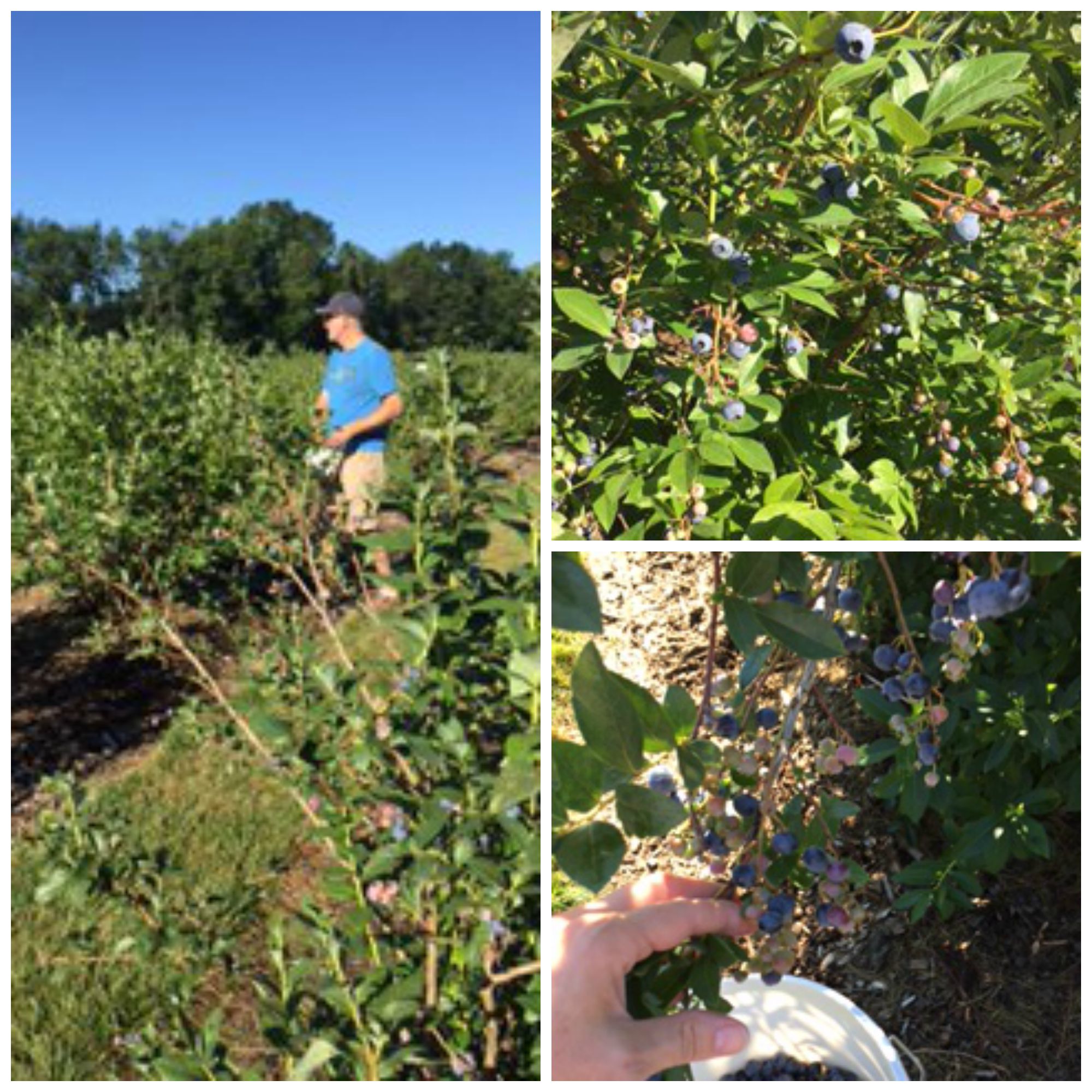
Blueberry season is over now, but I managed to squeeze in a little last minute blueberry picking a couple weeks ago.  And good sport that he is, hubby agreed to come with so that we could make shorter work of those end-of-the-season slim pickings.

I say good sport because we were both required to pick blueberries with our moms as kids and it was (for both of us) anything but the idyllic Blueberries for Sal type of experience with ninety Blueberries For Saldegrees and Mom wanting to fill yet another  bucket. No, it’s hot. Sticky. Mosquito-y. Booooooring.

Let’s just say when I turned twelve and was designated Official Blueberry Picking babysitter for my brother and cousin and I could stay home—even with a seven-year-old and a two-year-old—I was thrilled. I was never. picking. blueberries. again.

But when the time came, I loved reading Blueberries For Sal to my littles all those years ago. The classic is the story of a young girl and her mother, and a baby bear cub and her mother, who are all four of them out on the same mission: finding blueberries. Because of that book, the memory I cherish about blueberry picking now comes from that one story which (in true McCloskey fashion) elicits a longing for a time and place I’ve never even experienced.

Blueberry picking

A perfect summer’s day

I learned everything I ever needed to know about blueberries from Robert McCloskey. “Kerplink kerplank kerplunk” became the sound blueberries always made in my kitchen. I’d even measure them out in my stainless mixing bowl so the kids (and I!) could hear the real deal. I once shocked my husband when on a lakeshore hike I bent down and popped some wild blueberries in my mouth. “You just can’t go eating berries in the woods without knowing what they are!” he said, alarmed. Oh, but I did know what the berries were—I had looked at those pictures in Blueberries For Sal over and over again.

Raspberry picking

A delight!

Now truth be told, the ten pound box at the farmer’s market did me just fine for many years. And then I got all nostalgic. (Maybe it’s an age thing.)  My daughter and I went raspberry picking. I survived! And then I returned to pick blueberries—not so bad at all. Much more like the Blueberries For Sal now that I was a sentimental old gal.

How life changes us.  A walk through the raspberry canes with my daughter and grandson is a delight, and blueberry picking on a Saturday morning is the perfect way to start a summer’s day.

Kerplink. Kerplank. Kerplunk.

The Woman Upstairs
Claire Messud
Vintage

Nora Eldridge is angry. She’s done pretty much everything expected of her:  graduates college, holds her dying The Woman Upstairsmother’s hand, calls her father every day, works a respectable job. Except that she was supposed to be a Great Artist, but instead she’s teaching eight-year-olds.  And she’s forty two and single.  “Don’t all women feel the same? The only difference is how much we know we feel it, how in touch we are with our fury,” Nora fumes.

Now I am I have been a pretty angry woman in my day (or as Nora would say I’m just in touch with my fury), so writer Claire Messud had me on page one. Nora’s rage is palpable from the first chapter and it fuels the events that unfold.

She hadn’t always known the depth of her dissatisfaction, though—Nora made do with girls nights out, an occasional boyfriend, a bedroom set aside as her ‘studio’–until she fell in love with a Lebanese French eight-year-old who walked in her classroom wearing linen Bermuda shorts and an oxford button-down. Reza Shahid. Spellbound, Nora loved his accent, his soft brown eyes, his malapropisms, his impeccable manners. And when she met his mother she was smitten all over again. Sirena was a gifted and driven artist trying to find time (and space) to continue her work while her husband served a year-long fellowship at Harvard.

It is Nora’s love for this family– the family she had always dreamt of having—that awakens the passion in her. Nora and Sirena come to share studio space in an old warehouse where Nora helps Sirena with an installation (presciently titled Wonderland) and also works on her own pieces: small re-creations of famous artists’ rooms. The family fills Nora’s thoughts every minute of the day, and she comes to feel as though she’s never really alive unless she’s with them.

But it’s not her family. And there’s the rub.

Boundaries are violated. Trust mislaid. Lines crossed. Things can’t end well, can they?  Except it’s the loss of what Nora dreamed of and loved that awakens the sleeping giant that is her anger.

I found The Woman Upstairs both difficult to read and reassuring. Difficult because so many woman choose lives that restrict, rather than enliven them. Reassuring because I’m not alone. Is there any real resolution for Nora? Or for any woman living with the rage of a Life Unlived? Are we doomed to become the woman upstairs, some shadow-sister of the madwoman in the attic? Or will that fury stir us into action?

That’s the decision Nora–and every woman–must make.

@wikipedia.org

@wikipedia.org

While my reason for visiting Pepin was really to check off a Little House site from my bucket list, I was charmed by the village itself and  the surrounding area. Driving in on US 61, I turned onto the Great River Road and drove alongside the bluffs, overlooking the Upper Mississippi. Known as the Driftless Area, this region escaped the glaciers of the last ice age and is characterized by high wooded bluffs, deep river valleys, and, of course, the mighty Mississippi. I had no idea.

@wikimedia.org

@wikimedia.org

Pepin itself was already a place for settlers to trade during the nineteenth century. Remember when Pa tramped off seven miles into town one day from the Ingalls’ house in the Big Woods? That town was Pepin.  Settlers who trapped all winter sold their pelts during the early months of spring, and the river gave traders a route for selling those furs. The surrounding countryside, once those Big Woods, is now farmland.

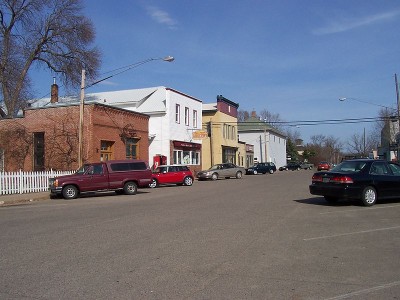
Downtown PepinToday Pepin itself seems to be centered on the Laura attractions and Lake Pepin. The marina was hopping the day I arrived, and it looked like every slip was taken. Brochures for sailing and kayaking trips, as well as guided fishing expeditions were stacked at every cash register, it seemed, and I’m guessing the outdoor adventure industry is a lot more lucrative than the Laura connection. Outside of the harbor area (which was “prettified” nicely), Pepin resembled most other small towns (pop. 837) in rural America.

I stayed at A Summer Place Inn on Main Street just two blocks up from the lake. Owner Nancy greeted me at the door and took me to my room. Nancy was the perfect B&B owner for my tastes: she gave me a suggestion for dinner and directions to the Laura Ingalls Wilder Museum (just a block and a half away), told me what time coffee and pastries would be set out in the mornA Summer Place Inning, and otherwise left me on my own. The room was cozy, clean, and decorated in pretty typical (but tasteful) B&B fashion. (Check out Ruth’s Room on A Summer Place’s website for a photo.) The cottage garden around the lawn of A Summer Place was sweet as sweet could be—bordered, of course (!), by a white pIMG_2112icket fence.

Nancy’s dinner suggestion was Harbor View Café and I’d go back in a New York Wisconsin minute. No menus, just their famous chalkboard! I started with a craft beer (spilled a bit because my hubby wasn’t there to pour it correctly for me), and ordered black bean fritters over a warm kale salad. It was served with a timbale of rice which was delicious, but really not needed. Dessert was the chocolate buttercream pie I mentioned here.

This trip was quickly thrown together, but I’d love to return to Wisconsin and take in more along the gorgeous Mississippi—talk about God’s country.

Next time: maybe kayaking?!

I have long wanted to visit the Laura Ingalls Wilder Little House sites scattered around the Midwest and decided this summer was the time to start with a quick trip to Pepin, Wisconsin—which also, coincidentally enough, is the closest to my West Michigan home.

One thing you should know about Little House Wayside, as the Little House In the Big Woods site is known, is that it’s in the middle of nowhere. Another thing you should know about this part of Wisconsin is that it’s Little House Waysidegorgeous. This post will be about the Laura connection, my next about Pepin.

I started planning my visit by reading parts of Wendy McClure’s The Wilder Life. McClure tried out all things Wilder from the Little House books, like grinding her own wheat and mixing up sourdough starter and churning butter. She also traveled to a number of the Little House sites. In some ways, her trip to Pepin was much like mine—quick and thrown together at the last minute. But McClure traveled to Pepin on a dreary March day, and I visited in August. So while she noted bare trees, gray skies, and Lake Pepin iced over, I saw lush green everywhere, brilliant blue sky, and sailboats dotting the lake.

Little House WaysideAnd maybe because I read as much as I could about this Little House site before I visited, I wasn’t disappointed. I expected a reproduction cabin circa 1978. I expected the small, we-did-it-ourselves kind of museum. Laura, after all, was only five when she lived in the Big Woods, so she certainly didn’t leave a mark on Pepin, and the Ingalls family didn’t either.  I don’t think I was quite as  disillusioned disappointed as McClure seemed to be after her visit to Pepin.

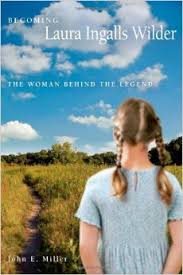
The Laura Ingalls Wilder Museum might better be called an interpretive center. Its recent expansion includes four rooms: a model kitchen, a room filled with household items from the era, a school room, and a room that houses a play area for small children and a covered wagon. There’s also a bookstore with the requisite Christmas tree ornaments, calico bonnets, coloring books, and postcards. I toured the rooms in fairly short order (no kids begging for a Little House book; no little ones to drag away from the play kitchen!) and wasn’t disappointed. I purchased a book (what else?!) titled Becoming Becoming Laura Ingalls WilderLaura Ingalls Wilder about the writer Laura—only two chapters are devoted to her childhood and courting years. Most of the book is about the adult Laura and her writing career. Can’t wait to start reading.

The collection of artifacts is impressive for such a small place, but the only items having any personal connection to Laura are a quilt from her teacher in the Big Woods and a donated quilt that had once belonged to Wilder. The docent explained that the entire museum is pretty much the efforts of a local artist couple who does the collecting, displays, and signage—and their love of All Things Laura shows. I wondered, however, what the efforts of an enthusiastic historian from a nearby university might add to the museum. What a great Master’s project for a budding curator.

The Little House Wayside is seven miles out of town on Country Route CC. It’s a beautiful drive through the winding roads of Wisconsin farm country. The Big Woods have made way for corn and beans. While the roads aren’t canopied by old growth forest, plenty of woods are left so that if you squint out the farm fields, you can almost imagine the miles and miles of forest that was just being tamed in the mid-nineteenth century.

My biggest surprise were the hills. Known as the Driftless Area, this part of Wisconsin remained untouched by glaciers during the last ice age. The gorgeous landscape is one of rolling hills and rocky bluffs, which I don’t remember being mentioned at all in Little House In the Big Woods. Pa, remember, walked the seven miles to town (Pepin) to sell the furs he had collected trapping all winter and I’m guessing the hike was made quite a bit longer in order to go around those hills.

The cabin itself is surrounded by cornfields. Built in 1978 it is an unfurnished replica of the Little House: a main room, small store room, and the loft. When I read the Little House books, I always wanted to sleep in tPioneerhat loft—and when I saw it, I still thought the same! Even though far from the fire, I’m guessing that loft was pretty snug and warm with the heat rising to the top of the cabin.
One of my school’s-out-for-the-summer gifts to myself was Laura Ingalls Wilder’s Pioneer Girl: The Annotated Autobiography. The book, published by South Dakota Historical Society Press, is the definitive book for readers who enjoyed the Little House books as children and want to read what is basically Wilder’s first draft of those books.

The night before I visited the sites in Pepin, I read the chapter “Wisconsin, 1871-1874” from Pioneer Girl. Sitting in a cozy B & B, the sun was setting over the river which was just visible from my window. Trains rumbled by every so often. A sprinkler hit the side of the house in perfect swish swish rhythm. I had chocolate buttercream pie left over from dinner and a stack of books by my side … a perfect way to end a long day of travel and get ready for a day visiting the Little House Wayside.

Circling the Sun (NetGalley)
Paula McLain
Ballantine Books

There was a time when I thought I was born in the wrong time and place–a time when I dreamed I was meant to stand on the wide savanna scanning the horizon, when I thought I might have my own antelope calf as a pet and sit on the veranda of a house that nestled at the foot of a mountain.

I read Isak Dinesan’s Out of Africa (and saw the movie, too, but it wasn’t nearly so good) and all of Elsbeth Huxley’s books (the best being The Flame Trees of Thika and this time the Masterpiece Theater production was nearly as good!), and Beryl Markham’s West With the Night. The sad thing is I read them all in a period of several months and so keeping the women and their experiences separate is nearly impossible these thirty years later. Instead, I have colorful blur of colonial Kenya in my mind’s eye.

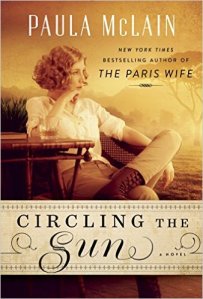
Writer Paula McLain, best known for The Paris Wife, writes about the life of Beryl Markham, who, in her eighties, Circling the sunpublished her autobiography–that West With the Night I read so many years ago. Because of my reading muddle, the only thing I could remember about Markham was her accomplishment as an aviator—but Circling the Sun gives us much more than that.

Beryl Clutterbuck had a childhood marked by a sort of wild freedom that we really can’t relate to today. Her father moved the family from England to Kenya to farm and train horses. But Beryl’s mother couldn’t take the rough life and she left the family and returned to England before Beryl was six. After that, her father pretty much left Beryl to her own devices. She had a roof over her head, food in her belly, plenty of native friends to play with, animals galore, and at least one neighbor, Lady D, who tried to mother her as best she could. Beryl was Lakwet, “a very little girl”, living in wild and wonderful Africa.

All that changed when Beryl was nearly twelve and an evil step-mother (of sorts) entered the picture. Mrs. Orchardson (first introduced as the new housekeeper) expected Beryl to wear shoes and take lessons. No more killing snakes or hunting warthogs. English clothes, not her Kenyan shuka.  Beryl is finally packed off to a girl’s school in Nairobi for a little bit of book learning and (hopefully) a lot of taming.

When Beryl turned fifteen, her father lost their beloved ranch Green Hills. She made a disastrous marriage and, in order to deal with the fall out of that, began her journey towards independence: training to become the first female horse trainer in Kenya.

While Beryl succeeded in her professional life, her personal life was another story—hearth and home would not come easy for her. There was that first marriage. An affair or two. An abortion. Another marriage. A son. A rumored affair with royalty. And all the while her greatest love was just out of reach. McLain gives the impression that colonial Africa was very much a place where staid English men and women could throw off the strictures of polite society and live and love more freely–but where a double standard was still in place when it came to looking away from the “indiscretions” of women.

For me, the novel went on too long in those years between Beryl’s early success as a horse trainer and her life as an aviator, which, surprisingly, filled little of the book.

But I enjoyed Circling the Sun in a special way since it gave me a peek into a world I had once loved so much.

July joy darea scrappy black cat ♥ restoring order ♥ put-together & stylin’ ♥ morning prayer ♥ Miss Anna Pie ♥ baby on the move ♥ vote ♥ Fr. John ♥ fresh raspberries & cherries ♥ blue sky smilin’ at me ♥ this old dog ♥ laughing family ♥ try a new approach ♥ mid-life ♥ life’s work vs. life’s love ♥ stepping in ♥ homemade strawberry jam ♥ iced tea ♥ I never promised you a rose garden ♥ meadow blooming ♥ summer sun ♥ memories of a happy lab ♥ garden stepping stones ♥ garden haiku boulders ♥ weeping willow ♥ kitchen blinds ♥ detach ♥ soften ♥ singing with baby ♥ old hymns remembered ♥ soft molasses cookies ♥ this is my symphony ♥ just a glimpse ♥ summer dusk ♥ a tough old broad ♥ drifting away ♥ under my heart ♥ retirement in sight ♥ snapping green beans ♥ newly dripped coffee ♥ tussy mussy from the meadow ♥ my corner ♥ headspace ♥ new kids new year just around the corner ♥ morning sunshine ♥ my inventory ♥ making sense ♥ garden magic ♥ Raffi radio ♥ squeals of delight ♥ making it right ♥ standing on my own two feet ♥ life’s disappointments

* thanks to Ann Voskamp’s Joy Dare