This is my symphony

What I read & what I lived …

The Bad Daughter
Joy Fielding
Ballantine Books

Every year I read at least one mystery just to keep myself open to the idea of reading whodunits and thrillers and all books mysterious. This bad daughteryear’s is Joy Fielding’s The Bad Daughter. (Of course I might also have chosen the book because of the title, so there’s that. Years of therapy … but that’s another post, I guess!) And even though I almost bailed on it, I’m glad I didn’t. It was a rollicking good time, with suspects galore.

Robin is heading home after five years away, and she’s a bundle of nerves. Not necessarily because her father and step-mom have been brutally murdered, but because she is heading home to Red Bluff and her older sister Melanie. To say their relationship was contentious is putting it mildly. Melanie is snarky and snide and downright cruel where Robin is concerned. She’s got a chip on her shoulder and she’s not shy about voicing her resentments: Robin went to college; Robin is a professional; Robin lives in L.A. And truthfully, Melanie’s life sucks. She had her son Landon when she was in her teens, and he is autistic. She never escaped Red Bluff, and her love life is non-existent. So the battle between the sisters is intense–in fact, it was the reason that I almost didn’t stay with The Bad Daughter. The first chapter or two were a little too “chick-lit-y” for my taste. You know, the “my-sister-hates-me-and-I-don’t-know-why” sort of book.

But once the investigation gets going and the suspects start lining up, it’s a great read. When the evidence was stacked against each new person of interest, I’d play the rest of the novel out in my head to see if it made sense. Now I’m no whodunit expert, but that has got to be the sign of a good one. But the victims? Their lives made the story. Melanie and Robin’s father is a wealthy, philandering loud-mouth. Always has been. So truth be told, we don’t feel terrible that he got his. But their step-mom Tara was Robin’s best friend in high school (I know, ewwww) and once engaged to her brother Alec. Complicating matters, Greg and Tara have a twelve-year-old daughter, Cassidy. The girl was indulged by their dad as Robin and Melanie the never were. Cassidy witnessed the robbery–and perhaps even the murder–but she’s hospitalized with gunshot wounds.

So who did it? The daughter? The nephew? The son? Or someone else entirely? I’ll tell you what–this family puts the ‘fun’ in dysfunctional!
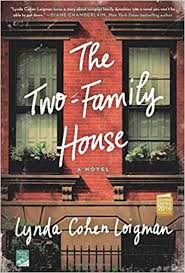
I don’t think there is a family on the planet that hasn’t experienced some devastation or other: illness, betrayal, deception, loss. (And sometimes, sadly, all at once.) But some of us fight the undertow and rise above those waves–and some of us are caught in the rip current and end up alone, far from where we began. It’s the secrets we keep that are the most destructive force of all, I think; they’e either powerful forces that pull us under or daunting waves that lift us up … and over.two family house

The Two-Family House by Lynda Cohen Loigman is the story of two brothers, Abe, kind and jovial, and Mort, dour and reserved. Even though the brothers owned and ran the family business together, it wasn’t clear whether or not they even liked each other. The brothers lived in a two-family house, one above the other. Their wives Helen and Rose were fast friends–like sisters, they were. Abe had four sons, and Mort had three daughters. The house was lively and filled with love. Until it wasn’t.

After the birth of their last babies–born on the same night in the throws of a blizzard, attended only by a midwife–tensions between the wives grew. Why, no one knew. Abe and Helen finally had a daughter, and Mort and Rose, their longed-for son. But the wives had a secret, one born of discontent. So Rose became jealous of Helen, and Helen mourned when Rose could not. Abe and Mort had even less to say to each other, and finally, the families spun out and out, separated by what they did not know.

Love and Other Consolation Prizes opens with Ernest Young walking the grounds of the 1962 Seattle World’s Fair, unsettled by his wife Gracie’s fall into madness, trying to make sense of the loss of their family home to an urban renewal project. They had lived a good life until the past year. But Ernest and Gracie had secrets, too.

love and other consolation prizesYoung Ernest came from China, sold by his starving mother to a ship captain bound for America. Both, so the sales pitch went, would have a chance at a better life. On the ship Ernest, still Yung then, met Fahn, a girl from Japan who would change his life. Yung spent his first years in America at the Washington State Children’s home before he was auctioned off in a raffle at the 1902 World’s Fair. The woman who rescued Yung, Madame Flora, owned a brothel. But it was in her home that he learned the true meaning of family … and fell in love.
Ernest’s secret is threatened when his daughter JuJu, an aspiring journalist, puts two and two together after finding an old newspaper clipping about a boy raffled off at the 1909 World’s Fair. JuJu has taken Gracie in after the couple lost their home. Her fragile mental condition is threatened by Ernest, and she is often agitate in his presence. Because Gracie has a secret, too, and it’s best she be kept as calm as possible, so her mad raving doesn’t give it away. For dignity’s sake, the doctor who treats her make-believes the illness is a form of viral meningitis . But Gracie’s madness was caused by neurosyphilis, contracted from her days in the Water Trade. Ernest met Gracie at Madame Flora’s.

It’s only when Ernest and Gracie’s secret comes to light that they can both put their demons to rest, and get back to the business of loving each other.

As it should be.

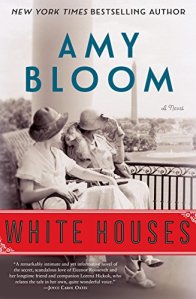
White Houses
Amy Bloom
Random House

The story begins April 1945, just weeks after FDR’s death. Lorena Hickok, Eleanor Roosevelt’s dear friend, is readying the apartment–Eleanor white housesneeds to gather herself after the President’s funeral with all its pomp and obligations for the widowed First Lady. She is tired. Bereft. (She only learned after his death that Lucy Mercer had been at Warm Springs with Franklin when he died.) So Eleanor turns to Hick, as she calls Lorena, for comfort and tenderness. The two had met eleven years prior and their relationship was an anchor for both of them.

What follows is a flashback of those eleven years, four of them with Hick living in the White House, just down the hall from the President and Eleanor. Lorena Hickok was a trailblazing political journalist for the Associated Press at a time when newspaper women were relegated to the social pages. After an interview with Eleanor shortly before FDR took office, the two women developed a fast friendship. They vacationed together, went on road trips and picnics, corresponded daily when apart.

Author Amy Bloom tells the story of Eleanor and Hick as if the two had been lovers. And it’s difficult to know if that was the case. Or not.

Their correspondence was certainly passionate and even suggestive of an affair. Here is Eleanor to Hick just after Franklin’s inauguration: “I want to put my arms around you … to hold you close. Your ring is a great comfort. I look at it and I think she does love me, or I wouldn’t be wearing it” (Goodwin).  Hick moved into the White House after resigning from the AP to work for the Democratic National Committee, but the real reason for her career move might have been to be closer to Eleanor. Her years long relationship with Ellie Morse was in the past, and Hick was smitten with Eleanor. For her part, Eleanor was not at first comfortable in her role as First Lady and it was Hick who saw her potential and urged Eleanor to start her syndicated column My Day and hold press conferences of her own. Each woman had suffered and was insecure in her own way–the other provided support and encouragement not found elsewhere.

One of the best books I’ve ever read about the Roosevelts was Doris Kearns Goodwin’s No Ordinary Time which covers Franklin and Eleanor during the War years. It’s a painstaking look at the couple, one that reveals how their relationship changed over time. Goodwin’s book is much less concerned with romanticizing the couple, as did the popular Franklin and Eleanor by Joe Lash. I’m not certain how Goodwin would view this novel, but she did write that the communication between women of the Victorian age needs to be put into the context of the time, that because the relationships between men and women “lacked ease … women opened their hearts more freely to other women.” Goodwin admits the correspondence between Eleanor and Hick  does “possess an emotional intensity and sensual explicitness that is hard to disregard,” but that a historian recognizes that there is no way to ascertain the true nature of what went on behind closed doors.

Amy Bloom goes behind those doors in a novel that some will find engaging … and others unsettling. But the novel is thought-provoking–maybe enough so that you’ll read its perfect companion No Ordinary Time.

Did you know …

Alan Bradley started writing after he retired from a career in TV engineering and production.

Bradley never planned on writing more than ten Flavia de Luce novels (*yikes*) because he can’t imagine her as a teenager. He has considered, however, Flavia at 70 looking back at her life.

The author is … Canadian! and never traveled out of North America until the publication of the beloved novels. Now he and his wife plan to live for a time in each of the countries where the novels have been translated–that’s 31 and counting.

Bradley sold film rights to Sam Mendes whose production company also brought us Call the Midwife.

While there is no release date or cast for the BBC series, I found this intriguing trailer for a Flavia film in Norway, of all places!

And last of all, friend (and blogger) Denice at Denice’s Day makes a pretty good case for suggesting Flavia join the ranks of Jo March, Hermione Granger, Scout Finch, and Nancy Drew.  We need to promote images of strong and confident young protagonists for girls to dream about … and grow into.

The Grave’s a Fine and Private Place
Alan Bradley
Random House
release date: January 30, 2018

It’s certainly no secret that I have a little crush on Flavia de Luce. How could I not? She’s brilliant, confident, beguiling, and misunderstood. the grave's a fine and private place(I’m pretty sure I’ve reviewed all of her books on this blog!)) I couldn’t have been happier that Flavia returned to Buckshaw in Thrice the Brinded Cat after her brief interlude at Miss Bodycoate’s in Chimney Sweepers. While I’ve never gone on a Flavia adventure I haven’t loved, it was good to be home.

In The Grave’s a Fine and Private Place, the 9th Flavia mystery, Flavia, her sisters Feely and Daffy, and Dogger have gone on holiday to recover from a death in the family and spend time together before Buckshaw is sold. The girls will scatter in different directions (Flavia to London to live with Aunt Felicity), Dogger and Mrs. Mullet released from service. But while boating on a lazy river near Volesthorpe, Dogger points out St.-Mildred’s-in-the-Marsh, where just two years before one Canon Whitbread had poisoned three members of his congregation with tainted communion wine. And quick as you can say cyanide and strychnine, wouldn’t you know–Flavia pulls a corpse out of the river.

There’s the usual eccentric cast of characters. A flamboyant actress, Poppy Mandrill, who directs village plays in her retirement. The nosy Mrs. Palmer, innkeeper-cum-poet. A gambling funeral director. And even a beautiful old flame from Dogger’s past, Miss Claire Tetlock.

The plot and cast of characters are pretty much what readers have come to expect in an Alan Bradley novel. I have a pair of fuzzy slippers I slip on the moment I come home from work. They’re not fashionable designer slippers and my feet get what they expect: cozy comfort.  And just like those slippers, the plot of this novel is as familiar and comfortable as the ones that preceded it.

After the dramatic cliffhangers of the last two novels, the ending of The Grave’s a Fine and Private Place is a happy one. Or maybe promising is more accurate. In any case, Bradley leads us to believe that we are about to set off on a Flavia adventure of an entirely  different sort in book #10.

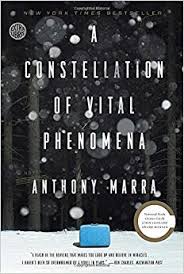
A Constellation of Vital Phenomena
Anthony Marra
Hogart

I confess to knowing nothing about the conflict in Chechnya. Okay, like many Americans (I’m assuming) I know a little. I know Chechen rebels took constellation of vital phenomenahostages in a Moscow theater. I know the Boston Marathon bombers were radicalized ethnic Chechen-Americans. But my eyes always glazed over whenever PBS News Hour featured a story on the wars and although I’m a daily NPR listener, I turned a deaf ear to any news Chechen. If you’d asked me to find it on the map, I couldn’t.

But like all good fiction, Anthony Marra’s extraordinary novel A Constellation of Vital Phenomena touched both my mind and my heart. (I have a list of articles to read about Russia’a involvement in Chechnya, and God bless Wikipedia for a quick tutorial.)

Spanning ten years and both Chechen wars, Marra tells the story of three neighboring families in the small village of Eldar, as well as two sisters in Volchansk. The novel opens with neighbor Dokka taken away in the night by Russian Feds to the Landfill (that name says it all), his house burned, and  neighbor Akhmed hurrying Dokka’s eight-year-0ld daughter Havaa to safety at the city hospital in Volchansk.

There they meet the head surgeon Sonja (who also happens to be the only surgeon), and she is none to pleased to find them in her waiting room. Akhmed makes the case that since he did attend medical school years ago, he might be of some use–even though he graduated in the bottom three percent of his class. Anything to find sanctuary for Havaa. Sonja, an ethnic Russian, runs on amphetamines, cigarettes, and contempt. But she’s desperate for help. She’s also desperate to find her sister Natasha, gone for nearly two years to where Sonja doesn’t know.

Havaa spends her days trailing Sonja or simply sitting in the waiting room clutching her blue suitcase of souvenirs, flotsam and jetsam that refugees had given her father as payment for a night (or two) in their house on the way to refugee camps. Havaa doesn’t open her suitcase until the end of the novel, and when she does, she reveals a poignant surprise.

Tucked next to Akhmed’s house is the old professor Khassan, who has spent most of his life writing a history of the Chechen people, and his informant son Ramzan, who has made eleven villagers disappear, but whose trade as a snitch keeps the electricity on, food in the refrigerator, and Khassan’s insulin needs supplied. Father and son haven’t spoken in months, but it is Ramzan’s last betrayal that sets the story in motion.

A Constellation of Vital Phenomena is a sweeping novel that uncovers the characters’ pasts and propels them into the future. Each chapter is set in one of the ten years the book covers and the alternating stories require the reader’s close attention. It’s also a difficult book to read. There’s nothing easy about torture. Sex slavery. Dismemberment. Murder. But it’s a story about love as much as it is about hate. About what connects us as much as what divides us. Most of us experience (at some point or another) estrangement from those we love dearly, and Marro’s long view gives us hope.

Marra’s writing is lush and evocative, his storytelling tender, the ending oh-so-satisfying. I’m only sorry A Constellation of Vital Phenomena sat neglected on my TBR pile for so long.

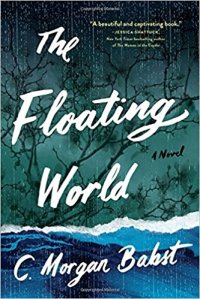
The Floating World
C. Morgan Babst
Algonquin Books

October 15. Forty-seven days after landfall.

The Boisdore family is collapsing, the levees of their carefully constructed life breached by the destruction that wthe floating worldas Hurricane Katrina. The patriarch Vincent, once a renowned New Orleans furniture carver, drifts in and out of dementia, one moment clear-thinking, the next living in the past. His son Joe, an sculptor, has made his name in the art world with his primitive carvings, and life had been good. Joe’s wife Dr. Tess Eshleman is a successful psychologist with a thriving practice. And family money. Now their daughter Cora is suffering from the trauma of the death and destruction she witnessed during the storm; her sister Del leaves her life in New York behind to rescue them all. Their historic home on Esplanade is destroyed, a life of privilege gone, a marriage in ruins.

Katrina only reveals what has slowly been unraveling all along. It’s a sobering thought.

So Cora’s mental illness is just a symptom of family dysfunction. And Joe and Tess, the biracial couple who years earlier risked everything for their love, had simply glossed over differences they couldn’t deal with. Del finds she can’t save her family because she’s not yet set her own feet on the solid ground of adult life.

Writer C. Morgan Babst peels back the characters’ shortcomings until they are defenseless before us, not certain who they are without the veneer of social niceties.

Ninety-three days after landfall and the rebuilding begins. For some, more than others.

But aren’t we all of us just a hurricane–metaphorically speaking, anyways–away from finding our lives flung open and ripped apart? By disease. Unexpected death. Addiction. Estrangement. It’s how we confront that reality that will define us.

If you want a novel that is gritty and revealing–thought-provoking–The Floating World would be it.

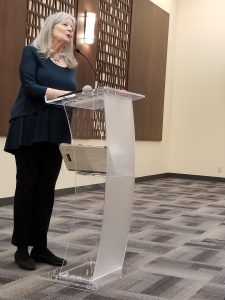
I didn’t give it a second thought when friend Denice emailed the first week in September to ask if I would take time off work to hear writer Elizabeth Berg speak at the Kent District Library in November. I’m sure you can guess my answer. What better way for an English teacher to spend a personal day, no?!

Ms. Berg is every bit as down-to-earth as her characters: she is funny and warm and took the time to autograph every attendee’s book. There’s nothing like getting a peek into the life of a writer I’ve read and loved. Berg begins her day writing and said it’s a “great job when you can work in your pajamas”, drink “90 cups of coffee”, and then take the dog for a walk. (Sounds pretty good to me, too!) She was also open about the more creative aspects of the writing life, saying she doesn’t know a book’s ending when she begins writing. Writing is a “process of discovery and surprise” and Berg believes in the “wisdom and creativity in [the] subconscious”.

We listened as Berg read passages from Arthur Truluv and  she confessed that the book is now her favorite. (It might be mine, too.) She graciously took the time to answer audience questions and when asked if there was a story she hadn’t written yet, Berg said she always has an idea for another book … adding “may it ever be so”.
I’m pretty sure her readers feel the same.

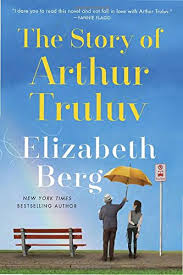
The Story of Arthur Truluv
Elizabeth Berg
Random House

Elizabeth Berg’s new novel The Story of Arthur Truluv is, as the title suggests, a story about True Love–not necessarily the love you’ll find in sappy Valentine cards, but the kind of love that is even greater. Like the love that reaches across generations, old to young and back again. And the love that lives across the street in a neighborly sort of way. The love that awakens between a mother and her child at the first little flutter. Or even the love that comes in a home-baked orange blossom butter cookie, shared.

Arthur Moses visits his Nola every day in the cemetery, riding the bus to eat his lunch and have a little chat with her. Since her death nearly six months before, Arthur’s life has become flat. Gray. It’s just Arthur and their cat Gordon making do with hots dogs and beans, toast and soup. There are no more garden bouquets on the kitchen table. Gone is the hum of her sewing machine. And the steady rhythm Nola brought to Arthur’s life? Missing.

Until he meets seventeen-year-old Maddy Harris.

Now Maddy has always been sad. Her mother died when she was only two weeks old, and her father’s parenting was distant, at best. He never talked about her mother, never shared his remembrances.  Maddy loves cemeteries and that’s where she meets Arthur. Distraught after being dumped by her older boyfriend, Maddy finds a warmth in Arthur that she’s never experienced. And they become fast friends.

Arthur’s neighbor Lucille thought love had passed her by sixty years ago until a high school sweetheart returns and they make plans for the future. But Lucille’s plans are foiled and she, too, finds a friend, first in Arthur–and then Maddy.

When Maddy suddenly finds herself in a difficult spot, she runs away–and ends up running towards a love that is big enough to save her. And Arthur. And Lucille.

Now that I’m closer in years to my end than to my beginning, one of my greatest worries is that I’ll feel like Lucille did for a time: useless. What happens when the career is over? Passion has been snuffed out? The children (and someday even the grandchildren!) are preoccupied with their own lives? Our world worships youth and values productivity–what will be my place? Arthur found his calling: “I am the audience. I am the witness. I am the great appreciator … I don’t feel useless. I feel lucky.”

The Story of Arthur Truluv is a deceptively simple story, and it might be tempting to read it as a sweet tale about an old man and a young girl. Nothing more. But as in the best of storytelling, it is Truth. Arthur continued to reach out and offer love even when he seemed to have nothing worthwhile to give. And in doing so, he changed lives.

May this be my own love story, too.

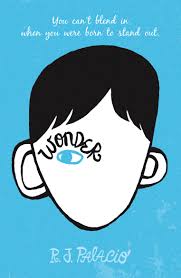
Wonder
R. J. Palacio
Knopf

I might very well be the last reader in the U.S. to have read Wonder, writer R. J. Palacio’s best-selling first novel. I’m kind of out of the middle-reader loop at this stage in my life, and I found the title by clicking on a trailer that popped up on my Facebook feed. Thank goodness (at least in this case!) for click bait because this book was a gem.

Auggie Pullman was born with Treacher Collins syndrome, a craniofacial condition that left him facing surgery after surgery (twenty-seven, to be precise) from his first few months of life. Because he was so often hospitalized or recovering from surgery at home, Auggie’s mom home-schooled him. His dog Daisy and sixteen-year-old sister Via are his best friends because Auggie doesn’t get out much. When he was younger, Auggie wore an astronaut’s helmet in public just to minimize the stares from adults and children alike. (Strange creatures we humans are that a boy wearing a helmet is less odd than dealing with a facial difference.)

But now ten-years-old, Auggie is starting school for the first time. A small group of children–Jack Will, Julian, and Charlotte–have been recruited to show him around the building before the school year begins, and it’s a rocky start. Charlotte is overly niceJulian pretty much ignores Auggie and then bluntly asks “What’s the deal with your face?” But Jack Will. Auggie smiled at him, and Jack smiled back.

The first days of school, Auggie keeps his head down and his mouth shut. Except that the tween world is a stratified place and his difference isn’t easy to hid. Fifth grade can be rough. There are whispers. The lunchroom is hell. A cruel game called the Plague circulates around Auggie. Even his English teacher Mr. Browne’s monthly precepts (September’s is “Choose kind”) can’t keep the wolves at bay. But Auggie’s humor and wit win over a few good souls and he finds a tribe.

Of course that’s not the whole story. There’s a betrayal, a violent episode on a class camping trip, a heart-wrenching loss, and some pretty despicable adults. Palacio also gives us the story from the voices of Summer and Jack, true friends both of them. Auggie’s sister Via’s chapters reveal how a condition like TCS affects the whole family. My heart ached for her.

When I saw the movie trailer, I wondered how the movie industry ever put out a call for actors to play Auggie and how the boy with TCS who played Auggie would be recieved. But this is Hollywood, after all, and it was prosthetics and make-up that turned child actor Jacob Tremblay into August Pullman. Shouldn’t have been a surprise.

If you’d like a thought-provoking response from a young woman who lives with a craniofacial condition, read Ariel Henley’s review in Teen Vogue. Invoking the attitude “nothing about us without us”, Henley is clearly disappointed that the movie makers chose Tremblay: “… it was devastating to realize that the directors involved with Wonder would rather cast a healthy, “normal” looking child and put him in makeup and prosthetics, rather than cast someone who looked like me.” If you are a Wonder fan already, please read her article “What ‘Wonder’ Gets Wrong About Disfigurment and Craniofactial Disorders” for another perspective.

In the end, though, August Pullman’s story is fiction. And the most important Truths can be found in story. For me, it’s Auggie’s indomitable spirit that makes me want to be a better person.