This is my symphony

What I read & what I lived …

The Blue Kingfisher
Erica Wright
Polis Books (November 2018)

I’ve written a number times over the past ten years on This Is My Symphony of my dislike for mysteries and whodunits. Then I read one and rationalize that this particular title is an aberration–an outlier–a fluke. Except in the past two years, I’ve managed to read at least several. There was August Snow, The Bad Daughter, Girl Last Seen, Unbecoming, Girl Waits With Gun, and at least two Flavia DeLuce mysteries. (I also read a Tony Hillerman and John Grisham that I just never bothered to blog!)

*Cough* Methinks I do protest too much.

And now there’s another: The Blue Kingfisher by Erica Wright. The story begins with private detective Kathleen Stone out for a jog on a foggy morning along the Hudson River. Her destination is Jeffrey’s Hook Light, a place to clear her head because it brings back memories of her childhood when she had a bedroom decorated in a Little Red Lighthouse and the Great Gray Bridge theme. What wouldn’t have shown up in a little girl’s bedroom, though, is the dead body that Kate sees lying on the widow’s walk of the lighthouse. blue kingfisher
What’s worse? The body belongs to Tambo Campion, her apartment building maintenance man–he was quiet, kind, and hard-working, if not always timely. A jumper, the police say–but so out of character for the man Kate knew. (That, and Tambo missed the water.) And so begins her quest to find out the real story behind Tambo’s death.

We learn a lot about Kate as she tries to uncover Tambo’s story. As a cop she was a master of disguise and alter-egos, relying on Russian wig-maker Vondya and any number of personas to help her go incognito. She is Kat. Katya. Kacey. We know Kate once infiltrated drug lord Salvatore Magrelli’s inner circle in an effort to bring him down, but that her cover was blown and now she is hiding in plain sight, using disguises in an attempt to stay one step ahead of Magrelli’s henchmen.

Kate also learns that Tambo was a “un martin pescador”, a kingfisher–someone who found off-the-books jobs for immigrants. That a set of creepy looking masks line the walls of his bedroom. That the masks are a fertility totem. That a hidden compartment in each mask can hold  small pills. 

Could it be the masks that are the clue to Tambo’s death? Or was it his job as a kingfisher dodging immigration officers that put him at risk? Or maybe–somehow–Magrelli and Tambo are connected? Or are those tiny pills the key to his death? Kate gets a job at a Coney Island fishing tour boat company where Tambo secured jobs for illegals, hoping to get closer to the truth.  And in the manner of all whodunits, she does.

A testament to the strength of The Blue Kingfisher is that fact that, unbeknownst to me, the novel is actually the third Kat Stone novel–but it was compelling enough, with just enough backstory to stand on its own. Truth be told, I think I’ll go back and read the other two. Because here’s the deal. I think I like mysteries … I’m just very, very picky. No stale writing, no overblown tropes allowed.

And Erica Wright’s The Blue Kingfisher fits the bill.

Mr. & Mrs. American Pie
Juliet McDaniel
Inkshares (August 2018)

mr. & mrs. american pieJuliet McDaniel’s Mr. & Mrs. American Pie is chick lit turned on its head. Call it wacky. Call it madcap. But however you describe it, the novel is 172 pages of fun, largely because the characters and situations are larger-than-life. Here’s a run-down.

Mrs. Maxine Hortence Simmons: Palm Springs junior league social climber, she of the Cartier watch, catered Thanksgiving dinner, and imported gold-foiled wallpaper. A bombshell. Married to airline executive Douglas Simmons–for the first few pages, at least … until she’s exiled to the Kachina Palms Condominiums in Scottsdale, Arizona. Drinks too much.

Robert Hogath: Thirty-something proprietor of the tavern La Dulcinea. A recent transplant from Lake Geneva, Wisconsin, he is, by his own admission, a “lifelong bachelor”. It’s 1969. And Robert has a secret.

Charles “Chuck” Bronksi: Age twelve, he has big plans that involve the FBI or CIA. Wakes at 5 AM to do calisthenics. Learning to read lips by watching Bugs Bunny with the sound turned off. Keeps spy notes in a little book. Pretty much the sole caretaker of his nearly two-year-old sister Dawn. He’s got an absentee mom and a dad “fighting the commies in Viet Nam”.

There’s a crazy Thanksgiving dinner scene that ends with the turkey in the pool. There’s a nasty divorce. Exile. More drinking.  Chuck and Dawn become Maxine’s ‘wards’ (her word).  There’s an arrest–for something they used to call lewd and lascivious behavior. A rushed marriage at city hall. A honeymoon with the kids in Old Tucson amusement park.

Now that right there? That would be a fine story in itself. But there’s more …

Maxine decides in an attempt to earn prize money and win back her dignity to enter the Mrs. American Pie beauty pageant. She’s got the family now, after all. And so begins the preparations to become June and Ward, Ozzie and Harriet and take home the prize. But first this.

A doctored photo to dethrone one of the current Mrs. Arizona Pie contestants. And some rumors about the others spread thick. As the now-reigning Mrs. Arizona Pie, there’s a cabin decorating contest, a cooking competition involving a dish called Spam ‘n Limas, and a chorus line of Mrs. wannabees singing and dancing to “It’s a Grand Old Flag”. Maxine’s talent? Reciting the Pledge of Allegiance. And a revelation–which comes via Chuck’s sleuthing skills–that just might bring the Director of Pageant Operations down.

The real kicker? The pageant is held at the Whitewater Country Club in Palm Springs. And Maxine’s ex-husband is a judge. But never fear. Alls well for this Mr. and Mrs. Chuck has the last word on the night the winner is crowned: “You won and then you lost because you love us!”

And his sister Dawn has the last last word. It’s 1982 …

[NO Spoiler Alert here]

But the end? It’s a keeper.

Ohio
Stephen Markley
Simon & Schuster (August 2018)

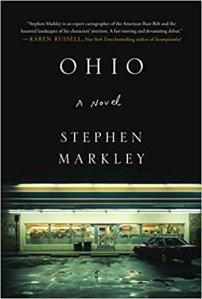
Stephen Markley’s novel Ohio follows four twenty-somethings (Class of 2004) back to their home town in Ohio shortly after Obama’s election. ohioChapters follow each character to New Canaan, giving their backstory with special attention to their high school years. New Canaan has been ravaged by the financial crisis and torn apart by the conflicts in the Iraq and Afghanistan. But despite the biblical name, this was no Promised Land. Life in New Canaan was man against man, neighbor against neighbor.
Bill Ashcroft, Stacey Moore, Dan Eaton, and Tina Ross each have their own dark reason for returning to town and one fateful night culminates in conflict. (That word ‘conflict’ is quite the understatement.) In some ways, the character’s stories can stand alone, a bit like the those in Elizabeth Strout’s work. But from childhood through high school and into the present, their lives–and a whole cast of hangers on–have woven together in inexplicable ways and Markley shows us the underside of the tapestry, all loose threads and knots.

Let me be blunt: this book was a difficult read. Markley touches on alcoholism and drug abuse, sexual violence, assault, eco-terrorism, and murder. The angst of a generation–born of economic disparity, family dysfunction, misogyny–is revealed in all its ugliness.

I began reading the book one night before bed and within the first fifty pages had read about a detailed description of a meth trip, a drug-fogged drive involving some sort of contraband, and a funeral with an empty casket–and all I could think was, “This is waaay too depressing. I’m not sure I can finish it.” Twenty-four hours later I turned the last page.

Nearly two years ago I read J.D. Vance’s Hillbilly Elegy, a raw look at the same time and place, told through the eyes of Vance who had overcome his circumstances–and escaped. While it was an intriguing read, it didn’t touch me quite like Ohio did. There is something about fiction that cuts deep.

So read Ohio … but be prepared to have your quiet world shaken.

Three Things About Elsie
Joanna Cannon
Scribner (2018)

“Everyone’s life has a secret, somethings they never talk about. Everyone has words they keep to themselves. It’s what you do with your secret that really matters. Do you drag it behind you forever, like a difficult suitcase, or do you find someone to tell?”

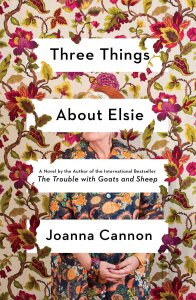
three things about elsieJoanna Cannon’s first novel The Trouble With Sheeps and Goats was a delight–Cannon’s insight into the hearts and minds of little girls and her portrayal of the rough waters of family life was spot-on.  Her second novel, Three Things About Elsie, gives us a glimpse into the heart and mind of Florence, resident of Cherry Tree assisted living, and in this book it’s the rough waters of aging that she explores.

The story opens with Florence Claybourne who has fallen in her room, and, as she waits for help, replays her life both at Cherry Tree (which, by the way, has no cherry trees, much to Florence’s annoyance) and her childhood. Each chapter marks the intervals with a time stamp. Florence isn’t easy to deal with for the staff or residents: she avoids social events, is loud and often belligerent, and (everyone assumes) delusional. The home’s manager Miss Ambrose is her nemesis, probably for continually threatening to send Florence to Greenbank, the next step in care, and dreaded by all the seniors–probably because it’s the Last Stop. When Florence suspects a new resident at Cherry Tree is a shadow from her past out to destroy her, her hunch is summarily dismissed.

So who is this Elsie-in-the-title? And what are the three things we need to know about her? The first is that she is Florence’s best friend. Has been since they were young girls growing up in a small English town. The second thing is that “she always knows what to say … to make [Florence] feel better.” And it’s quite clear from the story’s beginning, that Elsie and Flo were inseparable as children and that even now Florence turns to Elsie, ever at her side, for reassurance and advice. But only a few chapters in, it’s clear that Elsie isn’t visible to anyone else in the story, and the only person who converses with her is Florence. And that’s where I’ll leave Elsie. Because the third thing … oh, the third thing …

Florence, she of the outbursts and crazy rants, gets the attention of Jack, another Cherry Tree resident, and their friendship gives Florence hope simply (simply?!) because he believes her. The end of the novel is tender and poignant, and Florence–for all of her difficult behavior and troublesome accusations–is vindicated at last.

As to that third thing about Elsie? You’ll just need to read the book.

“It’s strange, isn’t it? How love paper-aeroplanes where it pleases. I have found that it settles in the most unlikely of places, and once it has, you are left with the burden of where it has landed for the rest of your life.”

Broken
Lisa Jones
Scribner (2009)

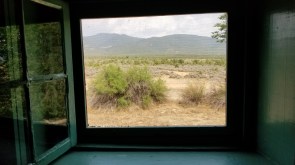
As I drove through New Mexico on my trip this summer, I was struck by the signs–Leaving Nambe Pueblo; Entering Ohkay Owingeh Pueblo–and those ubiquitous green historical markers–Aqua Fria: a traditional historical community; Bandelier National Monument: home of the Cochiti; Captive Women and Children of Taos County.

This is very clearly a land proud of its heritage and its people.

But as my car slowed to wind through reservation land, I was struck (as many are) by the poverty. It seemed to me that we talked out of both sides of our mouth. “We honor the heritage of these Native peoples, but we really screwed them over … so we’ll honor the heritage of these Native peoples.” I visited the famous Taos Pueblo and saw the love our college-student guide had for his traditional way of life–but I felt like an intruder, traipsing through someone’s living room and gawking at their kitchen. Add to all this the fact that I know many in the New Age movement who have (in my mind at least) co-opted religious traditions and practices that don’t belong to them–and it seems like a kind of spiritual colonization.

Writer Lisa Jones wrote about one Native American, Stanford Addison, in her memoir titled Broken: A Love Story. And while she didn’t lay to rest any of the conflict I felt in New Mexico, she did speak eloquently to the incredible spirit that can transform even the most desperate circumstances–and in that very transformation come to heal others, including her. Through her eyes, I came to see New Mexico in a different light.

As a young man, Stan Addison lived life at full tilt. He boozed it up, used women shamelessly, and didn’t shy away from a good fight. That is until a truck accident left him first, near death, and finally, a quadriplegic. But even while he recovered in the hospital–even when he hadn’t yet accepted his fate–the spirits came to his side and made it clear: he could stay or he could go. But if he stayed, he had some compelling business to attend to. Stan wasn’t ready to leave quite yet, and he gradually came to understand that he was given some powerful medicine. And he was to share those gifts. He held sweat lodges and took on the pain of others so they could heal. Shared his visions. Warned off bad spirits. Gentled horses. Took in young men who needed the anchor he provided.

But that’s Stan Addison’s story.

And, yes, the story in Broken seems at first to be Stan’s–but it is, in the end, the story of Lisa Jones. Lisa grew up in a less-than-functional home. (This, despite the fact that her father was a psychiatrist.) When her parents divorced, meeting the emotional needs of three children wasn’t high on their list of priorities. But Lisa was smart, driven, and independent. A survivor. She became a successful journalist and lived a life of adventure. It was the Good Life. Except when it wasn’t. There were those nagging doubts. Feeling lost. The draw of commitment and its companion, the fear of being tied down. Uncertainty.

Like most 20th century educated professionals, Lisa disguised her fears quite well. Except Stan saw through her and her heart felt the pull of the man with incredible gifts. Lisa became the supplicant to Stan’s sage. So she returned to the sweat lodge over and over again. She listened to Stan’s stories. She argued. Questioned him for hours on end. She washed his hair, lit his cigarettes, and drove into town for his sodas. Cooked meals. Stan waited and Lisa learned–but not without unraveling even more emotional pain.

And that’s what I failed to keep in mind as I drove through New Mexico–I was outside looking in. My eyes saw what might have been material poverty, but they failed to see the richness of spirit.  I wasn’t privy to the private lives of Native peoples or their spiritual practices–but Lisa Jones was when one very extraordinary human being welcomed her into his circle, and I am grateful she shared her story with us in Broken. 


* When I looked over the art on the both the hardcover  and paperback of Broken I so. totally. misjudged the book, actually passing it over a few times. (Isn’t there some saying about that … ?) The cover art was rather … romantic … and then there was the subtitle “a love story”. I convinced myself I wouldn’t like the book (I was thinking shades of Horse Whisperer) until I actually read the back cover blurb. I finished the book in just under two days. ‘Nuff said about that whole ‘book by its cover’ thing. How fitting that my first drive through New Mexico left me feeling similar.

The Forgotten Guide to Happiness
Sophie Jenkins
Avon (July 2018)

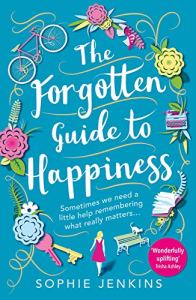
Lana Green writes romance novels–or at least one, the best seller Love Crazy. Her second romance, Heartbreak, has just gotten a thumbs Forgotten guide to Happinessdown from her publisher. The reason? It’s bleak and bitter, hardly the stuff of romance. Except Lana was just writing what she knew. And what she knew was that the hero of Love Crazy, photographer Marco, had dumped her the heroine Lauren, just as Lana’s photographer boyfriend Mark had dumped her. See where this is going?

And to be sure, for the first few chapters, Sophie Jenkins’ The Forgotten Guide to Happiness is chick lit, plain and simple. Numbing her broken heart in a pub, Lana meets a scruffy IT guy, Jack Buchanan. Over wine and a beer, she confesses she needs to find a new hero for her second book–and Jack sets out to become that hero. Romance ensues.

But, wait a minute … not so fast.

It turns out that Lana is also looking for a job and a place to live, what with the fact that she didn’t get her book advance and all.  And Jack has just the thing. His step-mother suffers from dementia and has become increasingly difficult to manage; social services is threatening to intervene. Add to the mix that his step-mom is none other than the famed feminist writer Nancy Ellis Hall, and Lana quickly agrees to become her companion and caregiver. At first, Lana is convinced that Nancy, who carries around a black notebook and scribbles in it furiously, is still writing. (In fact, Lana even thinks she might be able to help the ailing Nancy write a new book.) And while Lana’s denial is based on her infatuation of the writer Nancy used to be, she soon comes to love the Nancy who is–and that Nancy draped her head with sheets of toilet paper and insisted she was eight years old; she kept a pastry brush in her purse and set the table with clothes pins, a book, and a ruler; that Nancy quoted the bible as her own work and bit the woman who ran the London Literary Society where Lana tutored–Nancy, the woman she cared for and loved, might seem strangely out of touch, but Lana “knew what [Nancy] meant. Language is just a means of communication, and she could communicate and I could understand her.”

It’s got to be a tricky business to write about a character with dementia, but Sheila Jenkins handles the character of Nancy tenderly, lightly, always with compassion–just as Lana does. And I hope that someday, should my aging self need a minder, I encounter someone with just as much love.

And about that love story Lana is trying to write–Does Jack get a role to play? Does Marco return and win back Lana’s love? Will there be heartbreak or more crazy love? I think its fair to say The Forgotten Guide to Happiness has plenty of love (and happiness!) to go around.

Heaven Adjacent
Catherine Ryan Hyde
Lake Union Publishing
June 2018

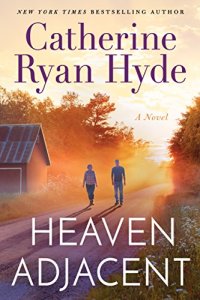
Heaven AdjacentWith over thirty books, Catherine Ryan Hyde’s fan base is deep. There are probably few who don’t remember the movie Pay It Forward which is based on her book by the same title; her novel Take Me With You is a favorite of mine. Hyde is a story-teller, plain and simple–her novels may not be high art, but the stories are compelling. Heaven Adjacent is no different.

Manhattan lawyer Roseanna Chaldecott has walked away from everything: her established law firm, apartment in the city, friends, and family. With the clothes on her back and a few things thrown in the back of her Maserati, she heads for the hills (literally) and runs out of gas next to a piece of property with a FOR SALE sign posted in the yard. The house (if you can call it that) is barely two rooms, unheated save for a wood stove. There’s an even smaller out-building and an unoccupied barn. Perfect for someone who wants to escape from the stress of modern life–for someone who wants quiet. Peace. Freedom. And little, if any, human interaction.

Except that’s hardly how it played out for Roseanna.

Before she knew it, Roseanna has a young veteran camping in the woods by the creek, a mother and her five-year-old daughter squatting in the out-building, and an elderly man living on her Adirondack retreat. Her estranged son shows up on her doorstep. Add a dog and an old horse and you see how things weren’t going as she planned.

Roseanna fled New York broken-hearted and shaken: her best friend and law partner Alice died of a massive stroke at fifty-three. Alice, like Roseanna, was working full tilt, waiting for the day she could retire. And then … gone. The work? The sacrifice? All for nothing. Roseanna becomes an evangelist, of sorts, nudging others to ask themselves: am I really happy? As you can imagine, that peace and quiet suddenly becomes less and less important, and Roseanna’s relationships with Nelson and Patty and Willa and Martin and Lance become what she was seeking all along.

I had only one reservation. Hyde seems, at times, to use Roseanna as her own mouthpiece, and it comes off a bit didactic, even though fitting with the story. I want my characters to be human beings in their own right, not the writer’s proxy. But because I loved the story, I could forgive that flaw.

Go ahead and Google ‘writing retreats’. (No, seriously–do it.) Over thirteen million hits. How was I ever going to figure out which retreat fit my writing needs? Which retreat wasn’t going to break the bank? Which one wasn’t too prescriptive? Last July my roomie at the Boston AWA facilitator training suggested I try one of Jen Louden’s Taos Writer’s Retreat. She had attended at a time of great change in her life and had nothing but positive things to say about her time writing with Jen in Taos. How serendipitous! I was also going through a great time of change in my life … so I trusted Kathy’s suggestion, and hit the “apply now” button before I could change my mind.

Because here’s the deal. I’m a fairly reserved person. I tend to warm up slowly, especially in a group. Butterflies and all that … at least initially. So why the heck did I sign up for a retreat that was comprised of ‘Small Group Check-in’ and ‘Evening Council’ according to the sample schedule online? (Honestly, by June I was a little panicked.) The truth is, I might be reserved, but that doesn’t mean I’m a loner, nor do I dislike sharing once I settle in. And another truth is that I needed some event to mark my retreating from my professional life (I retired from 25 years of teaching high school in May) so that I could move forward into another life. It was get-out-of-my-comfort-zone time*.

So off to Taos I flew for what I called my Transition Trip. And what a beautiful transition it was!

Everyone probably has a friend like Jen Louden. She’s that one who is funny and doesn’t have a whole lot of inhibitions. She’s the one who is genuine and warm and at times a little crazy. The one who is hard-working and smart. She’s that friend who is your biggest cheerleader. She’s the one who has no problem having a heart-to-heart, but at the same time will respect your privacy.

Our retreat days were full–and as productive as each participant wanted them to be, beginning with writing prompts in the morning that gentled us into two or more hours of time to work on our projects. After lunch there was a class on a specific topic: plot, structure, dialog. Yoga closed our work day–teacher Genevieve of Shree Yoga in Taos shared a lovely Anusara practice that was accessible to most levels of experience. Evening Council was a time of book discussion, guided sharing (*gasp*) and reflection, along with a loving kindness meditation.

So what about the women, my fellow retreaters?

They are remarkable. Accomplished and driven. Open-hearted. Supportive. Progressive. There was no drama, no exclusion. Women as women are meant to be. Our professional talents ranged widely: we were a social worker, therapist, university instructor, energy worker, realtor, visual artist. But what connected us all was our drive to write. Each retreat Jen hosts a guest teacher, and this week’s was journalist and writing teacher Lisa Jones, author of Broken(Which, of course, I have ordered!) Lisa’s class was rigorous–and gave me new insight into plot development.

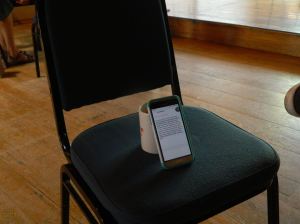
This is the text I sent my group, explaining my unexpected departure. They held my spot. Photo: Jenny Grill

The retreat was held at the Mabel Dodge Luhan House, which could be a post in itself. Suffice it to say, the setting was beautiful–and, in my mind at least, teeming with Story Sprites. And the food. Oh, my heart, the food …

My retreat didn’t end as fortuitously as it began. I received a midnight text that my flight out the next day had been cancelled and I needed to find another one–at 1 AM. The best connection was one that left Santa Fe at 6:30 that morning (maybe you see where this is going) and it was easily a 90 minute drive to the airport. In the dark. On roads I’d only traveled once before. So my time at the Taos Writing Retreat ended with me sneaking out as quietly as I could at 3 AM and missing our closing circle. I texted Jen. I texted my small group. And the picture they posted on Facebook sums up the spirit of the week beautifully.

I’ll be back.


Mind you, I didn’t totally abandon my comfort zone. Something about morning dance and all at 7 AM. Just. couldn’t. do. it. At least not this time!

On the O’Keefe tour at Ghost Ranch–many of her painting sites remain as she saw them.

When life looked desolate to me a few years ago, I threw out all my writing. Emptied the file folders onto a pile on the floor … dumped in with 1999 tax forms, a window sticker from a car I no longer drove and Explanation of Benefit booklets for insurance that had expired. “That’s over and done with,” said I, “A waste of time and a road going nowhere. Life isn’t all fairy dust and light, so get over it.” But even as I stuffed those pages into the trash, I thought to myself, At least I birthed them–the stories made it out into the Universe, and while I might not have copies any longer, I brought them alive for a short time

When I started writing again (I guess life wasn’t so dismal after all) I had some momentary twinges of regret at tossing out my work, but, surprisingly, I do have a sense that those stories are still alive, swirling in the ether around me–Story Sprites that have a life and a mind of their own.

Last week I went to the land where many Story Sprites live.

New Mexico has long been home to the amazing art of its native peoples. And in the late nineteenth and early twentieth centuries, Anglo artists and writers began throwing their words and images into the cauldron that is this land, creating a delicious brew of magic art. Writing in New Mexico–with its elevated plateaus,

This was the view as I walked out of my room.

Part hallway, part gallery, outside windows opened wide on this hallway and let in extraordinary breezes every afternoon.

mesas, sandstone cliffs, sweeping sky and pulsing silence–is extraordinary. The women who came here at the beginning of the last century, especially, strode in bravely and fiercely, leaving behind the constraints they’d grown up with when they arrived–and Willa and Georgia and Mabel are only the famous ones. Their’s was a time bound even more to you musts and you musn’ts and yet they wrote into this space and carved out lives that fit them just so.

Mabel Dodge Luhan and her husband Tony built a house that was a draw for creatives, and the space they held for those artists and thinkers was a kind of extension of the beauty of the landscape. My retreat to New Mexico this month has given me a glimpse of the sacred space of that sky and land and it has beckoned me on to the Next Chapter. I’ve thought a lot about Willa and Georgia and Mabel. (And, you can be sure I’ve bought some books!) and how they ever had the courage to defy tradition and demand life on their own terms

I spent six. whole. days. in Tony’s room–the room Tony Luhan described to Mabel as he scratched the house’s plan in the dirt on her property nearly one hundred years ago. I’m writing this on the sleeping porch which he envisioned. This is a permission I’ve not ever given myself–take a solid block of time to write and the retreat is a kind of blessing I’m allowing myself. I’m retreating from something–a professional life in teaching–and, I hope, drawing back in order to move forward–to a writing life.

The labyrinth at Ghost Ranch

And truly what better place than here on the plateaus, sky wide and open above me, the adobe walls of Mabel’s home holding so many stories. Breathing in the stories of Cather and Lawrence and Huxley that still must spin around this space, blowing in the windows with the wind that stirs the cottonwoods so furiously each afternoon.


Next up: A Jen Louden retreat in Taos–my Transition Trip into retirement. (Go me!)

Radio Girls
Sarah-Jane Stratford
New American Library (2016)

radio girls

Every now and then when I was a teacher, I’d get a box of books donated to my classroom library. Maybe from a parent or another teacher or a community member. I have to admit I found this title in one such delivery, and I’m glad I brought it home. The novel Radio Girls gave me a peek into a world I knew nothing about: the early days of the BBC in 1928 and the pioneering women who worked there. While the story’s focus is the fictional Maisie Musgrave and her rather Mark the Match Boy rise in the world, I found the inner workings of the newly established British Broadcasting Corporation a more compelling story and the figure of Hilda Matheson (who was the dynamic head of Talks at the BBC) fascinating.

hilda matheson

image@nationalportraitgallery (London)

The first general manager of the BBC, John Reith, couldn’t decide whether to keep the left-leaning, open-minded Matheson on a short leash–or a long one. While he basked in the accolades the BBC received for Matheson’s programming decisions, he feared she was a communist too liberal and his conservative nature was offended by her affair with Vita Sackville-West. The relationship between Reith and Matheson was often a contentious one. Matheson, however, used her position as the Director of Talks to bring the public information conveyed in a more informal, conversational manner, and she featured the first on-air political debate, popular authors from Virginia Woolfe to H.G. Wells, and newly enfranchised women voters. Matheson’s position opened the way to hiring other single women in positions other than secretary. (The BBC under Reith maintained a policy of hiring women only if they were not married.) Add to her trailblazing at the BBC the fact that Hilda Matheson worked as an M15 operative during the Great War and the fact that she served as secretary to Britain’s first female parliamentarian Lady Nancy Astor and you’ve got quite an incredible individual.

In researching her life I discovered another book, a privately published (and so difficult to find) biography titled Stoker: The Life of Hilda Matheson. I think it would be well-worth the read. In any case, if you’d like to read about a pivotal time in the history of the BBC and English women, I don’t think Radio Girls will disappoint.

How is it I’d never heard of this incredible woman before now?